

Ghanaian consumers are speaking their searches instead of typing them. Mobile phones have become personal assistants across Accra, Kumasi, and beyond. People ask Google Assistant to find the nearest pharmacy or chop bar. They request directions to East Legon salons while driving through traffic. This shift creates massive opportunities for local businesses willing to adapt.
Voice search optimization isn’t futuristic—it’s happening right now in Ghana’s digital marketplace. The GWI 2018 report documented 1,787 Ghanaian internet users actively utilizing voice search tools, and adoption continues to grow among young professionals and mobile-first consumers. Businesses optimizing for conversational search queries capture customers that their competitors miss.
This guide reveals practical strategies to dominate voice assistant search results in Ghana’s evolving market.
GET IN TOUCH
Let WebSys Technology boost your voice search rankings
What Is Voice Search SEO?
Voice search SEO optimizes your online presence for spoken queries. Unlike traditional typing, people speak naturally when using Google Assistant, Siri, or Alexa. Your content must match these conversational patterns to appear in results.
Voice search optimization involves several interconnected elements working together:
- Natural language targeting: Creating content answering questions exactly how Ghanaians ask them aloud
- Featured snippets optimization: Structuring information so assistants can extract clear, concise answers
- Local SEO signals: Strengthening your Google Business Profile and maintaining NAP consistency across directories
- Schema markup implementation: Adding structured data helps voice assistants understand your business context
- Mobile-first approach: Ensuring fast-loading, responsive experiences since 27% of users conduct mobile search optimization via voice
Recent reports estimated that voice search will reach 20 million users by 2028, making early adoption crucial. Businesses implementing FAQ schema markup and conversational content capture voice traffic that competitors ignore. Question-based keywords like “Where can I fix my phone in Accra?” replace traditional short keywords. Your optimization strategy must reflect how real customers speak, not just type.
Read more: Why Video Marketing is the Key to Business Growth in Ghana
How Does Voice Search Actually Work in 2026
Voice technology has matured significantly with advanced AI capabilities. Understanding the technical process helps you optimize more effectively. Modern systems deliver remarkably accurate results through sophisticated processing steps.
When someone speaks a query, their device captures audio and converts it instantly:
- Audio capture and transcription: The smartphone or smart speaker records spoken words and transforms them into searchable text
- Natural language processing analysis: Advanced NLP algorithms interpret user intent, context, and conversational nuances beyond literal words
- Search execution: Google Search or other platforms scan indexed content matching the interpreted query
- Result prioritization: Algorithms favor featured snippets, local pack rankings, and authoritative sources providing direct answers
- Voice-friendly answer selection: The system chooses content formatted for spoken delivery, typically 40-60 words long
- Audible response: The assistant reads the answer aloud while displaying supplementary information on-screen
Enhanced contextual understanding in 2026 recognizes Ghanaian English search patterns and local references better. Systems now interpret “near Palace Mall” or “close to Circle” with improved accuracy.
Currently, 40.7% of voice searches pull answers directly from featured snippets. Optimizing your content for position zero significantly increases your chances. The technology also supports multiple languages, though English dominates Ghana’s voice search landscape currently.
Read more: How Voice Search Optimisation in Ghana Can Increase Your Website’s Traffic
Why Are Voice Search Trends Important for Ghanaian Businesses?
Ghana’s digital transformation accelerates faster than many African markets. Mobile-first indexing dominates because smartphones represent the primary internet access point. Voice technology aligns perfectly with this mobile-centric behavior pattern.
The business case for voice optimization becomes compelling when examining these factors:
- Explosive adoption growth: Voice adoption is concentrated among younger users: almost 67% of mobile voice searchers are aged 16-34, representing Ghana’s digitally-savvy consumer base
- Local discovery dominance: Approximately 58% of voice searches specifically seek local business information like restaurants, salons, or repair shops
- Minimal competition: Only one voice search optimization company currently operates in Ghana, creating massive first-mover advantages
- Revenue impact proven: Globally, 91% of businesses that invest in voice search report improved conversions and measurable revenue increases
- Hands-free convenience: Ghanaians multitask constantly—driving, cooking, working—making voice searches incredibly practical for immediate needs
- Customer acquisition channel: Half of all local businesses worldwide now receive customers through voice search discovery
Ghana’s ICT infrastructure continues to strengthen with government support for speech recognition technologies. Businesses optimizing now establish authority before competition intensifies. Your Google Maps SEO and business listing optimization directly influence whether voice assistants recommend your establishment. The opportunity window remains wide open for smart entrepreneurs.
What Makes Voice Search Different From Traditional Search?
Typing and speaking trigger fundamentally different search behaviors. Traditional SEO targets short keyword phrases that people type quickly. Spoken search queries reflect natural conversation patterns humans use when talking.
Understanding these core differences shapes your entire optimization strategy:
- Query length expansion: Voice searches average 6-7 words compared to 2-3 words typed, creating more specific intent signals
- Conversational phrasing: Users naturally say “Where can I buy affordable phone accessories in Madina?” instead of typing “phone accessories Madina”
- Question-based structure: Approximately 10% of voice queries begin with who, what, where, when, why, or how
- Clearer intent signals: Longer, conversational queries reveal exactly what users need, reducing ambiguity significantly
- Local intent dominance: “Near me” queries and location-specific searches occur 3x more frequently through voice versus typing
- Single answer expectation: Voice assistants typically read one result aloud, not multiple options like traditional search displays
- Immediacy requirement: Voice users expect instant, actionable responses they can use without further research
Long-tail keywords become your optimization focus instead of competitive short phrases. Someone saying “Which salon in Osu specializes in braids?” provides crystal-clear commercial intent. Your content must directly address these specific local intent keywords and be conversational. Google prioritizes content matching natural speech patterns over keyword-stuffed pages.
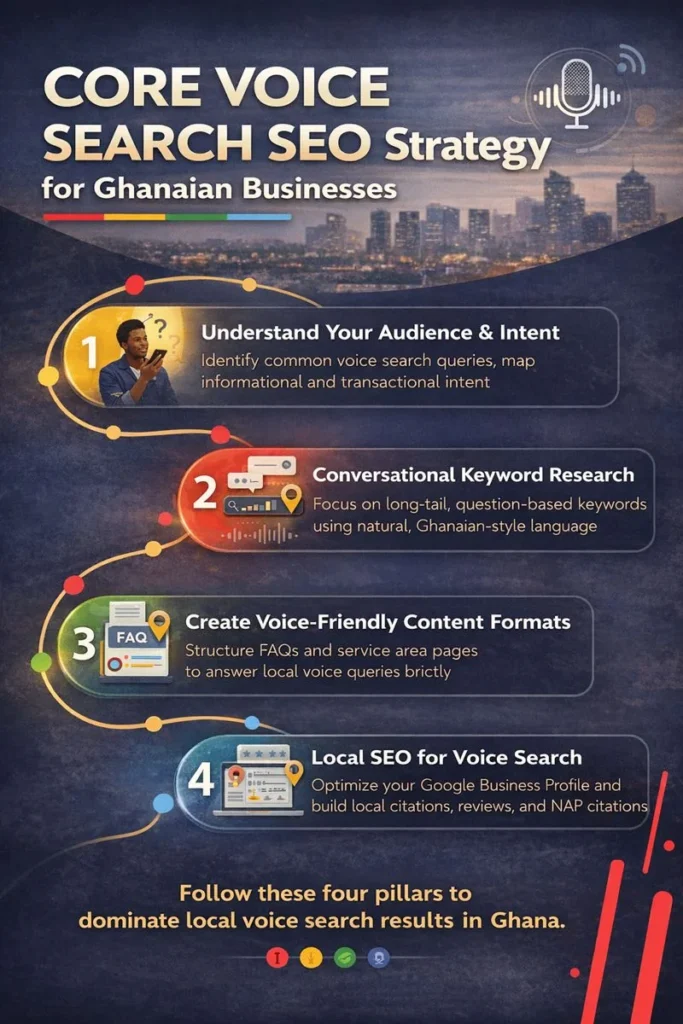
Core Voice Search SEO Optimization Strategy for Ghanaian Businesses
Implementing voice search optimization requires a strategic approach tailored to Ghana’s market. These four pillars form the foundation of successful voice SEO. Let’s explore each component to build your competitive advantage.
Understand Your Audience & Intent
Successful optimization begins by understanding exactly what your Ghanaian customers ask. Search intent falls into three primary categories: informational, navigational, and transactional. Map your content to each stage strategically.
Research reveals common voice query patterns across different business types. Someone searching for restaurants asks “Best chop bar near me open now.” Electronics customers say “Where can I repair my laptop in Accra today?” Pharmacies hear “Closest pharmacy to Spintex open right now.” Document the actual questions your customers verbally ask staff members. Create detailed customer personas reflecting real voice search behavior.
Use tools like Answer The Public to discover question-based keywords that people search. Analyze your Google Business Profile insights to see which queries drive calls and direction requests. Understanding informational versus transactional intent helps you create appropriate content types. Voice searchers want immediate solutions, not lengthy exploration.
Conversational Keyword Research
Traditional keyword tools miss the nuances of conversational search queries. You need long-tail, question-based phrases matching how Ghanaians actually speak. Natural language patterns differ significantly from typed searches.
Effective conversational keyword research involves several targeted approaches:
- Target question phrases beginning with “where can I,” “who is the best,” “what time does,” and similar natural starters
- Include Ghana location entities like specific neighborhoods—East Legon, Dansoman, Labone, Madina, Airport Residential—for hyperlocal targeting
- Incorporate Ghanaian English search patterns and local terminology that people actually use in daily conversation
- Focus heavily on “near me” modifiers, “open now” qualifiers, and “closest” proximity terms
- Research People Also Ask boxes appearing for your industry to identify common question variations
- Use Google’s autocomplete suggestions when typing conversational queries related to your business
Natural language keywords sound like actual sentences, not abbreviated phrases. “How much is passport photo printing in Accra?” represents a perfect voice search target. Ghana-specific modifiers like “MoMo payment accepted” or “digital address available” add local relevance. Your keyword list should read like a conversation transcript.
Create Voice‑Friendly Content Formats
Voice assistants prefer content structured for easy extraction and verbal delivery. FAQs become incredibly valuable because questions match voice queries perfectly. Format your information specifically for voice consumption.
Develop comprehensive FAQ pages that thoroughly answer every common customer question. Write responses in natural, conversational language avoiding corporate jargon completely. Structure individual answers within 40-60 word snippets that assistants can read smoothly. Use headers mirroring actual questions people ask, like “What payment methods do you accept?” Create step-by-step guides for process-related queries using numbered lists.
Organize service area pages targeting specific neighborhoods with unique, localized content. Implement content clustering strategies grouping related topics together with strong internal linking for SEO. Add FAQ schema markup helping search engines identify your question-answer format. Your content should sound natural when read aloud, not stiff or overly formal.
Local SEO for Voice Search
Local search ranking factors determine whether voice assistants recommend your business. Ghana-specific optimization requires meticulous attention to local signals. Geographic proximity heavily influences voice search results.
Comprehensive local optimization encompasses these critical elements:
- Google Business Profile optimization: Complete every section—hours, photos, categories, attributes, services, products, and GhanaPostGPS digital address
- NAP consistency: Ensure identical business name, address, and phone formatting across all Ghana business directory listings and citations
- Location pages development: Create dedicated pages for each service area you cover, like “Mobile Phone Repair in Tema”
- Review generation strategy: Actively collect customer reviews on Google and respond professionally to every review received
- Local citations building: List your business in relevant directories, including Ghana-specific platforms and international directories
- Click-to-call optimization: Make phone numbers prominently visible with proper markup enabling direct voice-activated calling
Read more: WhatsApp Lead Generation in Ghana: Proven Strategies
What Technical Aspects Should You Focus on for Voice Search Optimization?
Technical foundation supports your content and local optimization efforts effectively. Voice assistants prioritize websites meeting specific technical criteria. Backend optimization enables your content to be discovered and selected.
Strong technical voice SEO requires attention to these essential elements:
- Mobile-first indexing compliance: Voice searches occur predominantly on smartphones, making mobile responsiveness absolutely mandatory for ranking
- Page speed optimization: Fast-loading pages win voice search preference since assistants prioritize quick-loading, efficient websites consistently
- Schema markup implementation: Add LocalBusiness schema, FAQ schema, and Speakable schema helping assistants understand your content context
- HTTPS security: Secure websites rank higher in voice results; install SSL certificates immediately
- Featured snippets targeting: Format content specifically to win position zero through concise, direct answers
- Core Web Vitals optimization: Google’s user experience metrics—loading speed, interactivity, visual stability—directly impact voice rankings significantly
- XML sitemap maintenance: Ensure search engines can crawl and index all important pages efficiently
Currently, 40.7% of voice searches extract answers from featured snippets. Optimizing for position zero dramatically increases your voice search visibility. Structured data for local SEO helps assistants quickly identify your business type, location, hours, and services.
Technical excellence doesn’t require coding expertise—many platforms offer plugins and tools simplifying implementation. Prioritize mobile experience above everything else since mobile search optimization determines voice search success fundamentally.
Real-World Examples of Voice Search Optimization in Ghana
Documented Ghana-specific voice search case studies remain limited currently. However, international success patterns provide valuable blueprints that Ghanaian businesses can replicate. Global research demonstrates proven optimization strategies delivering measurable results.
A comprehensive case study from Gallea AI examined a local restaurant implementing voice search optimization. The single-location establishment with 12 employees and $750,000 annual revenue faced declining foot traffic. They restructured website content answering natural language questions like “Where can I get the best coffee near me right now?” The business created comprehensive FAQ pages addressing common voice queries conversationally. They targeted 6-7 word question-based phrases beginning with who, what, where, when, why, and how.
Technical implementation included schema markup for business hours, location, menu items, and reviews. They enhanced their Google Business Profile with complete information and voice-friendly content. Mobile-friendly website design with fast loading speeds ensured optimal performance.
The results achieved within three months proved remarkable:
- Walk-in customers increased by 20% directly attributable to voice search visibility
- 58% of new customers discovered the business through voice search queries
- 28% of voice searchers called the business directly for reservations or inquiries
- The business achieved 15+ first-page rankings for targeted local voice queries
Ghana’s hospitality sector—restaurants, hotels, guest houses—can replicate this approach immediately. Service businesses like salons, phone repair shops, and clinics benefit equally. Online reputation management through active review collection amplifies voice search performance. Accra, Kumasi, and Tema businesses have identical optimization opportunities available now.
What Are the Future Trends of Voice Search SEO?
Ghana’s voice search landscape will evolve rapidly over coming years. Global technology trends eventually reach African markets with local adaptations. Forward-thinking businesses position themselves ahead of these emerging developments.
Several transformative trends will reshape voice search in Ghana specifically:
- Multilingual voice search expansion: Integration of local languages including Twi, Ga, and Ewe, enabling voice searches in native tongues
- Voice commerce growth: Mobile money payments integration allowing complete purchase transactions through voice commands using MTN MoMo
- AI-powered personalization: Increasingly sophisticated contextual awareness delivering personalized results based on individual user history and preferences
- Smart speaker penetration: Affordable voice-enabled devices entering Ghanaian homes and businesses as prices decline globally
- Visual and voice combination: Hybrid search experiences combining voice input with visual results displayed on smartphone screens
- Hyperlocal targeting precision: Neighborhood-level accuracy improving with better GhanaPostGPS integration and landmark recognition
- Industry-specific adoption: Healthcare clinics, educational institutions, and e-commerce platforms are building voice interfaces for customer interaction
Globally, 8.4 billion voice-enabled devices operated in 2025, with numbers growing exponentially. Approximately 57% of businesses have already optimized for voice search.
Africa’s mobile voice assistant usage grows 14% annually, indicating strong regional momentum. Ghana’s strengthening ICT infrastructure and government support for speech recognition technologies position the market favorably.
Businesses establishing voice search authority now will dominate emerging opportunities. Review generation strategies and business listing optimization become increasingly critical as competition intensifies. The convergence of voice, mobile, and local search creates unprecedented customer acquisition channels.
Conclusion
Voice search optimization represents an untapped competitive advantage for Ghanaian businesses currently. Early adopters will dominate local pack rankings before markets become saturated. Implementation requires strategic alignment across content, technical infrastructure, and local signals.
The restaurant case study demonstrates measurable ROI—20% customer increase, 58% discovery rate—achievable within 90 days. Ghana’s growing mobile penetration and 60% usage increase among key demographics confirm the trend’s sustainability.
Your competitors haven’t optimized yet, creating a perfect opportunity window. Conversational keyword research, FAQ schema markup, and Google Business Profile optimization form your foundation. Don’t wait until voice search becomes a competitive necessity instead of an advantage.
Ready to optimize your business for voice search and capture Ghana’s growing mobile audience? WebSys Technology specializes in voice search SEO strategies tailored specifically for Ghanaian businesses. Contact us today to position your brand ahead of the competition and dominate local search results.
GET IN TOUCH