Harvard Business Review research reveals that only 35% of IT projects succeed globally. The remaining 65% crumble under delays, budget overruns, or outright failure. In Ghana’s rapidly digitalizing economy, this isn’t just concerning—it’s devastating.
This sobering reality hits close to home for Ghanaian businesses daily. Many rush into IT outsourcing partnerships without thorough vetting processes. They skip critical questions about security protocols and post-launch commitments.
The consequences? Abandoned projects plague operations. Security breaches expose customer data. Managed IT support services fail spectacularly, destroying operational efficiency.
Choosing the wrong IT support company in Ghana doesn’t merely waste budgets. It threatens your competitive positioning and business survival itself.
The antidote to these failures? Asking the right questions upfront. Before signing any contract with IT companies in Ghana, you need verified proof. Their track record must demonstrate industry-specific success. Post-launch support availability isn’t optional—it’s essential. Data protection compliance must meet Ghana’s regulatory standards without compromise.
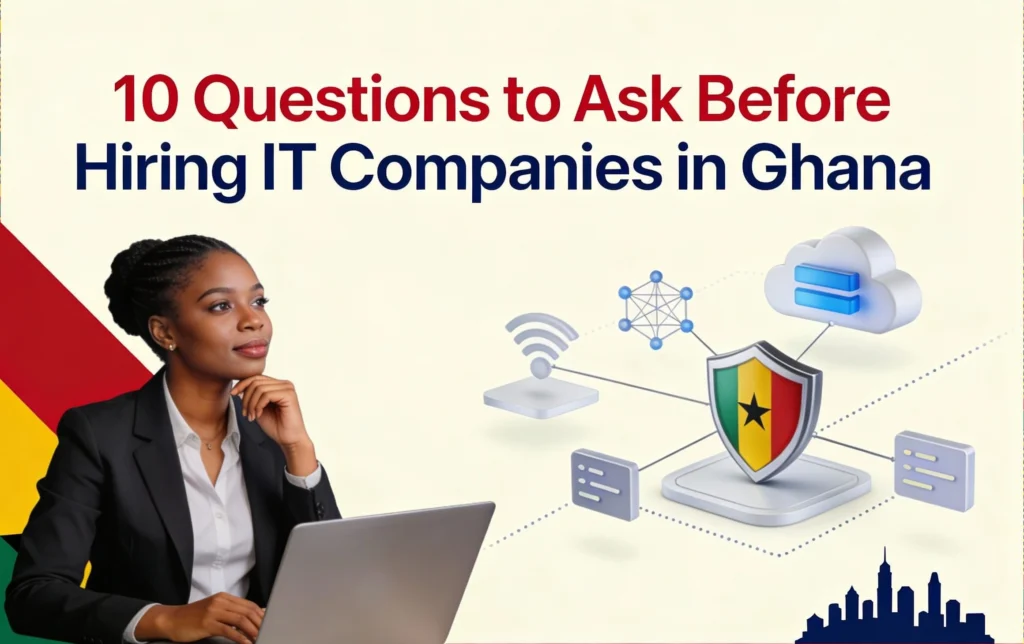
This guide arms you with 10 essential questions you must ask before hiring IT companies in Ghana. You’ll discover authentic success stories from MTN Ghana and Republic Bank. Let’s protect your investment and accelerate sustainable digital growth.
Why Your IT Vendor Choice Can Make or Break Your Business
Selecting an IT service provider isn’t just a business decision. It’s a critical investment determining your digital future. Wrong choices lead to catastrophic consequences extending far beyond wasted budgets.
The data reveals a sobering reality about poor vendor selection. Consider these eye-opening statistics demonstrating why thorough vetting matters:
- 65% of IT projects fail to meet their objectives, with vendor competency being a primary factor
- 50% of outsourcing relationships collapse within five years, costing businesses millions in disruption
- $2.5 million average loss from failed system integrations due to inadequate vendor expertise
- $100K-$1M lost per hour during unplanned downtime caused by unreliable IT support
- 76% of companies face hidden costs and supplier management issues with poorly vetted vendors
These aren’t abstract numbers—they represent real businesses facing operational collapse. Ghana’s growing tech ecosystem demands strategic partnerships, not rushed decisions. Your business technology solutions require partners who understand local market dynamics.
10 Must-Ask Questions Before Signing Any IT Contract
Armed with knowledge about failure consequences, you need actionable steps. These questions to ask IT service providers separate competent partners from risky choices. Each addresses critical vulnerability points where businesses typically encounter problems.
Before diving deep into each question, here’s your complete IT vendor selection checklist:
- What industry-specific experience do you have?
- What technologies and IT solutions do you specialize in?
- What is your response time for technical issues?
- How do you handle project communication and reporting?
- What are your pricing models and hidden costs in IT services?
- What security measures and compliance standards do you follow?
- Who owns the intellectual property rights?
- What post-launch support do you provide?
- Can you provide local references and success stories?
- What makes you different from other IT companies in Ghana?
Now let’s explore each question in detail. Understanding why it matters reveals what answers you should expect from qualified vendors.
Question 1: What Industry-Specific Experience Do You Have?
Generic IT management knowledge doesn’t translate to industry success. You need partners who understand your sector’s unique challenges. Banking regulations differ vastly from retail inventory systems or healthcare data compliance requirements.
Technical support means nothing without contextual application. A provider excelling in telecommunications might struggle with manufacturing automation. Industry expertise directly impacts project timelines, budget accuracy, and solution effectiveness.
What to request from potential providers:
- Portfolio showcasing similar businesses in your sector
- Measurable outcomes from past projects with specific metrics
- Client testimonials from your industry with verifiable contact information
- Understanding of sector-specific compliance and regulatory requirements
- Case studies demonstrating problem-solving in comparable scenarios
Red flag warning: Vague answers signal future misalignment. Inability to demonstrate relevant experience means you’ll become their learning experiment. That’s expensive and risky for your operations.
Question 2: What Technologies and IT Solutions Do You Specialize In?
Your business demands specific tools—cloud computing platforms, cybersecurity infrastructure, or e-commerce systems. Their technology stack must align perfectly with your requirements. Generalists lack depth in critical areas you’ll desperately need later.
Don’t settle for vague “we do everything” responses. That’s a warning sign screaming inexperience.
Ask these pointed questions:
- Which cloud platforms do you actively support daily?
- What IT infrastructure expertise helps scale businesses like mine?
- How do you stay current with rapidly evolving technology trends?
- Which hardware and software partnerships provide you with vendor advantages?
- Can you demonstrate cybersecurity services for small businesses specifically?
Request live demonstrations of technologies they’ll implement for your project. Polished presentations hide competency gaps that walkthroughs expose instantly. Ask specifically about disaster recovery systems and data backup protocols they’ve successfully deployed.
Their specialization depth determines your project’s success trajectory. Surface knowledge crumbles when complex challenges emerge. Choose expertise over generalization every single time.
Question 3: What Is Your Response Time for Technical Issues?
Remember Republic Bank of Ghana’s transformation story. They reduced resolution times from 2-3 days to 2-3 hours. That’s a 90% efficiency gain directly impacting revenue and business productivity.
Every minute of downtime costs money in lost sales and damaged reputation. Your managed IT support partner must guarantee rapid response time commitments. Delays in addressing IT issues and troubleshooting cascade into customer dissatisfaction.
Critical details requiring clarification:
- 24/7 IT helpdesk services availability with real human support
- SLA guarantees with financial penalties for breaches
- Escalation procedures for critical versus routine issues
- Average resolution timeframes categorized by priority levels
- On-site IT support versus remote IT support capabilities
Companies without clear SLA commitments will abandon you during emergencies. That’s when you need them most. Ask specifically about their IT disaster recovery protocols and backup team availability.
Warning sign: Providers offering only business-hours support can’t always protect the always-on digital operations.
Read more: 5 Red Flags to Avoid When Hiring Tech Companies in Ghana
Question 4: How Do You Handle Project Communication and Reporting?
Poor communication kills projects faster than technical failures ever could. You deserve transparency throughout development and implementation. MTN Ghana succeeded partly because its IT partner assigned dedicated managers.
Open communication channels prevented misunderstandings that derail projects. Regular updates maintain alignment between technical teams and business objectives. Silence breeds anxiety and mistrust.
Essential communication elements:
- Weekly progress reports with milestone tracking and deliverable status
- Access to project management tools (Jira, Asana, Trello, Monday.com)
- Designated point of contact available during business hours minimum
- Stakeholder engagement protocols ensuring your input shapes outcomes
- Quarterly business review sessions assessing performance and strategy
An ideal scenario includes development server access. Watching progress live eliminates surprises at launch. This transparency builds confidence and enables early course corrections.
Ask about their customer service philosophy beyond technical competency. Do they view you as a partner or a transaction?
Question 5: What Are Your Pricing Models and Hidden Costs?
Budget considerations extend far beyond initially quoted prices. Hidden costs in IT services destroy financial planning—licensing fees, maintenance charges, and scope change penalties accumulate quickly.
Demand a complete cost breakdown upfront covering the relationship’s entire lifecycle. Surprises six months post-launch damage vendor relationships irreparably. Transparency demonstrates respect and professionalism.
Cost components requiring clarification:
- Initial setup fees versus ongoing IT maintenance subscriptions
- Third-party tool subscriptions and licensing requirements
- Feature additions, modifications, or scope expansion charges
- Support tier pricing differences (basic versus premium managed IT support services)
- Hardware, infrastructure, and hosting expenses
- Training costs for your team members
Request itemized proposals from multiple vendors enabling accurate comparison. Fixed-price models offer predictability for well-defined scopes. Time-and-material arrangements suit evolving projects better.
Beware of affordable IT support in Ghana that seems too good. Unrealistically low quotes often hide deficiencies or bait-and-switch tactics. Quality IT consultancy commands fair compensation.
Question 6: What Security Measures and Compliance Standards Do You Follow?
Cybersecurity breaches cost African businesses millions annually in direct losses. Your IT systems partner must implement robust security protocols meeting legal requirements. Non-compliance risks, penalties and customer trust destruction.
Ghana Data Protection Act compliance isn’t optional—it’s legally mandatory. Your provider must demonstrate a comprehensive understanding of regulatory frameworks. Data protection failures trigger devastating consequences including lawsuits and reputational damage.
Security essentials requiring verification:
- Encryption standards (SSL/TLS certificates, data-at-rest encryption, end-to-end protection)
- Access control systems and multi-factor authentication implementation
- Regular vulnerability assessments and penetration testing schedules
- Dark web monitoring services detect credential leaks early
- Incident response protocols for breach scenarios
- Firewalls and intrusion detection system configurations
- Email security measures are preventing phishing attacks
Ask about their security awareness training programs for your staff. Human error causes most breaches, making education critical. Verify their business continuity planning includes your operations.
Compliance check: Understand regulatory requirements specific to your industry. Banking, healthcare, and e-commerce face different standards.
Question 7: Who Owns the Intellectual Property Rights?
IP ownership disputes cripple businesses during vendor transitions or pivots. Clarify code ownership comprehensively before signing any contracts. Some third-party IT providers retain rights, trapping you into permanent dependency.
This creates vendor lock-in preventing competitive bidding or migrations. You become hostage to their pricing and service quality. That’s an unacceptable business risk.
Legal protection requirements:
- Full source code ownership transfer upon final payment completion
- Access to documentation, architecture diagrams, and system specifications
- Freedom to modify, enhance, or migrate solutions independently
- Third-party component licensing clarity avoiding future complications
- Database ownership and export capabilities
Include explicit IP transfer clauses in written contracts. Never assume ownership without documented confirmation. Assumptions create expensive legal battles destroying relationships and budgets.
This matters especially for custom IT solutions differentiating your competitive positioning. Your intellectual property represents strategic business value.
Question 8: What Post-Launch Support Do You Provide?
Launch day marks the beginning, never the end, of your technology journey. IT systems require ongoing maintenance, updates, security patches, and optimization. Abandoned software becomes a security vulnerability within months.
Technology evolves constantly—yesterday’s secure platform becomes today’s breach target. Your managed services provider (MSP) must commit to a long-term partnership. IT scalability depends on continuous improvement and adaptation.
Support coverage requiring confirmation:
- Bug fixes and error resolution with defined response timeframes
- Security patch implementation protecting against emerging cyber threats
- Performance monitoring identifying bottlenecks before users complain
- Feature enhancement options as business needs evolve
- User training and comprehensive documentation for your team
- Remote access support for troubleshooting without site visits
WebSys Technology exemplifies proper commitment: “We’ll be at your side for the life of your site.” That philosophy separates true partners from transactional vendors. Small business IT support especially requires this sustained attention.
Ask specifically about their data loss prevention strategies and backup frequency.

Question 9: Can You Provide Local References and Success Stories?
Testimonials verify marketing claims through independent validation. Request Ghana-based references you can actually contact directly. MTN Ghana and Republic Bank of Ghana provide perfect examples.
These real companies achieved measurable results with proper IT support for businesses. Their transformations prove that asking the right questions protects investments. Verifiable success stories demonstrate capability better than any sales pitch.
Verification steps protecting your interests:
- Contact previous clients directly asking about their genuine experiences
- Check Google Reviews, LinkedIn recommendations, and industry forums
- Request specific outcome metrics, not vague success testimonials
- Verify projects through third-party validation or site visits
- Ask about challenges encountered and resolution approaches
Red flag warning: Reluctance to provide verifiable references suggests local performance problems. International-only examples might indicate minimal Ghana market experience. You need providers who understand local infrastructure challenges, power reliability issues, and internet connectivity realities.
Best practices for hiring IT companies always include thorough reference checking.
Question 10: What Makes You Different from Other IT Companies in Ghana?
This question reveals their value proposition and genuine market understanding. Strong answers demonstrate thoughtful positioning and competitive advantages. Weak responses expose companies lacking differentiation.
Generic answers like “quality service” or “competitive pricing” mean nothing. Specificity indicates self-awareness and strategic thinking. You’re assessing cultural fit alongside technical capability.
Look for differentiators including:
- Specific expertise areas (B2B focus, IT support for startups, industry specialization)
- Years of serving the Ghana market with a proven local track record
- Team qualifications, certifications, and continuing education commitments
- Unique methodologies or proprietary processes
- Tailored IT support approaches versus one-size-fits-all solutions
- Partnership philosophy and client success metrics
Their answer quality indicates whether they’ve thoughtfully built expertise. Or simply chase any available work without strategic focus. IT support for SMEs requires different capabilities than enterprise solutions.
Ask how they approach IT strategy development for businesses. Do they consult or just execute orders? Evaluating IT company expertise requires probing beyond surface credentials.
Read more: Top 10 IT Companies in Ghana Driving Digital Transformation in 2026
How Ghana Companies Transformed Their Business with the Right IT Partner
Real success stories prove these questions protect investments and accelerate growth. These authentic case studies demonstrate tangible outcomes when businesses properly vet IT service providers.
Case Study 1: MTN Ghana’s Digital Infrastructure Success
The Challenge: MTN Ghana, a leading telecommunications provider, needed reliable systems handling massive transaction volumes. Ghana’s competitive telecom market demanded operational excellence and minimal downtime. Their existing infrastructure couldn’t scale with customer growth.
The Solution: After thoroughly vetting potential partners using comprehensive questions, MTN selected an experienced IT provider. The discovery workshop deeply explored their requirements. A dedicated team ensured open communication throughout implementation.
The Remarkable Results:
- 73 million transactions processed in the first month of system operation
- The system became known as “MTN Ghana’s most reliable system” within their infrastructure
- Gained valuable insights into customer needs through integrated analytics
- Enhanced service delivery based on data-driven decision making
- Minimal downtime with responsive support mitigating incidents quickly
- Long-term business growth through successful digital transformation
Key Takeaway: Asking about scalability and proven experience with high-volume systems paid off massively. Their thorough IT outsourcing considerations prevented the failure statistics plaguing other projects.
Reference: seamless
Case Study 2: Republic Bank of Ghana’s IT Service Transformation
The Challenge: Republic Bank of Ghana struggled with manual IT ticket management. Critical issues took 2-3 days to resolve, causing productivity losses. Their operational delays frustrated staff and risked customer service quality.
The Solution: The bank implemented proper managed IT support services after careful vendor selection. They prioritized response time and support capabilities during evaluation. Their chosen partner understood banking sector requirements intimately.
The Impressive Results:
- 90% reduction in resolution times—now 2-3 hours instead of 2-3 days
- 100% increase in platform adoption from 50 to 100 administrators
- Automated workflows eliminate manual oversight requirements completely
- Enhanced productivity across IT, banking operations, and risk departments
- Transparent, streamlined processes create organizational efficiency
- Real-time updates through Microsoft Teams integration
Key Takeaway: Prioritizing support capabilities during vendor selection saved millions in productivity losses. Their success exemplifies the benefits of managed IT support done correctly.
Reference: sysaid
Both stories prove that scalable IT support solutions transform operations when properly implemented. These aren’t isolated successes—they’re achievable outcomes for any business asking the right questions.
Read more: How to Choose Between Tech Companies in Ghana for Your Next Project
Make the Smart Choice for Your Business
The stakes couldn’t be higher in today’s digital economy. Remember, 50% of outsourcing relationships fail within five years. But failure isn’t inevitable—it’s preventable through thorough vetting.
These 10 questions protect your investment from becoming another failure statistic. They empower you to identify genuine expertise versus marketing claims. Thorough evaluation saves money, time, and competitive positioning long-term.
Don’t rush this critical decision under budget or timeline pressure. Ghana businesses like MTN and Republic Bank prove that success happens when companies invest effort upfront. Why businesses need IT support extends beyond technical fixes—it’s a strategic partnership driving growth.
Your IT strategy deserves partners who understand your vision and challenges intimately. Ask tough questions, verify claims independently, and trust your assessment. Business IT support shapes your competitive future for years ahead.
Ready to find an IT provider near me you can genuinely trust? WebSys Technology has helped Ghanaian businesses achieve digital transformation for over a decade. With proven expertise in website development, network management, and computer IT support across Accra, we understand your unique challenges.
Our team delivers affordable IT support that Ghanaian businesses depend on daily. From cloud migration to cybersecurity implementation, we provide comprehensive business technology solutions. Contact us today for a free consultation. Discover how the right IT partner transforms your business trajectory completely.
GET IN TOUCH