
You’ve been there before. Your offshore development partner promised 60% cost savings. The proposal looked perfect on paper. Six months later, you’re dealing with missed deadlines. Communication feels like pulling teeth. Your budget has ballooned by 40%.
Sound familiar? You’re not alone in this frustration.
Here’s the uncomfortable truth: only 30% of companies find offshore outsourcing truly effective in reducing costs. The remaining 70% face disappointment, hidden expenses, and quality concerns. Yet businesses keep making the same mistake, chasing the myth of “cheap” outsourcing.
But what if there’s a better way? What if cost-effective software solutions don’t require sacrificing quality or battling time zones?
Software companies in Ghana offer something different entirely. Not distant outsourcing—true partnership. This isn’t about finding the cheapest developer on the planet. It’s about discovering partners who deliver real value without hidden costs.
By the end of this article, you’ll understand exactly why partnering beats outsourcing. You’ll see authentic data proving Ghana’s unique advantage. Most importantly, you’ll learn how and why partnering with software companies in Ghana is more cost-effective than outsourcing.
Let’s dive into the truth about software development costs.
Partnership vs. Outsourcing: Why the Distinction Matters
Most business owners use “outsourcing” and “partnership” interchangeably. They’re not the same thing at all.
What Traditional Outsourcing Really Means
Traditional outsourcing operates like a vending machine transaction. You insert money, select what you want, and retrieve your product. The relationship ends there. Offshore development contracts focus purely on deliverables, not outcomes. You get what you paid for—nothing more, nothing less.
Here’s how typical outsourcing really works. You sign a fixed-price contract for specific features. The vendor builds exactly what the contract specifies. Scope changes? That’s extra money and extended timelines. Quality issues after delivery? Not their problem anymore. Communication happens through formal channels with delayed responses.
Distance amplifies these problems significantly. When vendors sit 12 time zones away, real-time collaboration becomes impossible. Questions wait overnight for answers. Sprint planning happens asynchronously. Problems compound before anyone notices them.
Read more: 7 Benefits Of Outsourcing To IT Companies In Accra
What True Partnership Looks Like
A partnership means shared investment in your success. Your partner cares about outcomes, not just deliverables. They proactively suggest improvements to your original specifications. Quality remains their concern even after initial deployment. Communication flows naturally throughout working hours.
Software development collaboration transforms the entire dynamic. Partners integrate with your team’s processes and workflows. They attend your meetings in real-time. They understand your business goals beyond technical requirements. When challenges arise, they solve problems collaboratively.
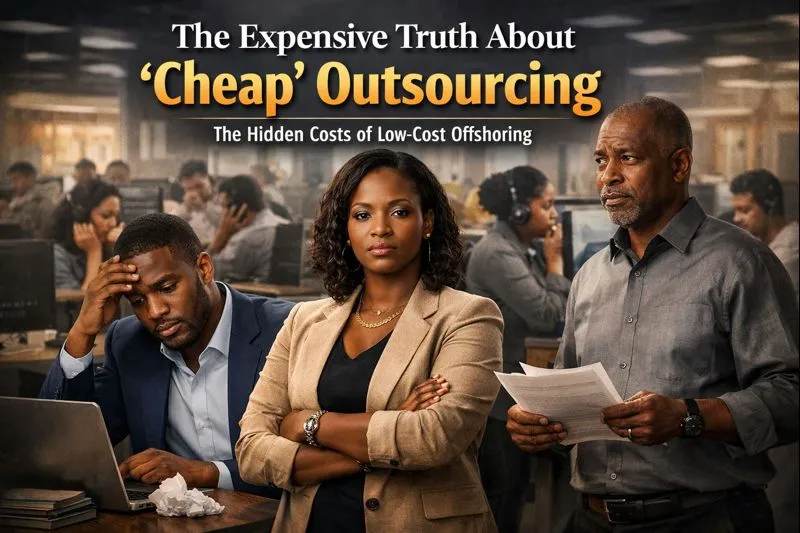
The Expensive Truth About ‘Cheap’ Outsourcing
The offshore outsourcing sales pitch sounds irresistible. “Save 60% on development costs!” Except most companies never realize those savings.
Research reveals a sobering reality about offshore development risks. Only 30% of companies report that offshore outsourcing effectively reduced costs. Another 55% found it “somewhat effective”—corporate speak for disappointed. A full 15% found it completely ineffective at delivering promised savings.
Think about those numbers for a moment. Seven out of ten companies don’t achieve their cost-reduction goals. Yet businesses continue chasing the offshore mirage.
Hidden Cost Breakdown
Let me show you where your money actually goes:
| Cost Category | Impact | Dollar Range |
| Cultural/Language Barriers | 3-27% additional costs | Varies by project |
| Productivity Loss (Year 1) | 10-20% efficiency gap | Significant delays |
| Transition Period | 3-12 months zero ROI | $0 returns initially |
| Contract Management | 6-10% overhead annually | $300K-800K/year |
| Travel & Coordination | Ongoing site visits | $300K+ annually |
| Quality Assurance Issues | 5-10 point CSAT drop | Extended timelines |
| Vendor Search/Legal Setup | One-time setup costs | ~$500K average |
| Staff Attrition & Turnover | 30-40% annual churn | Constant project delays |
That “cheap” $50/hour rate suddenly becomes $75-90/hour. Your custom software development costs spiral beyond initial projections. Management spends 15-20% more time coordinating distributed teams. Travel budgets balloon to $300K yearly for mid-sized programs.
Cultural and language differences add 3-27% to total costs. Development efficiency drops 20% during the first two years. Customer satisfaction scores fall 5-10 points compared to onshore. These aren’t minor inconveniences—they’re deal-breakers.
Real Failure Scenarios
The Royal Bank of Scotland learned this lesson at great expense. Their Infosys partnership for Williams & Glyn collapsed spectacularly. Hundreds of millions disappeared into coordination failures and technical problems. Public investigations revealed how distance destroyed accountability.
Queensland Health’s payroll outsourcing became a cautionary tale. Poor oversight and minimal accountability created operational chaos. Significant financial losses compounded the reputational damage. The distance between parties made problem-solving nearly impossible.
Offshore development risks aren’t just theoretical—they’re bankrupting businesses. When things go wrong across 12 timezones, resolution crawls. Email chains replace real-time problem-solving conversations. By the time everyone aligns, damage is done.
Read more: Best IT Companies in Accra for Cloud Migration Projects
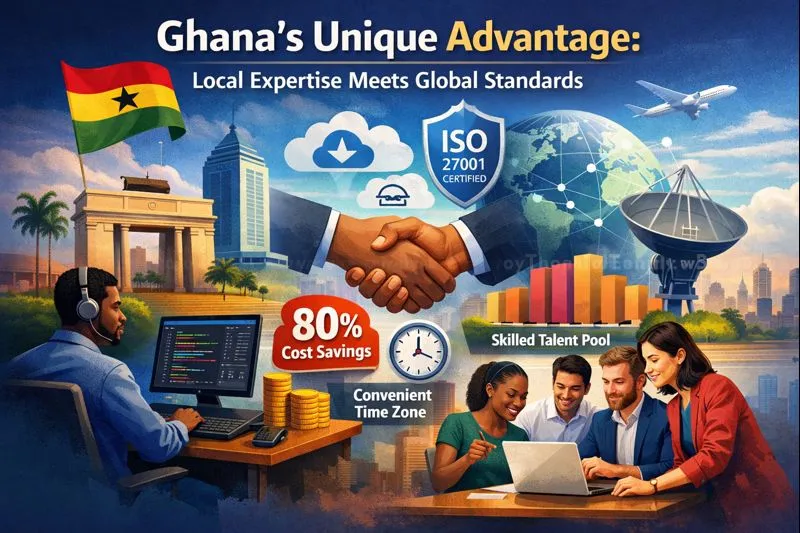
Ghana’s Unique Advantage: Local Expertise Meets Global Standards
Cost Advantage Without Quality Compromise
Here’s where things get interesting for smart businesses. African developers cost 60-80% less than US counterparts. But unlike offshore outsourcing, hidden costs stay minimal. You’re looking at 5-10% overhead instead of 30-45%.
Affordable software development in Ghana delivers real savings, not illusions. Let me break down actual monthly costs:
| Team Component | US Monthly Cost | Ghana Monthly Cost | Real Savings |
| Mid-Level Developer | $8,500 | $2,500 | $6,000 (70%) |
| Senior Developer | $12,000 | $3,500 | $8,500 (71%) |
| DevOps Engineer | $10,000 | $3,000 | $7,000 (70%) |
| 4-Person Team | $41,500 | $12,000 | $29,500 (71%) |
Sources: Betternship
That’s $354,000 saved annually on a small team. Scale to 10 developers? You’re saving nearly $900K yearly. These aren’t projections—they’re proven realities from operating businesses.
Time Zone Game-Changer
Ghana operates on GMT or GMT+1 depending on the season. European teams get a complete workday overlap for seamless collaboration. US teams enjoy 3-6 hours of real-time communication windows. Compare that to Asia’s 12+ hour gaps creating async nightmares.
Real-time collaboration accelerates decision-making by eliminating email ping-pong. Stand-ups happen live, not through recorded videos. Blockers get resolved in minutes, not days. Ghana tech talent participates in your timezone, not theirs.
Managers report 15-20% less oversight time with nearshore teams. Synchronous work windows mean faster iteration and feedback cycles. Sprint planning becomes collaborative instead of documentative. Daily standups actually happen daily with everyone present.
Talent Pool & Expertise
Nigeria alone boasts 120,000+ active software developers currently. Ghana specializes in fintech, e-commerce, and enterprise solutions specifically. Ghana software development partners work with modern stacks daily. React, Node.js, Python, AWS—they’re fluent in contemporary technologies.
English proficiency eliminates communication friction entirely from projects. Western business culture alignment means fewer workflow surprises. Developers understand Agile, DevOps, and modern development practices naturally. Many trained internationally or work with Fortune 500 companies.
Staff retention rates tell the quality story clearly. Ghana experiences less than 15% annual attrition typically. Offshore markets struggle with 30-40% yearly turnover constantly. Lower churn means institutional knowledge stays with your project. Relationships deepen instead of constantly resetting.
Infrastructure & Ecosystem
Accra’s tech hubs rival any emerging market globally. International investment pours in as Google and Microsoft establish presence. Government initiatives support digital transformation actively across sectors. Infrastructure in major cities meets world-class standards reliably.
Over $5 billion funded African tech startups recently. STEM education expands rapidly throughout Ghana and neighboring countries. The ecosystem matures quickly with accelerators, co-working spaces, and meetups. Professional development opportunities keep skills current and competitive.
ISO 27001 certifications become standard among established firms. Quality assurance processes mirror international best practices precisely. Reliable development partners invest heavily in redundancy and backup systems. Power and internet uptime exceed 99% in professional settings.
Real Results: Companies Thriving with Ghana Partnerships
Case Study #1: German Fintech Startup × Ghana Developers
A European fintech startup faced critical talent shortages locally. German developers commanded premium salaries exceeding their seed funding. Their six-month runway demanded immediate, cost-effective solutions quickly.
They partnered with a Ghana-based team of five developers. Integration happened smoothly thanks to English fluency and timezone overlap. Modern collaboration tools bridged the minimal geographic gap easily.
The results speak louder than any sales pitch:
- 40% cost reduction versus local German developer rates
- Project delivered on time and under budget impressively
- 85% employee retention after the critical three-month mark
- Four of five developers extended contracts for ongoing work
- Platform launched successfully, meeting all quality benchmarks perfectly
This demonstrates how software partnership benefits compound over time. Cost savings came without sacrificing quality or timelines. Retention proved the team’s satisfaction and project alignment. Cheaper than outsourcing delivered premium results, not bargain outcomes.
Source:Azubi Africa
Case Study #2: WinCorp Solutions – From Failed Offshore to Local Success
An enterprise client watched their offshore vendor fail repeatedly. Quality issues threatened their most valuable customer account directly. Something had to change before irreparable damage occurred.
They switched to a local partnership model immediately. WinCorp Solutions provided nearby, accountable developers with skin in the game. Communication improved instantly without timezone gymnastics.
The turnaround was nothing short of remarkable:
- ROI achieved in under one month—not the typical 6-12 months
- 20% reduction in previous vendor fees immediately
- $300K+ direct savings with targets reaching $400K annually
- $10MM+ indirect division gains from retained customer relationships
- Ranked as “vendor of choice” with extensive referral growth
- Avoided losing major client worth millions in annual revenue
Why partner with local software companies? Because they deliver immediate ROI. Distance creates accountability gaps; proximity closes them. Local software development partners share your timezone, language, and business urgency.
Source: Win Corp Solutions
Case Study #3: Tech Partnership Revenue Growth
A software company partnered with a development firm strategically. Close collaboration enabled rapid iteration and continuous improvement. Communication flowed naturally without cultural or language barriers.
Three months later, measurable improvements appeared across all metrics:
- 20% app speed improvement from optimization work
- 15% user retention increase from better UX
- 18% revenue growth directly attributed to partnership improvements
Fast iteration cycles made these gains possible quickly. Clear communication eliminated the translation overhead killing offshore projects. Cost-effective partnerships don’t just save money—they make money.
Source: E-Web Marketing
Comparing Ghana Software Partners to Traditional Outsourcing
Let me lay out the complete picture clearly:
| Factor | Offshore Outsourcing | Ghana Partnership | Clear Winner |
| Base Hourly Rate | $45-80/hour | $10-40/hour | Partnership |
| Hidden Costs | 30-45% additional | 5-10% additional | Partnership |
| Time Zone Difference | 12+ hours apart | 0-6 hours overlap | Partnership |
| Communication Style | Delayed, asynchronous | Real-time possible | Partnership |
| First-Year ROI | 6-12 months delay | Under 1 month | Partnership |
| Effectiveness Rate | Only 30% satisfied | 85%+ satisfaction | Partnership |
| Annual Staff Attrition | 30-40% turnover | Below 15% churn | Partnership |
| Cultural Alignment | Significant gaps | Strong Western fit | Partnership |
| Accountability Level | Limited oversight | High local presence | Partnership |
| Long-term Support | Contract-dependent | Partnership-driven | Partnership |
5 Essential Criteria for Selecting Your Ghana Software Partner
Criterion #1: Proven Track Record
Request detailed case studies with measurable outcomes clearly documented. Client references should span multiple industries and project types. Portfolio work demonstrates technical capabilities across your required stack. Long-term relationships prove partnership viability beyond single projects.
Red flag: Companies with only short-term contract work shown. Green flag: Multi-year partnerships with expanding scope over time. Ask specifically about retention rates among existing clients. High retention signals satisfaction that sales pitches can’t fake.
Criterion #2: Technical Expertise & Modern Stack
Verify proficiency in your exact technology requirements thoroughly. Certifications and training programs show investment in continuous improvement. Team structure should match your project’s complexity realistically. Quality assurance processes must meet your standards explicitly.
Choosing software partners requires technical due diligence, not just a pricing comparison. Request code samples or conduct technical interviews directly. Assess their CI/CD pipelines, testing practices, and documentation standards. Modern stacks require modern development practices supporting them.
Criterion #3: Communication & Cultural Fit
Test English fluency through actual conversations, not email alone. Evaluate their project management approach for compatibility with yours. Responsiveness during evaluation predicts responsiveness during collaboration accurately. Look for Western business practice alignment in meetings and documentation.
Communication style matters more than most realize initially. Do they ask clarifying questions or just say yes? Can they articulate technical concepts to non-technical stakeholders? Ghana tech company selection should prioritize communication as highly as coding ability.
Criterion #4: Transparency & Partnership Mindset
Clear pricing structures prevent surprise invoices from destroying trust later. Honesty about capabilities and limitations shows professional maturity. Proactive problem-solving beats reactive finger-pointing every single time. Investment in your success—not just billable hours—defines partnership.
Ask how they handle scope changes or unexpected challenges. Partners propose solutions; vendors demand change orders. Partners care about outcomes; vendors care about deliverables. This distinction separates great relationships from transactional nightmares.
Criterion #5: Support & Scalability
Ongoing maintenance and support offerings demonstrate long-term commitment. The ability to scale teams efficiently matters for growing businesses. Local presence enables in-person meetings when complexity demands them. Long-term relationship capacity shows they’re building businesses, not churning clients.
Software companies in Ghana should articulate growth paths clearly. How do they onboard new team members smoothly? What happens when your needs suddenly expand or contract? Flexibility combined with stability creates ideal partnership conditions.
Read more: Avoiding Common Pitfalls When Working With IT Companies in Ghana
Recap: Making the Smart Choice: Partnership Over Outsourcing
Let’s recap what we’ve discovered throughout this blog:
Offshore outsourcing disappoints 70% of companies with broken promises. Hidden costs devour 30-45% of expected savings relentlessly. Ghana partnerships deliver 60-80% cost savings with minimal hidden costs. Time zone alignment enables real-time collaboration that offshore models can’t match.
Proven case studies demonstrate immediate ROI, not distant promises. The partnership model beats transactional outsourcing across every meaningful metric. You’ve seen the data, the stories, and the clear comparisons.
The bottom line is refreshingly simple:
You don’t need to choose between cost and quality anymore. You don’t have to accept communication barriers as inevitable. Also, you don’t have to tolerate high turnover destroying project continuity.
Software companies in Ghana offer a genuinely better way forward. True partnership replaces distant transactions with shared success. Collaboration replaces contract negotiations at every turn. Your success becomes their success through aligned incentives.
Read more: Top 10 IT Companies in Ghana Driving Digital Transformation in 2026
Ready to Experience the Partnership Difference?
WebSys Technology has been delivering cost-effective, results-driven software solutions since 2013. As one of Accra’s most trusted IT companies, we don’t just build software—we build lasting partnerships that drive real business results.
What sets WebSys apart from typical vendors:
- Local presence in Accra with international quality standards
- Proven track record with B2B clients across industries
- Comprehensive services: web development, mobile apps, IT infrastructure, digital marketing
- Transparent pricing with absolutely no hidden costs
- Dedicated support throughout your entire project lifecycle
- 4-phase proven process: Strategy → Design → Development → Launch
Whether your business needs:
- Custom software development tailored to your processes
- E-commerce solutions that convert visitors into customers
- IT infrastructure setup and ongoing network management
- Digital marketing services that drive measurable ROI
- Ongoing technical support with real human beings
WebSys Technology stands ready as your trusted partner in Ghana.
Don’t settle for distant outsourcing relationships when you can have a committed local partner invested in your success. We understand B2B marketing, sales funnels, and proven tactics for attracting ideal client leads.
Contact WebSys Technology today for a free consultation. Discover how our partnership approach delivers better results at better value. Let’s build something remarkable together.
GET IN TOUCH