

Digital transformation in the Ghanaian business environment is taking unbelievable speed. By 2025, mobile money transactions had topped GHC 500 billion, and the use of e-commerce and cloud technologies was pervasive among SMEs and big companies.
This kind of swift adoption results in innovation. However, it also subjects companies to a rising danger of cyberattacks. As per CSA, more than 2,000 organizations in Ghana reported cybercrime activities in the period between January and September 2025, comprising ransomware, phishing, and data breaches. That means any unprotected networks are potential entry points for attackers.
But how can you protect your business from such costly attacks? A simple answer is to hire network security experts. These professionals use their expertise to help keep your data and business safe around the clock.
They offer a wide range of network security solutions—including firewalls, intrusion detection and prevention systems, endpoint protection, managed detection and response (MDR), and network access control—to support business continuity and protect organizations from unexpected disruptions. Let’s explore what services most of the network security companies offer in detail.
GET IN TOUCH
Secure Your Network With Our Security Experts
Why Network Security Is Now Critical for Businesses in Ghana
Ghana is facing various cyber threats that are targeting the networks in the finance, logistics, retail, and government sectors. Over 2,000 cases of cybercrimes were already reported in the first half of 2025 alone—a 52 percent increase from the previous year (MyJoyOnline). These are phishing, ransomware, and insider attacks. Neglecting these poses a threat of loss of data, work stagnation, and brand destruction.
In Ghana, the use of zero-trust architectures, endpoint protection, and real-time monitoring has become part of effective network security solutions. This guide gives the trusted providers, service comparisons and practical information that is typically nonexistent in other resources. Achieving digital infrastructure security is not an option but a strategic requirement.
Read more: Common Network Vulnerabilities in Ghana & How Professionals Fix Them
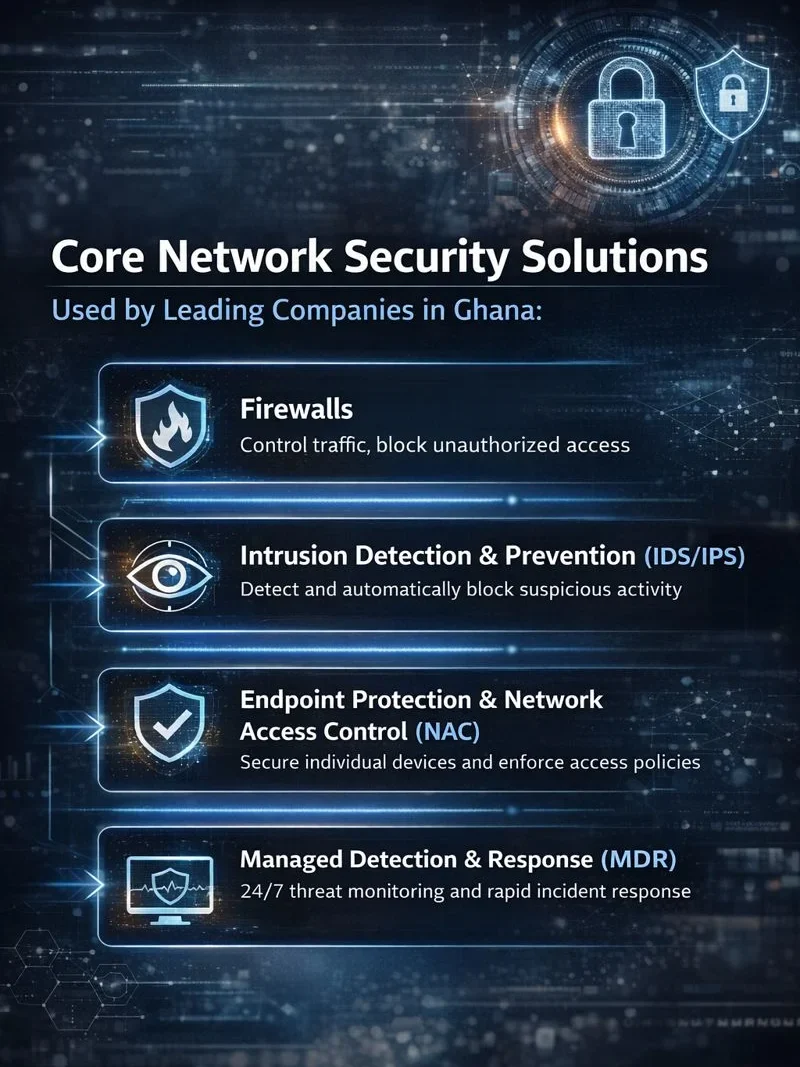
Core Network Security Services Offered by Leading Companies in Ghana
Leading companies in Ghana follow best practices by adopting a multilayered network security strategy that integrates preventative, detective, and responsive solutions. All the elements deal with particular risks and are involved in a unified defence policy.
- Firewalls serve as the first line of defence. They act as gatekeepers, controlling all incoming and outgoing traffic based on predefined security policies. The next-generation firewalls are no longer limited to packet filtering but include encryption-level and application-level policy enforcement as well as integration with centralized monitoring systems. The first advantage is the avoidance of unauthorized access to internal networks and the preclusion of numerous threats before they access sensitive systems.
- Intrusion Detection and Prevention Systems (IDS/IPS) go hand in hand with firewalls as they serve as supervisors to complex attacks that might not be caught by perimeter barriers. IDS detects the abnormal patterns and suspicious activity in the network traffic and notifies the security teams about the potential threat. IPS goes a step further by automatically blocking detected threats, reducing dwell time and preventing lateral movement within the network. In the case of Ghanaian companies, IDS/IPS can be used to prevent advanced malware and zero-day attacks as well as insider attacks, which can never be prevented using firewalls.
- Endpoint Protection and Network Access Control (NAC) secure individual devices and users. NAC enforces strict policies, allowing only authorized and compliant devices to access the network. The endpoint security software monitors the workstations, laptops and mobile devices and prevents malware infections and reduces internal risk exposure.
- Managed Detection and Response (MDR) offers 24/7 tracking, active searching for threats, anda quick reaction to the attack. MDR minimizes the time a threat remains undetected, reducing operational disruption and financial loss.
- Cloud, hybrid, and remote network security solutions protect both on-premises and cloud environments. Secure SD-WAN and cloud access security brokers (CASBs) tools make it easier to see into remote teams and provide security to them and secure connections to distributed operations.
All these services work together to create a robust, dynamic security posture. By incorporating preventative and detective as well as responsive solutions, Ghanaian organizations will be in a position to mitigate the threats and guarantee adherence and business continuity in a digital world that continues to become increasingly digitized.
How Does Each Service Benefit Your Business?
In Ghana’s rapidly digitizing economy, rising cybercrime—with reported incidents increasing from 1,317 to 2,008 in the first half of 2025 and losses nearing GH¢14.9 million—underlines why strong network security services are essential for protecting revenue, data, and continuity.
To understand how each core security service generates business value, consider the following benefits and supporting evidence.
- Firewalls: Reduce Exposure to Attacks
Keep out intruders and filter malicious traffic before it gets into your systems. Companies that have well-established perimeter controls reduce the chances of experiencing expensive intrusions, which is crucial in a setting where fraud and impersonation constitute most of the online losses. - Intrusion Detection & Prevention (IDS/IPS): Early Threat Identification
IDS/IPS systems are constantly hunting suspicious signatures and preventing malicious activities, which minimizes dwell time and eliminates a comprehensive violation of the system. This functionality is directly useful in combating the increased online fraud patterns. - Endpoint Protection & Network Access Control (NAC): Safe Devices, Safer Networks
Laptops, mobile devices and other endpoints can be secured to ensure that attackers do not use the devices that they have compromised as gateways. Endpoint security reduces risk exposure from infected or unmanaged endpoints — a common initial attack vector in business breaches globally. - Managed Detection & Response (MDR): Faster Detection and Response
The use of MDR can reduce the time organisations spend detecting and responding to threats by up to 74% compared to relying solely on internal teams, which transforms possible crises into containable incidents. - Cloud & Hybrid Network Security: Protect Distributed Operations
With the development of cloud and remote working approaches, built-in security such as secure SD-WAN and CASBs can provide coverage and protection of all the places and reduce the likelihood of misconfigurations or unguarded access points used by attackers.
Combined, these services not only reduce risk and cut losses but also support compliance and customer trust in an increasingly dynamic threat landscape.
Read more: How to Choose the Best Cyber Network Security Company in Ghana
Real-World Case Studies: Network Security in Ghana
The Problem:
In late 2025, a mid-sized bank in Accra suffered a ransomware attack. Critical customer and transaction data were encrypted, and daily operations were at risk. Estimated potential losses exceeded USD 120,000, and customer trust was eroding rapidly (Graphic Online).
The Solution:
The bank engaged a local MDR and SOC provider with expertise in threat intelligence and incident response. A phased containment approach was implemented: high-risk endpoints were isolated first, malware analysis was performed, and secure restoration of critical systems began within hours. Staff received targeted guidance to avoid further compromises.
Results:
- Encrypted data was recovered safely within 48 hours
- Potential financial loss mitigated by over USD 100,000
- Detection and containment speed improved by 68%
- Operational disruption has been reduced to less than 1 business day
Impact:
The bank’s CIO stated, “Implementing proactive MDR transformed our response capability. Threats that could have shut us down were neutralised quickly.” The presence of constant surveillance has since prevented the recurrence of attacks and improved preparedness to adhere to the regulations.
Frequently Asked Questions (FAQs)
Network security helps block malware and unauthorised access while preventing data breaches. In Ghana, as cybercrime cases are on the increase, it will be able to secure the continuity of business, protect confidential data, and facilitate adherence to such legislation as Act 843.
Expenses are tied to size and sophistication. Endpoints and cloud protection are available to SMEs at thousands of cedis per year, and SOC, MDR, and zero-trust solutions are needed by large companies and are frequently tailored to their risk profile and budget.
Yes. Most of the local firms have adopted the models, such as the ISO/IEC 27001, NIST, and CIS Controls, by combining global and local threat intelligence to safeguard data, ensure compliance, and build trust with international partners.
Absolutely. Act 843 mandates companies to protect personal information, enforce accessibility and control information. Adherence reduces the legal liability, and it eradicates fines and increases customer and stakeholder confidence.
Begin with a risk assessment to identify weaknesses. Use multifaceted controls such as firewalls, endpoint guards, NAC, and surveillance. Collaborate with the local professionals to develop unique, sensitive solutions to suit the Ghanaian infrastructure problem.
Conclusion
In the modern digital world, cyber threats in Ghana are not a far-fetched concept, but they are real, common, and more advanced. All businesses, SMEs and multinationals alike have to take the initiative to ensure that they secure their networks.
The appropriate network security solutions in Ghana do not just block the attacks, but they also improve the efficiency and safeguard the trust of the customers, and they are also consistent with the regulations. Layered protection and active threat hunting, as well as zero-trust architecture, minimise financial and reputational risks and create a resilient IT environment.
Secure your business with a tailored security assessment by WebSys Technology. Identify vulnerabilities, install customised defence and protect your operation in the evolving threat environment. You do not need to wait for a breach—act now before your network becomes the next headline.
GET IN TOUCH