

Businesses pour money into new websites expecting clients, only to end up with glossy pages that barely generate leads or sales. Across industries, average conversion rates from organic search hover around 2–3%, showing that well‑designed, optimized sites can reliably turn visitors into paying customers when done right.
Many companies also see at least double their money back from SEO over time, proving that smart website development and optimization directly drive revenue growth rather than vanity traffic.
Yet a recent review of 367 licensed accounting firms in Ghana found that only about 130 even had websites, and just 87 of those were actually functioning, while many Bank of Ghana‑licensed institutions still operate with broken sites or corporate emails.
These gaps usually begin at the hiring stage, when businesses rush into hiring web design companies in Ghana, chase rock‑bottom prices, skip due diligence, ignore maintenance and ownership details, and launch without proper testing.
This blog exposes the ten costliest mistakes businesses make when hiring web design companies in Ghana and shows how to avoid them so your next website becomes a real growth asset, not another sunk cost.
GET IN TOUCH
Elevate Your Business with a Professional Website!
What Common Mistakes Do Ghanaian Businesses Make When Choosing Web Agency Ghana Partners?
Many Ghanaian businesses do not set out to waste money on website development for Ghana projects. Yet, they still end up disappointed with slow, confusing, or invisible sites that never deliver real ROI. In the next sections, we will break down the most common errors Ghanaian businesses make when hiring web designer Accra and other local agencies, so you can recognize these red flags early and avoid repeating them.
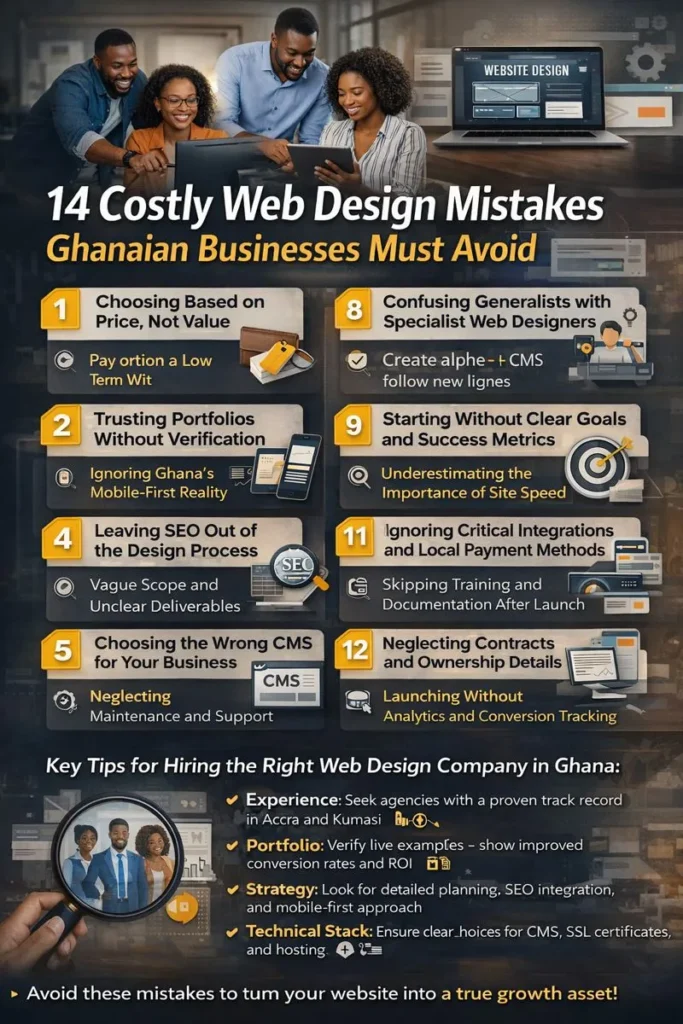
Mistake 1: Choosing only by price, not value
One of the most common web design mistakes Ghana business owners make is chasing the cheapest quote without understanding the long-term cost of poor quality. Many avoidable problems arise later, including broken features, weak security, and sites that fail to convert visitors into leads or sales.
When you avoid the cheapest web design companies Ghana that rely on low prices often cut corners on critical elements like SSL certificates, mobile responsiveness, and SEO-friendly structures, which eventually harm your ROI and website performance. A small initial saving can quickly turn into a budget overrun when you pay again to fix fundamental issues, extend the project timeline, or rebuild the site from scratch.
Consider these questions before you choose web agency Ghana service providers purely on price:
- Does the agency explain how the design supports business goals, such as conversion rates or lead generation?
- Do they include domain registration, SSL certificates, and basic on-page SEO, or will these become hidden costs later?
- Can they show examples where their work increased revenue, reduced bounce rate, or improved ROI website metrics for other clients?
A professional web designer, based in Accra or located in other Ghana IT hubs should be able to justify their pricing with clear deliverables, a structured process, and measurable outcomes.
Mistake 2: Trusting portfolios without proper verification
Many businesses fall for beautiful screenshots without checking whether those websites actually exist, work well, or even belong to the agency showing them. Portfolio theft by web agencies Ghana wide is a growing issue, where some firms copy Dribbble or Behance designs and claim them as their own projects.
A strong portfolio must go beyond visuals and demonstrate real results from website development Ghana projects, including performance metrics and business outcomes. You need proof that the agency understands your audience, your industry, and the realities of doing business online in Accra, Greater Accra, Kumasi, Madina Zongo, St Johns-Dome, and other local markets.
To protect yourself from common mistakes when choosing a web design firm in Accra and other cities, always:
- Visit live sites listed in the portfolio and test their loading speed, mobile responsiveness, and navigation.
- Ask for specific case studies with before-and-after numbers around conversion rates, bounce rate reduction, and organic traffic growth.
- Verify references by contacting previous clients directly, not only reading testimonials on the agency’s own website.
Genuine agencies and every serious agency owner will welcome these questions because they reveal the quality of their work and the depth of their expertise.
Mistake 3: Ignoring Ghana’s mobile-first reality
Ignoring mobile-first design Ghana businesses still do is one of the most damaging mistakes in today’s environment. Mobile connections in Ghana now stand at about 41.8 million, equal to more than 119% of the population, which shows how dominant phones are in everyday internet use.
Users in Accra, Kumasi, and other Ghana IT hubs often pay high data costs and expect fast-loading, mobile-friendly pages, especially when browsing on 3G or congested networks.
A competent web designer Ghana businesses trust will:
- Prioritize mobile responsiveness from the first wireframe, not as a last-minute adjustment.
- Compress images, clean up code, and implement loading speed optimization as part of the standard workflow.
- Test on different screen sizes and network conditions that reflect real users in places like Madina Zongo or St Johns-Dome, not just high-speed office connections.
Web design mistakes Ghana companies often make include focusing only on how the site looks on a large desktop monitor, even though most customers interact through small mobile devices.
Mistake 4: Leaving SEO out of the web design conversation
No SEO strategy in web design contracts remains a silent killer of many digital projects in Ghana. Research shows that organic search delivers about 53% of all website traffic.
When businesses treat search engine optimization (SEO) as an optional extra instead of a core part of website development teams must plan; they end up with attractive but invisible websites.
Search engines reward sites that load quickly, have clean structures, and deliver relevant content for specific searches such as hiring web design companies or Web design mistakes, so ignoring SEO from the start wastes significant potential. Many agencies still build sites without proper meta tags, structured headings, internal linking, or local SEO considerations for locations like Accra, Greater Accra, or Kumasi.
Before signing anything, ask direct questions to ask before hiring Ghana web developers or an IT consultant based in Ghana:
- How will the site architecture support SEO, including category structures, internal links, and crawlability?
- What on-page SEO elements will be included, such as title tags, meta descriptions, image alt text, and schema markup?
- How will the site target local searches like “Web designer Accra” or “Choose web agency Ghana” without keyword stuffing?
When SEO is integrated into the proposal, you reduce the risk of paying twice, once for design and again for separate SEO fixes.
Mistake 5: Accepting vague scope and unclear deliverables
Unclear scope of web design projects often causes tension, cost overruns, and disappointing outcomes. Many conflicts arise because the client assumed something was included, while the agency believed it was extra or outside the original agreement.
Ambiguity around content, revisions, integrations, and support can easily lead to budget overrun or missed project timeline milestones. For example, you might think copywriting, blog setup, or email newsletter integration comes as part of the package, but the agency may only deliver basic page templates with placeholder text.
To avoid these misunderstandings, insist on a written document that clarifies:
- Number of pages, templates, and unique page designs to be delivered.
- Responsibility for content writing, photography, and stock images.
- Which integrations will be included, such as payment gateways, CRM tools, or marketing platforms?
A clear scope helps both the freelance developer and the web design company manage expectations, allocate resources, and deliver websites that truly match your business needs.
Read more: How Web Design Companies in Ghana Help SMEs Turn Their Websites Into Sales Machines
Mistake 6: Choosing the wrong CMS for your business
Wrong CMS for business website decisions often lock businesses into expensive, inflexible, or overly complex systems. Recent CMS research found that 46% of companies say website changes are limited to a small number of people. Another 40% struggle to add new content types, which shows how the wrong platform can slow everyday marketing work and create bottlenecks.
A content management system (CMS) should make it easy to update content, publish blogs, and manage products without constantly calling your agency owner or developer.
Popular options like WordPress, Shopify, and Wix each have different strengths and limitations. WordPress offers powerful flexibility for most small and medium businesses in Accra and Greater Accra, while Shopify works well for e-commerce stores that need integrated payments, and Wix suits very simple sites with minimal customization requirements.
Before committing to a specific CMS, consider:
- Who will manage the site day to day, and what skills do they have?
- Whether you need custom features built with HTML/CSS, plugins, or third-party tools.
- How easy it is to scale or add new functionality as your business grows in Kumasi or other Ghana IT hubs.
A thoughtful CMS choice reduces future costs, improves user experience, and avoids painful migrations later.
GET IN TOUCH
Boost Your Online Success with Our Expertise!
Mistake 7: Forgetting about maintenance and support
Overlooking maintenance plans that web firms propose is another mistake that quietly erodes website value over time. Every modern site, whether built on WordPress, Shopify, or custom HTML/CSS, needs regular updates, backups, and security checks.
Without a structured maintenance agreement, plugins become outdated, SSL certificates expire, and vulnerabilities increase, which can damage your brand and SEO performance. When issues are left unresolved, websites slow down, forms stop working, and user experience suffers, especially for mobile visitors who already face data and connectivity limitations.
A good maintenance plan should include:
- Regular updates to themes, plugins, and the CMS core.
- Automated backups with quick restoration procedures in case of failures.
- Monitoring of uptime, performance, and security, with clear response times for support requests.
Ignoring these basics can cause sudden downtime or data loss, which directly impacts website outcomes and customer trust.
Read more: Why Website Development Companies in Ghana Are Shifting to AI-Powered and No-Code Solutions
Mistake 8: Confusing generalists with specialist web designers
Some businesses hire a general graphic designer or freelance developer and expect full digital strategy, UX research, and high-converting web funnels. However, web design requires a specific mix of visual design, technical skills, and marketing awareness.
For example, a talented logo designer might create beautiful graphics but lack knowledge of search engine optimization (SEO), user experience (UX), or conversion-focused layouts. A skilled web designer Ghana clients can rely on understands how to arrange content, calls to action, and navigation pathways to guide visitors towards inquiries or purchases.
When choosing between a Web designer Accra based freelancer and a full agency, evaluate:
- Their understanding of UX principles, information hierarchy, and user flows.
- Their ability to collaborate with IT consultant Accra specialists or copywriters when needed.
- Their experience working with analytics tools and conversion tracking to improve performance over time.
Hiring the right specialist reduces trial and error and speeds up the path to measurable online results.
Mistake 9: Starting without clear goals and success metrics
Many web projects begin with vague instructions like “make it modern” or “look professional,” but lack precise, measurable goals. Without clear objectives, you cannot judge whether your investment in website development Ghana services has generated satisfactory ROI.
You need to define what success looks like before the first design concept appears. For some SMEs, the main goal may be increasing inbound leads, while others focus on e-commerce sales, bookings, or brand awareness in locations such as Kumasi or Madina Zongo.
Clarify your goals by answering questions like:
- What actions should visitors take on the site, and which pages support those actions?
- How many leads, sales, or sign-ups do you expect, and over what timeframe?
- Which metrics will you track, including conversion rates, bounce rate, and time on page?
With these answers, you can brief any web designer Ghana teams more effectively and hold them accountable for outcomes, not just aesthetics.
Mistake 10: Underestimating the impact of site speed
Slow websites frustrate users and damage search visibility across all sectors. According to recent reports by Google, if a page takes longer than three seconds to load, more than half of visitors may abandon it, and when page load time rises, bounce rate can increase dramatically by over 30%. And delays of several seconds can more than double bounce rates.
For Ghanaian audiences, who often pay per megabyte and face variable mobile speeds, a slow site becomes even more costly. A sluggish landing page can reduce conversion rates sharply, and for e-commerce platforms or service providers, even a one-second delay may cut conversions by around 7%.
Ensure that your chosen web agency in Ghana provider:
- Optimizes images, code, and scripts to reduce file sizes.
- Chooses reliable hosting and configures caching and content delivery networks where appropriate.
- Test performance regularly using tools like Google PageSpeed Insights and adjust designs when they slow down the experience.
By focusing on speed, you help both users and search engines engage more deeply with your content.
Read more: How Website Development Companies in Ghana Use Modern Web Development Trends to Boost Conversions
Mistake 11: Ignoring critical integrations and local payment methods
Many businesses see web design as a standalone project and overlook how the site should connect with other business tools. In Ghana, this often means neglecting essential integrations with local payment systems, CRMs, and marketing platforms.
A modern business site should support Mobile Money options alongside cards and bank transfers, especially for customers in areas like Greater Accra and St Johns-Dome. Without these integrations, visitors may abandon purchases halfway, harming conversion rates and overall ROI website performance.
Discuss these integration needs upfront with any Web designer you consider:
- Payment gateways compatible with Ghana banks and mobile wallets.
- Email marketing tools for nurturing leads after initial contact.
- Analytics and CRM systems to track leads from first visit through final sale.
By planning integrations from the start, you reduce technical friction and create smoother customer journeys.
Mistake 12: Skipping training and documentation after launch
Lack of training after website launch clients’ experience is another recurring pain point. When agencies hand over a site without guidance, businesses struggle to update content, publish blog posts, or manage simple edits.
This dependency often leads to minor changes taking days or weeks, and every adjustment becomes an added cost. Over time, content becomes outdated, campaigns slow down, and opportunities disappear because the team fears breaking the site.
A solid handover should include:
- Live or recorded CMS training sessions covering everyday tasks and best practices.
- Simple written documentation or screen captures showing how to edit pages, menus, and forms.
- Clear instructions for when to contact the agency or the IT consultant partner for more complex work.
When your team understands the content management system (CMS), they can act quickly and keep your digital presence fresh and relevant.
Mistake 13: Neglecting contracts and ownership details
Some businesses still work on a handshake approach for projects worth thousands of cedis. Without proper contracts, you may not clearly own the code, designs, or content you paid for.
Studies on project performance show that around 37% of projects fail primarily because goals and requirements were not clearly defined from the start, which is exactly what happens when contracts and scopes are vague.
Unclear agreements can also create disputes about timelines, payment schedules, and what happens if the relationship ends early. This risk is especially high when dealing with smaller outfits or a freelance developer who may juggle multiple clients simultaneously.
Before starting any project, make sure your contract addresses:
- Ownership of all design assets, code, and content after final payment.
- Milestones linked to deliverables, not just dates, to manage project timeline expectations.
- Terms for termination, refunds, and access to backups if you switch providers later.
This clarity protects both sides and reduces the chance of difficult legal or financial conflicts later.
Read more: Timeline Expectations: How Long Do Website Development Companies in Ghana Take to Deliver?
Mistake 14: Launching without analytics and conversion tracking
Launching a site without analytics is like opening a shop with covered windows and no counters. Without proper tracking, you cannot measure campaign performance, user behavior, or ROI website outcomes.
Tools like Google Analytics and Search Console, when configured correctly, reveal how users arrive at your site, which pages they engage with, and where they drop off. You can see which traffic sources convert best and which pages suffer from high bounce rates or poor conversion rates.
Ask every agency or Web designer Ghana provider to:
- Install analytics and tag managers before launch.
- Set up goals or events for key actions such as form submissions, calls, or purchases.
- Provide basic reports and show you how to interpret them over time.
When data guides your decisions, continual improvement becomes much easier and more effective.
How to choose the right web agency in Ghana
To avoid the typical web design mistakes Ghana companies repeat, you need a structured way to evaluate partners. Whether you plan to hire a web designer from an Accra studio, a regional firm in Kumasi, or a remote team, the same principles apply.
Use this checklist when comparing proposals and interviewing agencies:
- Experience and specialization
- Have they worked with businesses similar to yours in Accra, Greater Accra, Kumasi, or other Ghana IT hubs?
- Do they demonstrate a strong understanding of UX, SEO, mobile responsiveness, and loading speed optimization?
- Portfolio and proof
- Can they provide verifiable live examples and client contacts rather than only Dribbble or Behance visuals?
- Do they show improvements in conversion rates, bounce rate, or ROI website performance?
- Strategy and process
- Do they ask detailed questions to ask before hiring Ghana web developers, including about goals, target audience, and content?
- Is there a clear process covering discovery, design, development, testing, and launch?
- Technical stack and CMS
- Can they explain why they recommend WordPress, Shopify, Wix, or another system for your specific needs?
- Do they handle domain registration, SSL certificates, and hosting configuration in a transparent way?
- Support and training
- Is there a maintenance plan that addresses security, backups, and performance monitoring?
- Will they provide training so your team can manage the content management system (CMS) confidently?
When you systematically compare these factors, you avoid many of the common mistakes when choosing a web design firm in Accra and beyond.
Conclusion
Hiring web design companies Ghana wide can either accelerate your business growth or quietly drain your budget if you make the wrong choices. The biggest risks arise when businesses focus only on price, ignore SEO and mobile responsiveness, accept unclear scopes, or overlook maintenance and training, which leads to poor performance and missed opportunities.
Ghana’s digital landscape is now too competitive for guesswork, especially in hotspots such as Accra, Greater Accra, Kumasi, Madina Zongo, and St Johns-Dome, where customers spend increasing time online and expect fast, secure, easy-to-use websites. When you evaluate portfolios carefully, insist on clear contracts, select the right CMS, and demand a strategy that combines UX, SEO, and performance, your website development Ghana investment begins to generate real ROI instead of vague promises.
If you are planning a new project or thinking about redesigning your current site, take the time to apply these principles, ask tough questions, and choose web agency Ghana partners who can prove their results rather than simply talk about them, so your next website becomes a powerful asset instead of an expensive experiment.
GET IN TOUCH