
Power reliability shapes productivity. According to a statement from Ghana’s Deputy Finance Minister, citing a Global Infrastructure Hub report, the nation currently invests about 5% of its GDP in infrastructure—well below the average for lower‑middle‑income countries. As a result, limitations in energy systems persist.
Recent studies show that power outages cost Ghana more than $680 million every year, while the country’s energy sector faces debts of $3.1 billion as of March 2025. These challenges push local technology companies to innovate constantly.
Yet, IT companies in Accra have built impressive systems that keep operations running even when the grid goes dark. From backup power to redundant internet routes, these companies have turned obstacles into a network of disciplined strategies.
This article explains how IT companies in Accra handle power outages and network issues, detailing the backup technologies, preventive measures, and smart planning that keep servers humming and business running continuously.
Why Resilience Matters More Than Speed
Every second of downtime affects customer trust, service quality, and profits. But while others slow down when the lights flicker, Accra-based teams pivot smoothly because resilience is engineered into every layer of their infrastructure.
These firms understand that true reliability isn’t just about fast hardware—it’s about power alternatives, connection backups, and tested procedures that work under pressure.
In an unpredictable environment, uptime becomes the real competitive advantage. Let’s uncover the systems behind that stability.
How a Professional IT Company In Accra Handle Power Outages
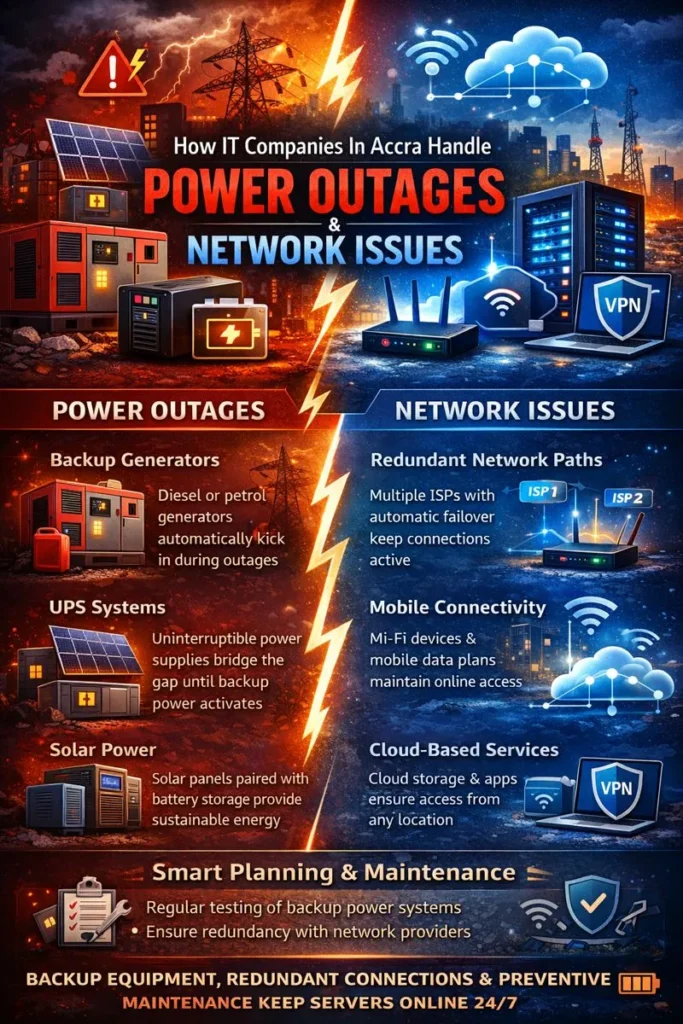
Frequent power outages—locally known as “dumsor”—are a reality for every business in Ghana. For IT firms, where systems must stay online 24/7, it’s a core operational priority. As a result, companies design layered power continuity systems, combining traditional and renewable energy to ensure smooth handovers during blackouts.
When the grid fails, there’s a clear sequence: the UPS (Uninterruptible Power Supply) immediately kicks in, bridging the gap until generators activate. Within moments, generators stabilize power for servers, cooling, and critical tools. Every step is tracked in system logs to confirm that operations never skip a beat.
Generators — The Backbone Of Extended Operations
Diesel and petrol generators remain the most common defense. They power entire server rooms, routers, and cooling systems for hours or days, depending on fuel supply. Mature tech firms configure Automatic Transfer Switches (ATS) so generators start instantly once power dips.
Key Considerations For Generators:
- Run-load capacity aligned with full IT demand.
- Secure fuel storage and replenishment plans.
- Monthly testing under real conditions.
- Fire and emissions compliance standards.
A reliable generator system doesn’t just restart work—it prevents damaging brownouts that could erase critical data or overheat hardware.
UPS Systems — Protecting Equipment And Data Integrity
A generator takes minutes to start, but a server can crash in seconds. That’s where a UPS steps in. It bridges the critical gap, standing as silent insurance that keeps systems operational until backup power activates.
Strong UPS Configuration Includes:
- Multi-minute runtime under full load.
- Comprehensive surge protection.
- Independent UPS for network cores and main servers.
- Regular battery health inspections.
The goal isn’t just to delay shutdowns—it’s to preserve workflows, minimize corruption risks, and keep communication channels open until normal power stabilizes.
Solar Power And Battery Storage — Clean, Quiet Resilience
Sustainability is now part of business continuity. Many IT companies in Accra pair solar panels with battery storage systems to cut reliance on diesel fuel and rising energy costs. Daylight powers servers directly, while batteries kick in after sunset or during outages.
Why Solar Investments Work Well In Accra:
- Abundant sun exposure throughout the year.
- Reduced operational cost over time.
- Silent and emission-free power ideal for city setups.
- Long-term savings against fluctuating fuel prices.
This hybrid approach ensures uninterrupted power while strengthening companies’ green credentials.
Colocation Data Centres — Outsourcing Uptime
Running an in-house server doesn’t always make financial sense when robust colocation data centres exist. Many IT firms use facilities such as Onix Data Centre, which boasts 99.995% uptime through redundant infrastructure. These centers maintain dual power feeds, climate control, and 24/7 surveillance, giving businesses peace of mind.
What To Verify Before Using A Data Centre:
- Dual power supply and generator redundancy.
- SLA-guaranteed uptime levels.
- Security access controls.
- Climate stability and disaster recovery plans.
| Power Source | Typical Usage | Strength | Limitation |
| UPS | Short gaps | Instant response | Limited duration |
| Generator | Long outages | Full capacity backup | Fuel dependency |
| Solar + Battery | Continuous days | Sustainable and low‑noise | High initial cost |
| Data Centre | Mission‑critical hosting | Professional redundancy | Monthly charges |
Read more: How IT Companies in Ghana Help Small Businesses Go Digital
How IT Companies In Accra Handle Network Issues
Power continuity is one challenge—network stability is another. Since consistent connectivity powers every service, local tech leaders use multiple providers, technologies, and redundant paths to stay online. This approach not only ensures customer satisfaction but also aligns with global uptime expectations.
When one connection falters, operations continue seamlessly through backup channels designed for automatic failover.
Redundant Network Paths — Two Lines Are Better Than One
Top IT companies in Accra rarely rely on a single internet provider. They connect through multiple ISPs to prevent full downtime. If one fails, routers detect lags and instantly switch to the secondary network.
Core Redundancy Practices:
- Dual ISPs with different routing paths.
- Dedicated hardware for failover switching.
- Network monitoring dashboards for uptime verification.
- Periodic failover tests logged for compliance.
This blend of automation and human oversight ensures smooth transitions unnoticed by clients.
Mobile Connectivity — Staying Online During Emergencies
When fixed broadband fails, mobile connections step in. Teams maintain MiFi devices and mobile data plans to guarantee constant communication and project continuity. It’s a low-cost, fast‑deploy solution that often bridges downtime gaps.
Companies integrate mobile backup into their workflow tools, keeping staff active even when office routers go offline.
Cloud-Based Services — Resilience Beyond Local Infrastructure
Cloud adoption across Accra continues to rise. Hosting data, collaboration platforms, and daily workflows on the cloud reduces dependence on physical office networks. Whether it’s Microsoft Teams, Google Workspace, or secure cloud backups, access persists from any connected location.
Cloud Continuity Advantages:
- Data accessible 24/7 from remote workplaces.
- Integrated security and retention policies.
- Multi‑region redundancy for mission‑critical files.
By migrating key systems online, IT companies shield clients from local disruptions and enable remote operations instantly.
VPNs — Secure Access Anywhere
Virtual Private Networks (VPNs) serve as digital lifelines during outages or remote shifts. They allow employees to securely log into company servers, cloud systems, or ticketing tools from any location with internet access.
Best VPN Practices Include:
- Enforcing multi‑factor authentication (MFA).
- Split tunneling for performance optimization.
- System‑wide encryption and activity logging.
- Automated session expiry for added security.
With a solid VPN system, business doesn’t pause—even when office lights do.
Read more: Top 10 IT Companies in Ghana Driving Digital Transformation in 2026
Business Continuity Planning — Keeping Everything Connected
Technology works best with a plan behind it. Business continuity frameworks make sure recovery steps are predictable and repeatable. Within Accra’s IT ecosystem, these plans mix remote-ready policies, offline tools, and structured monitoring to reduce downtime risk dramatically.
Remote Work Policies — People Continuity
Companies predefine when teams shift remote during severe outages. With cloud apps and VPNs, employees continue tasks uninterrupted from home or co‑working hubs. Scheduled communication ensures smooth coordination until full restoration.
Offline Operations And Syncing — Intelligent Adaptation
Certain applications now handle denial-of-service gracefully. Retail platforms and internal ERP tools log transactions offline, then sync automatically once networks return. This reduces manual correction later and maintains audit integrity in real-time.
Offline System Features:
- Automatic data synchronization.
- Local caching and validation.
- Secure handshakes during reconnection.
Maintenance And Monitoring — Prevention Is Cheaper Than Downtime
Predictive monitoring remains a core strength of IT companies in Accra. Using real‑time sensors and maintenance analytics, teams identify potential equipment failures before outages occur.
Routine Maintenance Checklist:
- Monthly generator testing.
- UPS battery check and firmware updates.
- ISP failover simulations.
- Review of load management dashboards.
These preventive rhythms keep operations steady all year round.
Real‑World Case Study: Onix Data Centre, Accra
A strong local example of uptime success comes from Onix Data Centre, one of Ghana’s Tier IV‑certified facilities. Built in Accra, it delivers 99.995% uptime even amid ongoing power fluctuations.
The company relies on dual independent grid connections, automatic diesel generators, UPS systems, and advanced cooling automation. Its infrastructure also includes redundant fiber links from multiple ISPs to protect clients against internet failure.
During the 2024 “dumsor” cycle, Onix sustained uninterrupted operations—hosting critical workloads for banks, telcos, and government agencies. The centre’s hybrid power model has become a benchmark, demonstrating how IT companies in Accra can mitigate outages through planning, proactive maintenance, and layered redundancy.
Read more: 5 Red Flags to Avoid When Hiring Tech Companies in Ghana
Conclusion — Stability That Builds Trust
Every thriving company depends on consistency, not chance. When the power blinks or networks lag, IT companies in Accra prove that preparedness turns disruption into opportunity. Their layered systems—generators, solar energy, cloud tools, and redundancy—keep data safe and operations seamless no matter the conditions.
So, what if your business could achieve that same reliability every day?
Partner with WebSys Technology and experience infrastructure built for endurance. Our IT solutions combine power resilience, network continuity, and secure cloud integration—making sure your systems never stop, even when the world does. Let’s build your business on a foundation that never goes dark.
GET IN TOUCH
Frequently Asked Questions
How Does The Electricity Supply System In Ghana Affect Businesses?
Power shortages interrupt operations and increase equipment wear. To stay efficient, companies invest in generators, UPS systems, and solar alternatives to maintain balance between grid dependency and uptime.
Why Is Electricity Shortage A Problem In Ghana?
Demand often exceeds supply due to old grid infrastructure and insufficient generation capacity. High energy costs and unexpected blackouts directly raise production and service costs.
Yes. Solar panels and battery storage are rapidly expanding. They cut reliance on unstable supply yet require upfront investment and maintenance to function optimally.