
The digital landscape shifts beneath our feet faster than ever before. A business owner in Accra opens ChatGPT instead of Google to research competitors. Another entrepreneur in Kumasi asks Perplexity for marketing recommendations, bypassing traditional search entirely. AI-powered search results now answer queries without sending users to websites at all.
This fundamental transformation poses a critical question for Ghanaian businesses: Should you stick with tried-and-tested SEO strategies, or pivot toward Generative Engine Optimization? The truth isn’t either-or, but understanding when and how to deploy each approach determines your search visibility for Ghanaian businesses in this AI-dominated era.
Traditional SEO built empires by securing top Google rankings through keywords and backlinks. However, generative AI platforms like ChatGPT, Microsoft Copilot, and Bing now synthesize answers directly, pulling information from authoritative sources without requiring clicks. Research shows 50% of consumers now use AI search, creating a seismic shift in how customers discover your brand.
Ghana’s digital market burgeons with 24.3 million internet users and 110% mobile penetration. Smart businesses blend GEO vs SEO differences into unified strategies that capture both traditional searchers and AI-assisted explorers. This comprehensive guide unpacks both methodologies, compares their mechanics, and delivers actionable AI search optimisation strategies tailored for West Africa’s most dynamic economy.
GET IN TOUCH
Partner with WebSys Technology to master AI search strategies.
Understanding Traditional SEO vs. Generative Engine Optimization
The search engine evolution reaches its most dramatic inflection point since Google’s founding. What worked brilliantly for ranking in 2020 barely moves the needle today when half your potential customers consult AI chatbots instead. Understanding this divergence empowers SMEs in Ghana to allocate resources strategically rather than guessing.
What is SEO and How It Works
Search engine optimisation represents the practice of enhancing website visibility on platforms like Google Search, Bing, and Yahoo through organic (non-paid) methods. Algorithms evaluate hundreds of ranking factors, including keyword relevance, page speed, mobile responsiveness, and inbound link quality. Ghana’s 69.9% internet penetration makes mastering SEO non-negotiable for capturing local audiences.
The SEO workflow unfolds through distinct phases that digital marketing agencies have perfected over decades:
- Crawling: Search engine bots discover your pages through links and sitemaps
- Indexing: Algorithms analyze content, images, and metadata to catalog information
- Ranking: Pages appear in SERPs based on relevance, authority, and user experience signals
- Clicking: Users select your result, driving traffic and potential conversions
Technical elements power successful SEO campaigns targeting local search optimisation in Ghana markets. On-page factors include strategic keyword placement, compelling meta descriptions, header hierarchy, and internal linking structures. Off-page signals encompass backlinks from reputable domains, social proof, and brand mentions across the web.
Google’s E-E-A-T framework (Experience, Expertise, Authoritativeness, Trustworthiness) determines which sites deserve prominence. A law firm in Accra demonstrating legal expertise through case studies and credentials outranks generic legal content farms. This quality threshold protects users while rewarding authentic, valuable resources.
However, SEO faces mounting challenges as AI-first search engines reshape user behavior. Marketing AI Institute shares that 61% drop in organic click-through rates when AI summaries appear threatens traffic even for top-ranked pages. Businesses clinging solely to traditional tactics risk invisibility as searchers embrace conversational interfaces.
What is GEO and Why It Matters
Generative Engine Optimization prepares content for citation in AI-generated responses rather than traditional search rankings. Platforms powered by Large Language Models (LLMs) like ChatGPT, Perplexity, and Google’s SGE synthesize information from multiple sources to deliver comprehensive answers. Your goal shifts from earning clicks to becoming the authoritative voice that AI platforms reference.
This paradigm requires fundamentally different AI content optimisation approaches compared to conventional SEO. GEO in digital marketing prioritizes fact density, unique insights, structured data, and quotable expertise that AI models extract confidently. Rather than keyword stuffing, you embed semantic richness that helps Natural Language Processing algorithms understand context and authority.
The market validates GEO’s explosive growth trajectory. The GEO services market is projected to reach $7.3 billion by 2031, growing at 34% CAGR as businesses scramble to adapt. Meanwhile, the AI search engine market is expected to reach $73.7 billion by 2034 at 15.6% CAGR, signaling permanent shifts in information discovery.
Ghanaian businesses stand at a crucial juncture where early GEO adoption delivers disproportionate advantages. As Ghana’s 7.95 million social media users increasingly consult AI assistants for recommendations, brands cited in AI responses capture mindshare that competitors miss entirely. A Kumasi-based hotel appearing in ChatGPT’s “best accommodations in Ghana” synthesis gains bookings without bidding on ads.
Core GEO principles include:
- Semantic footprint expansion: Covering related entities and concepts comprehensively
- Fact-density enhancement: Packing verifiable statistics and unique data
- Structured data markup: Implementing JSON-LD schemas for clear entity relationships
- Citation-worthy formatting: Creating quotable insights that AI models can extract confidently
- Source authority building: Establishing E-E-A-T signals that AI platforms trust
Unlike SEO’s focus on ranking positions, GEO success metrics track AI citations, zero-click impressions, and brand mentions within synthesized answers. You win when conversational AI presents your insights as authoritative answers without requiring follow-up searches.
Read more: AI Marketing Tools Ghana Businesses Must Use in 2026
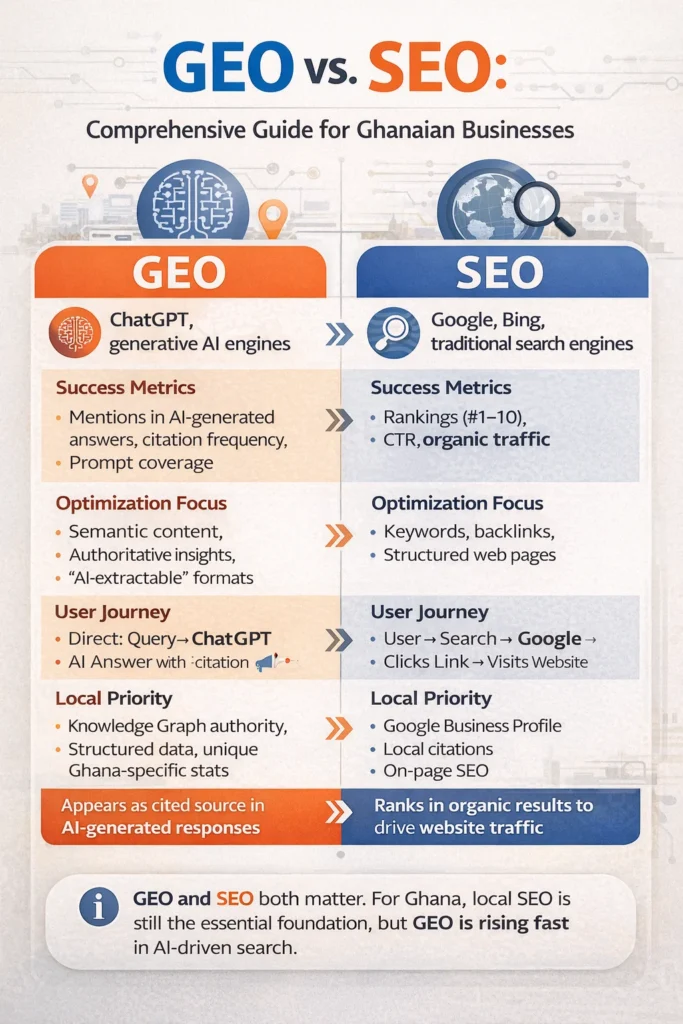
SEO vs. GEO: Side-by-Side Comparison Table
Understanding tactical differences between these approaches helps service-based businesses and e-commerce businesses allocate budgets strategically. This comparison clarifies where each methodology excels and how they complement one another.
| Aspect | SEO | GEO |
| Target platform | Google, Bing SERPs, traditional search engines | ChatGPT, Perplexity, Microsoft Copilot, SGE responses |
| Success metrics | Rankings (#1-10), CTR, organic traffic, conversions | AI citations, zero-click brand mentions, LLM references |
| Content approach | Keyword optimization, link-worthy assets, blog posts | Authoritative insights, fact-dense articles, and unique research |
| Technical requirements | Schema markup, page speed, mobile responsiveness, XML sitemaps | Quotable formats, entity markup, and clear source attribution |
| User journey | Multi-step: Search → SERP → Click → Website → Convert | Direct: Query → AI answer with brand citation (often zero-click) |
| Optimization focus | Backlinks, on-page signals, domain authority, and freshness | Semantic search, statistics, uncommon insights, expertise |
This side-by-side reveals how GEO is different from SEO in fundamental ways beyond surface tactics. Traditional SEO hunts rankings through proven formulas while GEO demands thought leadership that AI platforms recognize as authoritative. Neither obsoletes the other; instead, they address different audience segments and search behaviors.
Read more: SEO Strategies That Ghana Businesses Can’t Ignore in 2026
Why Generative AI Is Changing How People Search Worldwide
Machine Learning advancements transformed passive search boxes into conversational assistants that anticipate needs and synthesize comprehensive answers. This evolution accelerates globally, reshaping how billions discover information, products, and services. Ghana participates in this revolution as mobile connectivity enables AI access across West Africa.
Statistics illuminate the scale of disruption already underway:
- According to Capgemini, 58% of buyers now rely on AI recommendations during purchase research, bypassing traditional search entirely
- 13.14% of Google queries triggered AI Overviews in March 2025, nearly doubling previous months
- Search engine volume predicted to drop 25% by 2026 as AI chatbots intercept queries before they reach traditional search
The behavioral shift stems from the superior user experience that conversational interfaces deliver. Instead of scanning ten blue links, users receive synthesized answers combining multiple authoritative sources. Follow-up questions refine responses interactively, mimicking human expertise rather than merely retrieving information.
Knowledge Graph integrations empower AI platforms with structured facts about entities, relationships, and context. When someone asks “best fintech companies Ghana,” LLMs don’t just match keywords—they understand financial technology, geographic specificity, and implied quality assessments. This search intent optimisation delivers precisely what users need without trial-and-error clicking.
The 61% decline in organic CTR when AI summaries appear represents just the beginning. As AI-generated answers improve through continued training, fewer users will bother clicking source links at all. Brands absent from AI citations become invisible regardless of their Google rankings.
Digital marketing trends in Ghana mirror worldwide patterns as smartphone adoption democratizes AI access. The country’s 93.4% broadband mobile connections ensure that even rural users can consult ChatGPT for farming advice or business guidance. This accessibility makes AI search optimization urgent rather than experimental for forward-thinking companies.
Will GEO Replace SEO in a Few Years?
The binary question misses the nuanced reality unfolding across search landscapes. Is SEO still relevant with AI search dominating headlines? Absolutely—but its role evolves alongside rather than vanishing before generational change. Smart businesses embrace hybrid approaches that capture audiences across both ecosystems.
Traditional SEO maintains critical advantages AI platforms cannot replicate entirely:
- Transactional queries still drive high-intent traffic to e-commerce sites
- Local business marketing depends on Google Maps and location-based searches
- Niche long-tail keywords face less AI competition currently
- Users researching complex purchases often want direct website exploration
- Visual search and video content rely heavily on traditional indexing
However, GEO’s momentum cannot be ignored as platforms invest billions in conversational interfaces. The GEO services market hitting $7.3 billion by 2031, signals industry-wide recognition that AI citations matter as much as rankings. Businesses treat GEO as an optional risk of catastrophic visibility loss.
The likeliest scenario involves symbiotic coexistence where methodologies complement rather than compete:
- SEO drives bottom-funnel traffic for immediate conversions
- GEO builds top-funnel awareness through authoritative AI citations
- Traditional search serves specific product/service lookups
- AI assistants handle exploratory research and recommendations
The future of SEO in Ghana hinges on adaptation rather than abandonment. Agencies that integrate AI tools for SEO workflows while maintaining technical fundamentals will thrive. Those dismissing GEO as temporary hype will watch clients lose market share to invisible competitors dominating conversational search.
Mobile-heavy markets like Ghana face accelerated transitions as AI assistants embed directly into operating systems. When every smartphone defaults to conversational search, ignoring GEO becomes existential rather than strategic. Digital marketing agencies must master both disciplines to serve clients effectively.
Core GEO Strategies for Ghana Businesses
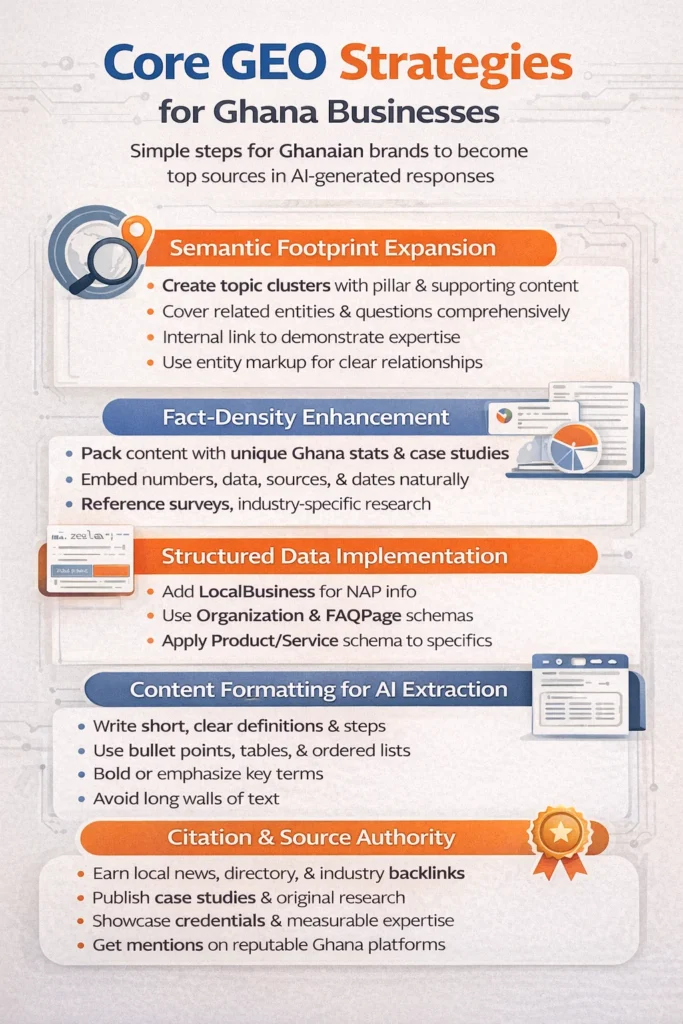
Implementing AI search optimisation strategies doesn’t require massive budgets or technical wizardry. These five approaches work for SMEs in Ghana regardless of industry, providing frameworks you can deploy immediately while scaling sophistication over time.
Strategy 1: Semantic Footprint Expansion
Semantic search prioritizes meaning and context over exact keyword matches, requiring broader topical coverage than traditional SEO demanded. Expanding your semantic footprint means addressing related entities, concepts, and questions comprehensively within your content ecosystem. AI models favor sources demonstrating deep expertise across topic clusters.
Start by mapping the conceptual neighborhood of your core offering. A fintech startup in Accra shouldn’t just target “mobile payments Ghana”—expand to digital wallets, transaction security, fintech regulations, merchant services, and customer financial literacy. Each related topic strengthens your semantic authority for AI platforms evaluating expertise.
Implementation tactics include:
- Creating topic clusters with pillar content and supporting articles
- Incorporating LSI keywords naturally throughout your writing
- Answering related questions that users might ask conversationally
- Linking internal content to demonstrate comprehensive coverage
- Using entity markup to help AI understand relationships
This strategy aligns perfectly with conversational search optimisation since AI assistants synthesize information from semantically rich sources. Your expanded footprint increases citation probability across varied query formulations.
Strategy 2: Fact-Density Enhancement
AI platforms prioritize content packed with verifiable statistics, unique research, and specific details over generic advice. Fact-density enhancement involves embedding more data points, case studies, and original insights per paragraph than competitors provide. This approach makes your content inherently more valuable and quotable.
Ghana-specific examples dramatically boost local relevance for targeting Ghanaian businesses. Rather than stating “internet usage grows rapidly,” specify “24.3 million internet users represent 69.9% penetration with 1.9% year-over-year growth.” Precise numbers signal authority that AI models extract confidently.
Tactics for increasing fact density:
- Conduct original surveys or research within your industry
- Reference credible statistics with inline citations and hyperlinks
- Include specific dates, percentages, and quantifiable outcomes
- Share proprietary data or unique case study results
- Update content regularly with the latest figures and trends
Avoid fluff phrases and generic observations that add zero informational value. Every sentence should advance the reader’s understanding through concrete, actionable, or data-backed insights.
Strategy 3: Structured Data Implementation
Structured data markup helps AI platforms parse your content’s meaning, entities, and relationships with technical precision. Implementing JSON-LD schemas transforms human-readable content into machine-understandable data structures that LLMs process efficiently. This technical foundation proves essential for local business visibility online.
Priority schema types for Ghanaian businesses include:
- LocalBusiness: Name, address, phone, hours for Google Maps integration
- Organization: Brand identity, logo, social profiles, corporate structure
- FAQPage: Common questions with authoritative answers AI can extract
- Product/Service: Detailed offerings with prices, availability, and specifications
- Review/Rating: Customer testimonials with structured rating data
Schema markup doesn’t guarantee AI citations alone but removes technical barriers preventing content extraction. Combined with semantic richness and fact density, structured data significantly increases citation probability for entities that AI models recognize confidently.
Strategy 4: Content Formatting for AI Extraction
Large Language Models parse and extract information more effectively from well-formatted content that signals importance through structural elements. Your formatting choices directly impact how easily AI platforms can identify quotable insights worth citing. Simple adjustments dramatically improve extraction success rates.
Optimal formatting techniques include:
- Short paragraphs (2-4 sentences) that isolate key ideas
- Bullet points for lists, benefits, or step-by-step processes
- Clear subheadings that signal topic shifts and hierarchy
- Bold text emphasizing critical terms and concepts
- Tables comparing data or features are systematically
- Numbered lists for sequential instructions or rankings
Avoid walls of text that bury insights within dense prose. AI models scan content patterns to locate authoritative statements; clear formatting acts as signposts guiding extraction algorithms toward your best material.
Strategy 5: Citation and Source Authority
AI platforms evaluate source credibility before citing content in responses. Building E-E-A-T signals (Experience, Expertise, Authoritativeness, Trustworthiness) establishes your brand as a reliable reference worth featuring. This strategy borrows from traditional SEO while emphasizing demonstrating expertise that AI models recognize.
Authority-building tactics include:
- Publishing bylines from recognized experts with credentials
- Citing credible sources with proper attribution and hyperlinks
- Earning backlinks from authoritative Ghana and international domains
- Maintaining updated, accurate information across all content
- Showcasing real case studies with measurable outcomes
- Building presence on industry platforms and publications
For local SEO vs AI search optimisation scenarios, authority signals include Google Business Profile optimization, local directory listings, and mentions in regional news outlets. The more external signals validate your expertise, the more confidently AI platforms cite your insights.
Essential SEO Strategies That Still Matter
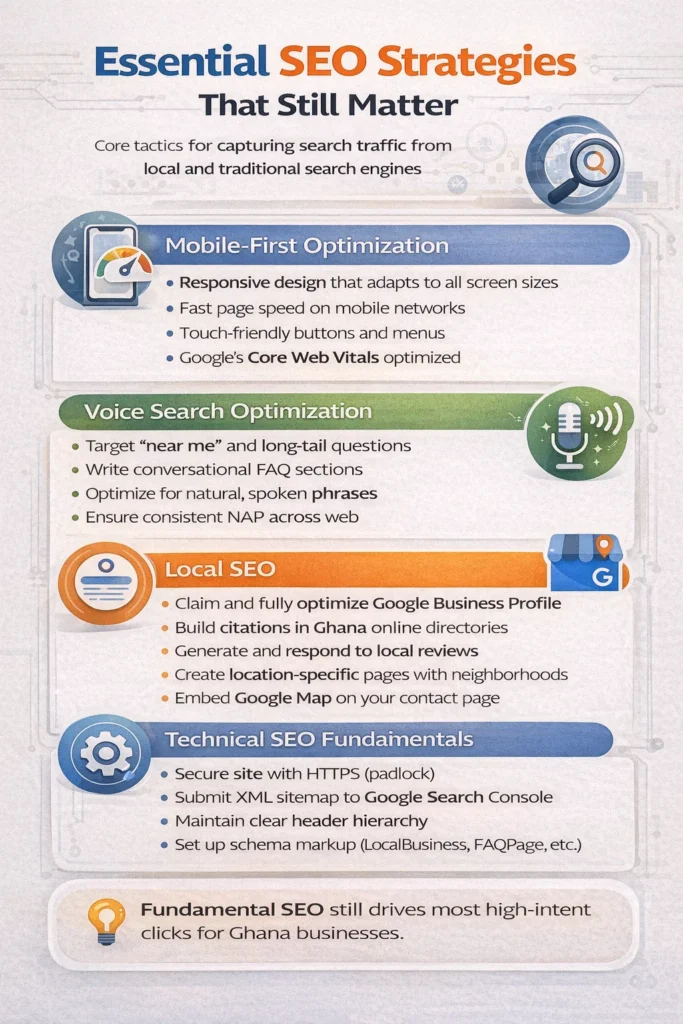
While GEO captures attention, traditional search engine optimisation continues driving the majority of organic traffic growth that Ghana businesses rely upon daily. These core tactics remain non-negotiable for capturing high-intent audiences actively seeking your products or services through conventional search engines.
Mobile-First Optimization for Ghana
Ghana’s 110% mobile connection penetration with 93.4% broadband coverage makes mobile-first optimization mandatory rather than optional. Google’s mobile-first indexing means your mobile site version determines rankings even for desktop searches. Poor mobile experiences devastate visibility regardless of desktop perfection.
Critical mobile optimization elements:
- Responsive design adapts seamlessly across screen sizes
- Core Web Vitals meet Google’s speed and interactivity thresholds
- Touch-friendly navigation with adequate button spacing
- Readable text without pinch-zooming requirements
- Compressed images and efficient code for fast loading on mobile networks
Test your site using Google’s Mobile-Friendly Test and PageSpeed Insights regularly. Ghana’s mobile users won’t tolerate slow-loading pages when competitors deliver instant experiences.
Voice Search Optimization
Conversational search optimisation extends beyond AI chatbots into voice assistants like Google Assistant and Siri. Users speak queries naturally—”Where’s the best jollof rice in Kumasi?”—rather than typing fragmented keywords. Optimizing for voice requires conversational content matching natural speech patterns.
Voice optimization tactics:
- Target long-tail conversational phrases and questions
- Create FAQ sections answering commonly spoken queries
- Optimize for local intent with neighborhood and landmark references
- Use natural language throughout content rather than robotic keyword insertion
- Ensure NAP (Name, Address, Phone) consistency across web properties
Voice search queries often carry immediate intent, making optimization valuable for local service business sectors like restaurants, clinics, and professional services seeking nearby customers.
Local SEO for Ghana Businesses
Local search optimisation Ghana campaigns capture customers searching for nearby solutions through Google Maps and localized SERPs. With mobile dominating search behavior, local visibility often determines which businesses customers visit physically or contact immediately.
Essential local SEO tactics:
- Claim and fully optimize your Google Business Profile with accurate information
- Gather customer reviews consistently across Google, Facebook, and local directories
- Build citations in Ghana-specific directories and industry listings
- Create location-specific content mentioning neighborhoods and landmarks
- Optimize for “near me” queries with clear service area definitions
Local SEO delivers unmatched ROI for service providers, retail shops, restaurants, and any business depending on foot traffic or regional customers. Neglecting local optimization surrenders market share to competitors appearing in map packs.
Technical SEO Fundamentals
Behind-the-scenes technical elements determine whether search engines can crawl, index, and rank your content effectively. Technical problems create invisible barriers blocking even exceptional content from appearing in results. Regular technical audits prevent catastrophic visibility loss from fixable issues.
Core technical requirements:
- HTTPS security certificates for trust and ranking signals
- XML sitemaps guiding crawlers to important pages
- Robots.txt files control crawler access appropriately
- Canonical tags preventing duplicate content penalties
- Structured data markup (discussed in the GEO section)
- Fast hosting with reliable uptime
- Proper header hierarchy and semantic HTML
SEO consultants typically handle technical audits for clients, but basic monitoring through Google Search Console alerts you to critical errors requiring immediate attention.
When to Focus on SEO vs GEO (Decision Matrix for Ghana)
Strategic resource allocation requires understanding which methodology delivers maximum impact for your specific business model and customer acquisition patterns. This decision framework helps Ghanaian businesses prioritize investments based on industry realities rather than generic advice.
| Business Type | Primary Focus | Secondary Focus | Strategic Reasoning |
| Local services (clinics, salons, trades, law) | SEO (70-80%) | GEO (20-30%) | Map packs and local searches drive walk-ins and appointments |
| e-commerce/retail | Balanced (50/50) | Both equally | AI shopping recommendations complement transactional searches |
| B2B / professional services | GEO (60-70%) | SEO (30-40%) | Authority in AI responses builds trust for high-consideration purchases |
| Content publishers/media | GEO (65%) | SEO (35%) | AI citations drive brand awareness without click dependency |
| Hospitality/tourism | Balanced (50/50) | Both equally | Travelers use AI research and traditional booking site searches |
This matrix provides starting guidelines rather than rigid rules. Your specific audience research and analytics should validate strategic emphasis over time.
If You’re a Local Service Business (Clinics, Salons, Trades, Law)
Local business marketing for service providers in Tema, Accra, or Kumasi depends overwhelmingly on traditional SEO tactics that capture immediate-intent searches. When someone’s plumbing breaks or they need legal counsel urgently, they search “emergency plumber near me” expecting map results with direct contact options.
Prioritize these SEO tactics:
- Google Business Profile optimization with complete information and photos
- Local citation building across Ghana directories and review sites
- Location-specific landing pages for each service area
- Customer review generation with systematic follow-up processes
- Mobile-click-to-call functionality for immediate contact
Allocate 20-30% effort toward GEO by creating authoritative content answering common client questions. A law firm publishing comprehensive guides on Ghana business registration might earn ChatGPT citations, building awareness before prospects need services urgently.
If You’re eCommerce / Retail / Hospitality
E-commerce businesses face balanced pressure from both search ecosystems as consumers research products through AI assistants before completing purchases on traditional websites. Hotels and retailers benefit from AI recommendation citations while maintaining transactional search visibility for direct bookings.
Balanced strategy components:
- SEO side: Product page optimization, category structures, technical e-commerce fundamentals
- GEO side: Detailed product descriptions with specifications, unique buying guides, and comparison content
- Review cultivation providing social proof across platforms
- Visual optimization for Google Shopping and image search
- Clear product data feeds for AI platforms to extract
This sector witnesses rapid AI shopping assistant adoption as 58% of buyers use AI recommendations. Being cited when AI suggests “best laptops under ₵5000 Ghana” captures shoppers early in consideration.
If You’re B2B / Professional Services
B2B businesses selling complex solutions with long sales cycles benefit dramatically from AI-driven content marketing that establishes thought leadership. Decision-makers research extensively through AI assistants before contacting vendors, making authoritative citations crucial for consideration set inclusion.
Prioritize GEO through:
- Comprehensive guides demonstrating deep industry expertise
- Original research and proprietary data your sector values
- Case studies with specific outcomes and measurable results
- Thought leadership content addressing emerging challenges
- Technical resources that AI platforms cite as authoritative references
Maintain SEO presence for branded searches and specific solution lookups, but recognize that B2B buyers increasingly discover vendors through AI research rather than keyword searches.
Integrated GEO + SEO Strategy Framework
The most successful digital marketing trends Ghana businesses embrace reject false dichotomies between old and new methodologies. Integrated approaches capture audiences across search ecosystems while building sustainable competitive advantages that competitors struggle to replicate.
Why You Need Both (Not Either/Or)
Specializing exclusively in either methodology creates dangerous blind spots as search behavior fragments across platforms. A content marketing strategy optimized only for Google rankings misses the 50% of users consulting AI assistants. Conversely, GEO-only approaches surrender high-intent transactional traffic that competitors capture through traditional search.
Synergies between approaches multiply effectiveness:
- SEO foundations (authority, backlinks, technical health) strengthen the GEO citation probability
- GEO’s fact-dense, comprehensive content often ranks well in traditional search
- Both methodologies reward E-E-A-T signals and expertise demonstration
- Integrated measurement reveals customer journey touchpoints across platforms
- Budget efficiency improves when content serves dual optimization purposes
How businesses in Ghana can optimise for AI search while maintaining SEO strength requires unified strategies treating both as complementary rather than competing priorities.
Step-by-Step SEO and GEO Implementation Roadmap
Implementing integrated optimization systematically prevents overwhelm while building momentum through quick wins before tackling complex technical elements. This roadmap works for SMEs in Ghana regardless of current optimization maturity.
Phase 1: Foundation (Weeks 1-4)
- Conduct a comprehensive content and technical audit, identifying gaps and opportunities
- Research target keywords for SEO alongside semantic topic clusters for GEO
- Optimize Google Business Profile and local citations for immediate visibility
- Implement basic schema markup for organization and local business entities
- Establish baseline metrics tracking both traditional and AI visibility
Phase 2: Content Enhancement (Weeks 5-12)
- Revamp existing high-traffic pages with fact-density and semantic expansion
- Create authoritative pillar content covering core topics comprehensively
- Develop FAQ sections answering conversational queries naturally
- Add structured data markup to all key content types
- Build internal linking structures connecting related content
Phase 3: Authority Building (Weeks 13-24)
- Launch original research or surveys generating unique, citable data
- Pursue strategic backlinks from authoritative Ghana and international sites
- Publish guest contributions on industry platforms, demonstrating expertise
- Systematize customer review generation across platforms
- Monitor AI citations and adjust content based on extraction patterns
Phase 4: Optimization & Scaling (Ongoing)
- A/B test different formatting approaches for AI extraction success
- Update existing content regularly with the latest statistics and insights
- Expand topic coverage based on semantic gap analysis
- Refine technical elements as search algorithms evolve
- Train team on integrated optimization principles for sustained execution
How to rank in AI search results requires patience as LLMs retrain on updated web data periodically. Allow 3-6 months before expecting significant AI citation increases while traditional SEO metrics improve more rapidly.
Conclusion
The search landscape transformation isn’t coming—it’s here, reshaping how millions discover businesses daily. Ghana’s surging digital adoption creates unprecedented opportunities for companies mastering both Generative Engine Optimization and traditional SEO before competitors catch on. The window for early-mover advantages closes rapidly as awareness spreads.
GEO vs SEO differences demand understanding rather than choosing sides in false battles. Your customers don’t care which methodology drove awareness; they simply expect to find you when seeking solutions. Integrated strategies capture audiences wherever they search, building resilient visibility immune to platform-specific algorithm volatility.
Success requires moving beyond reactive tactics toward proactive adaptation of emerging technologies. AI search optimisation represents not just another marketing channel but a fundamental shift in information discovery patterns. Businesses treat it as an optional risk invisible futures, where competitors dominate conversational interfaces entirely.
The roadmap ahead challenges comfortable assumptions while rewarding bold experimentation with measurement-driven refinement. Start with foundational elements—mobile optimization, local SEO, and semantic content expansion—before tackling advanced GEO tactics. Progress compounds as technical improvements strengthen both methodologies simultaneously.
WebSys Technology specializes in integrated SEO and GEO strategies tailored for Ghana’s unique digital landscape and business environment. Our proven frameworks combine local market expertise with cutting-edge AI optimization techniques, delivering measurable visibility and traffic growth. Ready to dominate both traditional search and AI-powered discovery? Contact WebSys Technology today for your comprehensive SEO and GEO audit. Let’s future-proof your digital presence together.
GET IN TOUCH