

Ghanaian businesses thrive in a booming Ghanaian technology sector, yet cyber threats cost GH₵14.94 million in the first half of 2025 alone. Secure IT infrastructure stands between you and devastating data breaches or downtime.
Follow these core steps to establish it successfully. Start your IT risk management with thorough asset mapping. Build network security layers, including routers and switches. Enforce zero-trust architecture through strict access controls and MFA. Secure endpoints and cloud platforms against malware. Use encryption for data protection, set up a SIEM for threat detection, embed security training into operations, and comply with the Cybersecurity Act 2020 requirements.
Such IT security solutions for businesses address local challenges, such as mobile fraud, which accounts for 42.5% of incidents. They foster secure IT operations that support rapid digital growth without fear. Ghanaian SMEs gain a competitive edge when infrastructure protection matches their ambition and scale.
What “Secure IT Infrastructure” Means for a Ghanaian Business
Ghanaian businesses handle sensitive data through mobile money and cloud apps every day. Secure IT infrastructure goes beyond basic antivirus to protect networks, endpoints, and people against local threats like online fraud. It ensures smooth operations despite rising data breaches in the Ghana technology sector.
These five key elements work together to create lasting protection that fits your business perfectly.
- Holistic network security creates layered defenses around your entire system. Firewalls block outsiders while intrusion detection systems spot trouble inside your servers and routers. Ghanaian SMEs rely heavily on shared Wi-Fi networks, so this setup prevents unauthorized access to customer data. For example, segmenting guest networks from payment systems helps stop threats from spreading quickly.
- Business continuity planning keeps you running during ransomware attacks. Recent stats show Ghana lost GH₵19 million to cybercrime in the first nine months of 2025. Secure business IT systems include disaster recovery systems that quickly restore operations. Think of it as a spare tire for your digital highway—always ready when trouble hits.
- Compliance with Ghana Cybersecurity Authority standards builds trust with clients. The Cybersecurity Act 2020 demands strong IT security framework practices. Your setup aligns with the Data Protection Commission Ghana rules, avoiding fines while showcasing reliability to partners.
- Scalable growth supports the Ghana technology sector boom at 13.1% quarterly. Secure cloud infrastructure, such as AWS or Microsoft Azure, grows with your business without introducing new risks. This means handling more transactions securely as your customer base expands across Accra and beyond.
- A people-focused cybersecurity strategy trains staff to defend against phishing attacks, which account for 36% of incidents. Everyone becomes a defender, reducing insider threats from simple mistakes. Regular drills make secure IT operations second nature in your daily workflow.
Why Ghanaian Businesses Cannot Afford to Ignore It
Cybersecurity for businesses in Ghana faces exploding risks as digital adoption skyrockets. Businesses lost GH₵23.3 million to cybercrime last year, with attacks against firms up 43%. IT infrastructure protection isn’t optional—it’s survival in this landscape. Ignore it, and you risk everything from profits to reputation.
These stark realities show exactly why Ghanaian companies must act now to protect their future.
- Massive financial hits drain resources fast. Ghana saw GH₵14.94 million vanish from fraud and breaches alone in early 2025. Small shops using mobile money lose transaction fees daily when systems go down. Strong business cybersecurity strategy stops these leaks before they grow.
- Attack volume surges overwhelm unprepared teams. Cyber incidents jumped 52% in the first half of last year, per official reports. Ghanaian SMEs suffer most from malware protection gaps in shared devices. Competitors with solid IT security solutions for businesses stay online and steal your market share.
- Sector-wide damage hits banks, hospitals, and schools hard. Credentials from 35 key organizations were recently posted on the dark web. Data breaches expose patient records or financial details, triggering lawsuits under the Data Protection Act 2012. Secure IT infrastructure shields your operations from such fallout.
- Lost growth opportunities hurt long-term. The ICT sector grew by 21.3% last quarter, but unprotected firms missed out oncontracts. Clients demand cyber resilience before partnering in Ghana’s digital economy. Build it now to tap into that 8% GDP contribution from mobile services.
- Reputation takes lasting blows from incidents like cyberbullying at 25% of cases. Customers flee after publicized hacks, per local news. IT security for businesses rebuilds trust through transparent protections and quick recovery, keeping loyal clients coming back.
Read more: Securing Your Business: Top Network Security Solutions for Companies in Ghana
How Can Ghanaian Businesses Build a Secure IT Infrastructure?
Ghanaian firms can create a secure IT infrastructure through eight practical steps tailored to local needs. These address cyber threats, such as mobile fraud, while meeting the requirements of the National Cyber Security Policy. Start today to strengthen your enterprise security architecture and compete confidently.
These steps illustrate how businesses can implement layered cybersecurity and strengthen their IT infrastructure against modern threats.
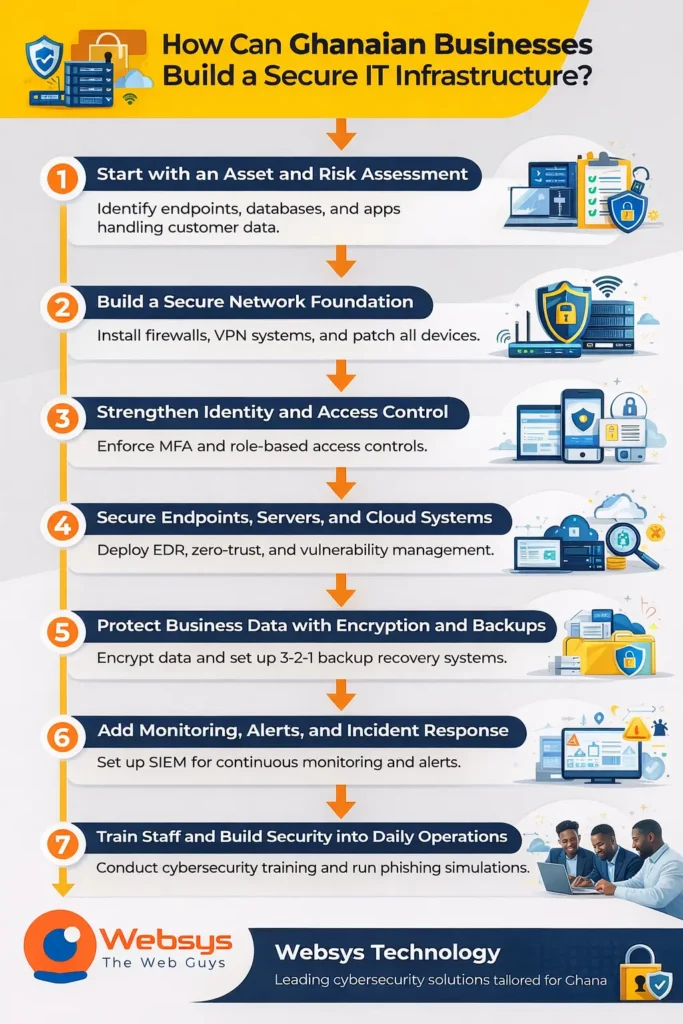
Step 1 — Start with an Asset and Risk Assessment
Cyber risk assessment reveals your weak spots first. List all endpoints, databases, and apps handling customer data. Ghanaian SMEs often miss shadow IT, like personal laptops on company Wi-Fi. This IT risk management reduces potential breaches by 70% by focusing efforts wisely. CERT-GH recommends annual scans to stay ahead.
Step 2 — Build a Secure Network Foundation
Network security forms your first line of defense against outsiders. Install firewall protection on routers and network switches to filter traffic smartly. VPN systems are common in Ghana’s hybrid setups. Regular patch management closes 80% of known vulnerabilities. Your foundation turns shaky connections into a locked gate.
Step 3 — Strengthen Identity and Access Control
Identity and access management stops account takeovers in their tracks. Roll out multi-factor authentication (MFA) everywhere— it blocks 99% of attacks. Set role-based rules so staff access only what they need. Phishing attacks drive 36% of Ghana’s fraud, so strong passwords matter. Lock doors tightly to protect privileged access management.
Step 4 — Secure Endpoints, Servers, and Cloud Systems
Endpoint security covers laptops, POS machines, and cloud platforms. Deploy endpoint detection and response (EDR) to catch sneaky malware early. Ghanaian retailers share cloud resources, raising risks, so they use a zero-trust architecture. System vulnerability management keeps Amazon Web Services (AWS) or Google Cloud safe. Every device becomes a vigilant guard.
Step 5 — Protect Business Data with Encryption and Backups
Secure data management uses encryption for data at rest and in motion. Set up 3-2-1 backup and recovery systems—three copies on two media, one offsite. Unauthorized access hit 12% of incidents here, making this essential. Ransomware can’t hold your info hostage when recovery stays simple and fast.
Step 6 — Add Monitoring, Alerts, and Incident Response
Security monitoring with SIEM watches traffic 24/7 for odd patterns. Automated alerts notify teams instantly about threat detection. Build incident response planning playbooks to cut breach costs by half. Ghana’s 52% rise in incidents demands quick action. Stay watchful to neutralize dangers before they spread.
Step 7 — Train Staff and Build Security into Daily Operations
Staff training stops human error behind most breaches. Run phishing attack simulations and appoint security champions per department. Cyberbullying often starts with clicks on bad links. Make information security management part of every meeting. Your team becomes the strongest defense.
Step 8 — Align with Ghana’s Compliance Expectations
Follow IT governance under the Cybersecurity Act 2020 and NCA guidelines. Ghana scores 86.69%, ranking third in Africa. Regular audits prove your regulatory compliance. Fines hurt worse than hacks, so document your security policy implementation. Stay legal while building true cyber resilience.
The 90-Day Cybersecurity Roadmap for Ghanaian Businesses
This cybersecurity roadmap for companies delivers a secure IT infrastructure without chaos. Ghanaian businesses gain quick protection first, then deeper controls, and lasting strength. Follow it to transform vulnerabilities into a fortified IT infrastructure in Ghana.
Days 1–30: Quick Wins
Patch all software immediately since old flaws cause 80% of exploits. Enable MFA on email and banking portals right away. Test staff with fake phishing emails. Inventory hidden devices for full visibility. These moves quickly block the most common cyberattacks on business systems.
Days 31–60: Core Controls
Deploy intrusion prevention systems (IPS) and endpoint security. Segment networks to limit breach spread. Launch encrypted backup and recovery systems. Write and test incident response planning scripts. Drills ensure your team moves smoothly under pressure. Core setup creates reliable infrastructure hardening.
Days 61–90: Resilience and Compliance
Deploy SIEM for round-the-clock threat intelligence. Train every employee on policies. Run your first vulnerability scanning audit. Test with penetration simulations on key assets. Document everything for the Data Protection Commission Ghana reviews. You now enjoy robust business continuity planning.
Read more: Cloud IT Services vs. On-Premise Solutions: What’s Best for Your Business in Ghana?
Common IT Security Mistakes Ghanaian Businesses Should Avoid
Many Ghanaian firms stumble on basic errors that invite disaster. Weak setups fuel 36% fraud rates, while skipping backups dooms recovery. Smart IT infrastructure protection strategies dodge these traps easily. Build a lasting cybersecurity strategy by learning from others’ slips.
- Relying on a single password anywhere is vital, since MFA stops nearly all takeovers.
- Skipping patch management, leaving 80% of systems compromised.
- Neglecting mobile money safeguards amid GH₵518 billion monthly flows.
- Allowing unchecked shadow IT to quietly bypass all protections.
- Lacking incident response planning, which doubles breach expenses every time.
- Ignoring staff drills when human slips cause 74% of security breaches.
- Overlooking CERT-GH compliance, inviting fines on top of damages.
Read more: How to Ensure Your Business’s IT Systems Are Future-Proof with Managed IT Services
Final Thoughts
Ghana’s digital transformation security opens huge doors, but cybersecurity in Ghana demands action now. With ICT growth at 17% per quarter and GH₵19 million lost to crime last year, a secure IT infrastructure protects your edge. You’ve got the steps, roadmap, and warnings—use them to safeguard critical IT resources and fuel expansion.
Ready to strengthen your setup? WebSys Technology delivers comprehensive IT security solutions tailored for businesses in Ghana. Our experts build secure IT infrastructure for businesses, from cyber risk assessments to full cloud access security broker (CASB) deployments. Claim your free risk scan worth GH₵5,000 today—it spots vulnerabilities in mobile money links and cloud gaps.
Local teams know Ghana Cybersecurity Authority rules inside out. Contact WebSys Technology for your custom 90-day plan. Start maintaining secure business operations—don’t let cyber threats steal your success!
GET IN TOUCH