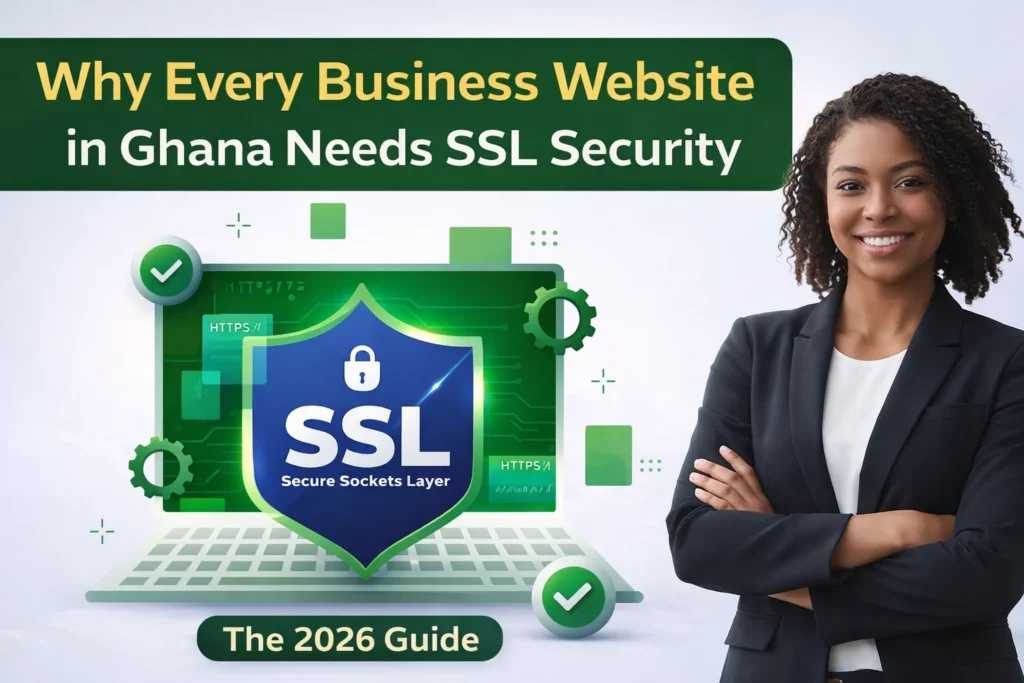
Running a business website in Ghana means you handle customer data daily. SSL security keeps that information safe from prying eyes. You need SSL security because cyber 43% of Ghanaian SMEs, resulting in a loss of GHS 59.9 million last year. Without it, hackers can easily steal payment details or personal info.
HTTPS protocol encrypts everything, showing a padlock that builds online trust. Google favors secure sites, too, boosting your visibility. Browsers warn visitors about unsafe pages, driving them away fast. Payment processors demand it for PCI compliance. Ghana’s Data Protection Act expects you to safeguard data properly.
Skip SSL certificates, and you risk fines, lost sales, and a bad reputation. Forward-thinking businesses in Accra or Kumasi have already locked down their sites. They enjoy higher conversions and peace of mind. You deserve the same edge in Ghana’s growing digital market. Let’s dive into why SSL security powers your success right now.
What Is SSL & How It Works
SSL security uses TLS encryption to scramble data between your site and visitors. Your server and browser perform an SSL handshake quickly. They exchange keys, verify identities, then secure all traffic.
- During the SSL handshake, your site sends a digital certificate from a trusted authority such as DigiCert or Comodo.
- The browser checks this website’s authentication instantly. If valid, it creates a unique session key for data encryption.
- Now every bit of info—like login details or orders—turns into unreadable code mid-transit. Hackers see gibberish only.
- You spot it by the padlock icon and “https://” in the address bar across Google Chrome, Firefox, or Safari.
- In Ghana, where 15-30% of sites still run HTTP, this gap leaves businesses exposed daily.
For example, picture a hypothetical Accra boutique owner submitting a form without HTTPS protocol—attackers can easily intercept it. This illustrates the risk clearly, not a real case.
Top 7 Reasons Ghanaian Businesses Need SSL Security
Ghanaian businesses face rising cybersecurity risks amid online growth. SSL security tackles these head-on with proven protection. Here are the top seven reasons you need it now.
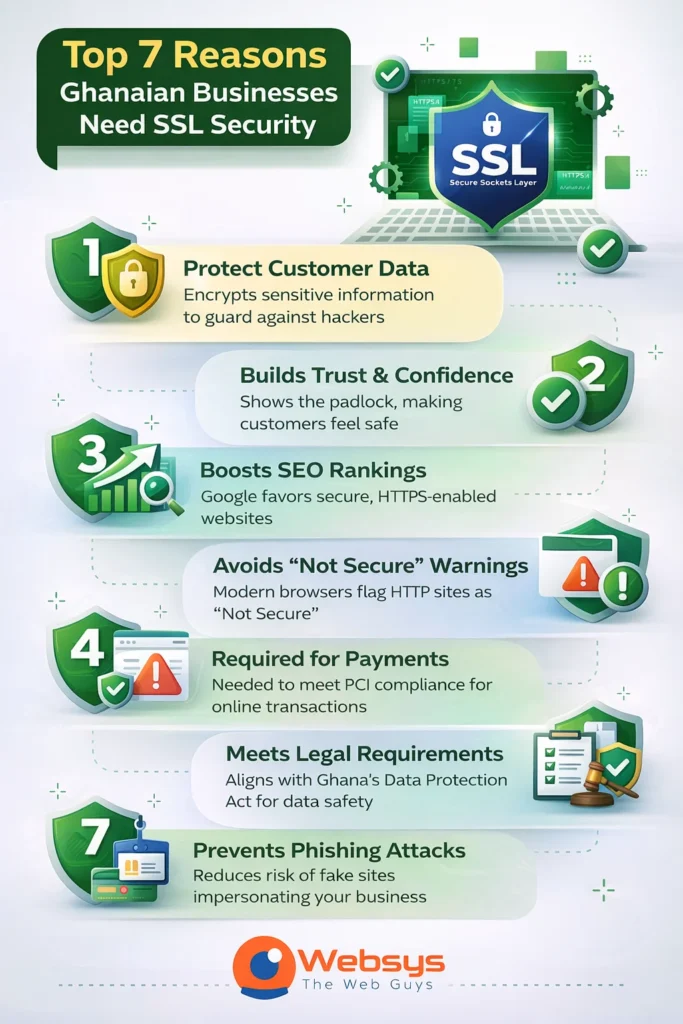
Protect Customer Data from Hackers
Hackers often target Ghanaian SMEs, with 43% hit by attacks recently. Data encryption stops man-in-the-middle attacks dead. Your customers’ details stay safe during transmission.
- Without SSL/TLS certificates, snoopers can easily grab emails, addresses, or passwords.
- Web encryption scrambles everything, so even Wi-Fi hackers in cafes get nothing useful.
- Ghana’s Cyber Security Authority noted 1,255 incidents last year alone. Don’t join that list.
Builds Trust and Confidence with Local Customers
Customers in Kumasi or Accra check for the padlock before buying. Visible website trust indicators lift conversions by 11-42% globally. Ghanaians, wary of fraud, abandon insecure sites fast—84% bail on unencrypted pages.
- The green padlock screams “safe” to first-time Mobile Money shoppers.
- Studies show that trust seals noticeably boost sales for e-commerce stores.
- Your site feels professional, encouraging repeat visits and word-of-mouth referrals.
SEO Advantages — More Visibility on Google
Google has treated the HTTPS protocol as a ranking signal for years. Secure sites climb higher in search results for Ghanaian users. You gain more traffic without extra ad spend.
- SSL security gives a small but steady edge over HTTP rivals.
- With digital transformation booming in Ghana, visibility matters more than ever.
- Optimized sites load faster, too, pleasing Google’s algorithm further.
Avoid “Not Secure” Browser Warnings
Modern browsers like Chrome flag HTTP pages harshly, especially forms. Users heed warnings now—fewer than 25% click through anymore. That label scares away potential customers instantly.
- Shoppers see “Not Secure” and close tabs without hesitation.
- No more lost leads from bounce rates spiking on contact pages.
- Everyone uses updated browsers, so warnings hit every visitor.
Required for Payment Acceptance (PCI Compliance)
Processors enforce PCI compliance strictly for card payments in Ghana. SSL encryption meets TLS standards and bans weak, older protocols. Fraud cost GHS 10 million last year—don’t contribute.
- You need strong keys, such as 2048-bit RSA, for secure online transactions.
- Accept cards or Mobile Money confidently, without the risk of rejection.
- Gateways quickly shut down non-compliant sites.
Meet Basic Legal & Regulatory Expectations
Ghana’s Data Protection Act requires you to reasonably secure personal data. SSL certificates count as industry best practice for transit protection. Regulators expect nothing less from compliant businesses.
- Implement safeguards or risk fines under Act 843 guidelines.
- Processors must follow suit to keep your entire chain secure.
- Stay ahead of Ghana’s government IT policies, which are evolving fast.
Enables Use of Future-Ready Web Technologies
Browsers lock advanced features to HTTPS-only, such as HTTP/2 speed boosts. Secure websites, PWAs, and modern APIs seamlessly. Prepare for 200-day certificate lifespans starting next week.
- Enjoy faster loads and app-like experiences for mobile users.
- Future updates demand web security certificates—get ready now.
- Ghanaian SMEs are adopting early to gain a competitive edge online.
Case Study / Example
A 2019 peer-reviewed study audited Ghanaian e-commerce websites for security gaps. Researchers used Nmap penetration testing on active retail sites. Many lacked proper SSL encryption or certificates, exposing customer data to theft.
These sites faced man-in-the-middle attacks easily. Hackers could steal credit card details, login credentials, or personal information during form submissions. The study highlighted weak HTTPS protocol as a core vulnerability across Ghana’s online shops. Fraud risks spiked in the absence of dedicated secure socket layer protection.
Businesses adopting SSL certificates saw immediate fixes. They blocked interception and built website trust. Global parallels show 42% conversion lifts from such security signals.
| Metric | Without Proper SSL | With SSL Implemented |
| Data Exposure Risk | High (Nmap detected) | Eliminated |
| Customer Data Theft | Vulnerable to attacks | Encrypted fully |
| Trust & Conversions | Low patronage | Up 11-42% |
| Compliance Status | Non-compliant | Meets standards |
Final Thoughts: Why Your Website Needs SSL Security Now
Every business website in Ghana needs SSL security to beat cyber threats that hit 43% of SMEs hard. Hackers can’t steal customer data when TLS encryption scrambles everything in transit. You build online trust fast with that padlock—84% of shoppers ditch unsafe sites. Google boosts your rankings, too. Browsers stop scaring visitors away. PCI compliance unlocks payments legally. Ghana’s Data Protection Act demands it. Secure your site today and watch conversions climb confidently.
Ready to Secure Your Website?
Don’t wait for a breach to strike your business. WebSys Technology delivers managed SSL certificates built for Ghanaian businesses like yours.
Why choose WebSys SSL?
- Instant Setup: Go live in minutes, not days
- Auto-Renewal: Never miss the new 200-day cycle
- Malware Protection: Extra layer beyond basic SSL
- Local Support: Accra-based team understands Ghana’s needs
- Perfect for SMEs: Affordable plans for any budget
- Mobile Money Ready: PCI-compliant for all payments
Get Your SSL Certificate Now – Protect customers, boost rankings, and start converting visitors into sales today. Join thousands of secure Ghanaian businesses. Your secure website awaits!
GET IN TOUCH
Get Your SSL Certificate
FAQ
Browsers now require HTTPS for safety. It encrypts data and shows trust signals. Without it, you lose visitors and face penalties.
SMEs report a 43% annual attack rate. Fraud hit GHS 10 million recently. Weak sites fuel phishing and data theft nationwide.
Business sites absolutely do for trust and compliance. Even blogs benefit from data protection against evolving threats.
SSL handshake verifies identities first. Then TLS encryption scrambles the info in transit. Ghana hackers can’t intercept orders or details anymore.
Domain Validation suits basics fast. Organization Validation adds business checks for trust. Extended Validation shows green bars—ideal for e-commerce in Ghana.
Warnings scare users away quickly. Google ranks you lower. Hackers steal data, risking fines under the Data Protection Act.