

Ghana’s digital economy is growing at a remarkable pace. With over 26.3 million internet users and an e-commerce market that crossed $1 billion in 2025, Ghanaian businesses are racing to establish a strong online presence. Web hosting is usually the first decision they make — and unfortunately, many choose based on price alone.
Cheap web hosting looks like a smart way to cut startup costs. But in reality, it silently drains your revenue, damages your search engine rankings, and leaves your website dangerously vulnerable. That tempting low-cost plan carries a hidden price tag most business owners don’t see until it’s too late. Slow servers push customers away before they even browse your products.
Additionally, unexpected downtime kills sales on your busiest days. And renewal charges can double your bill without any warning. Saving a few cedis on hosting today can cost your Ghanaian business far more tomorrow.
What “Cheap Web Hosting” Really Means
Cheap hosting isn’t just about a low monthly price — it’s about what providers quietly cut behind the scenes to offer that price. When a hosting company charges $2 or GHS 20 a month, they offset that cost by cramming hundreds of websites onto a single server. Those cuts directly hit your website’s speed, security, and reliability where it hurts most.
Here’s what cheap web hosting actually looks like under the hood:
- Oversold shared servers — Hundreds of websites compete for the same CPU and memory. When traffic spikes on any one of them, every site on that server slows down — including yours. This is called resource depletion, and it’s extremely common in budget plans.
- Outdated server infrastructure — Budget providers skip investments in modern NVMe SSDs, server-level caching, and CDN integration. The result is sluggish load times even on low-traffic days.
- Deceptive “unlimited” promises — That unlimited bandwidth and storage claim sounds great until you read the fine print. Fair-use caps are buried deep in the terms, and hitting them gets your site throttled or suspended without warning.
- Zero performance optimization — There’s no built-in load speed optimization or intelligent resource management on most cheap plans. You’re completely on your own when performance drops.
- The renewal pricing trap — Providers like GoDaddy advertise plans from $5.99/month but renew at $9.99/month — a 67% price increase for the same service. Some providers, like Hostinger, go from $1.99 to $3.99/month — a full 100% jump.
📝 For illustration purposes only — not a real case: A small boutique in Accra signs up for a GHS 20/month plan. It looks like a great deal at first. But when Year 2’s renewal invoice arrives, the price has doubled — and now includes separate charges for SSL and daily backups that weren’t clearly disclosed at signup.
Read more: Why WordPress Websites Need Optimized Hosting in Ghana
The True Cost of Cheap Hosting: How It Affects Your Business Value
The checkout page never tells the full story with cheap hosting. Real costs show up after you’ve launched your site and started building your business around it. In the form of lost sales, frustrated customers, compromised data, and hours burned troubleshooting problems your hosting provider caused in the first place.
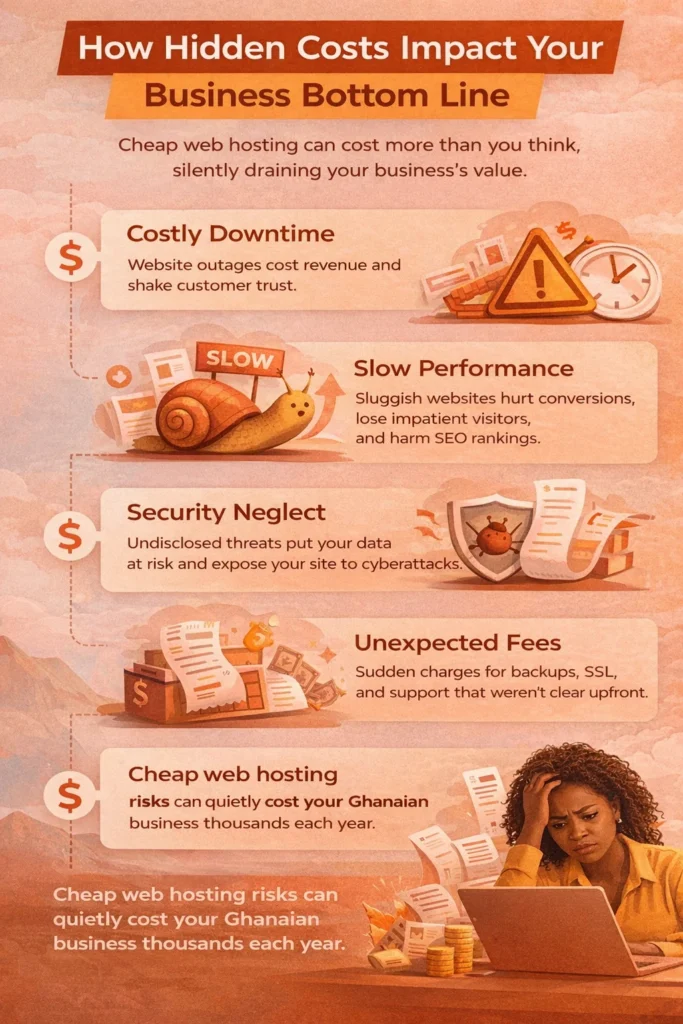
Downtime = Loss of Revenue & Trust
Every minute your website is offline, your business is bleeding money. For small and medium businesses, downtime costs anywhere between $137 to $427 per minute, according to IDC research cited consistently across industry reports. Budget hosting providers average only 99.5% uptime, compared to the 99.9% that quality plans deliver. That small gap translates into roughly 35 extra hours of downtime every single year.
A real Ghanaian example drives this home. A mid-sized retail business in Accra was losing an estimated GHS 200,000 per month due to frequent internet and system outages that froze its POS systems and wiped out online transactions. After switching to a reliable solution with a 99.9% uptime guarantee, they recovered GHS 184,000 of that monthly loss. (Source: Boldnet Ghana) Beyond the money, repeated downtime destroys customer trust. Once visitors encounter a broken or unavailable site, 88% won’t return — according to HubSpot’s 2025 research.
Slow Performance Hurts Conversions & SEO
Website performance isn’t a technical detail — it’s directly tied to your revenue. Research from Portent shows that at a 1-second load time, conversion rates hover near 40%. By 5 seconds, they fall to nearly half. A single second of delay can reduce conversions by up to 7%. That’s not a statistic to ignore if your site drives sales.
For Ghana specifically, this matters even more. A significant number of Ghanaian internet users browse on mobile devices over 3G or 4G connections. A slow site on those networks loses customers fast. Jumia Travel experienced this firsthand across Sub-Saharan Africa. After a full mobile performance optimization of their site, they achieved a 33% increase in conversions and a 50% drop in bounce rates — a direct result of optimizing their site speed for slow network connections. For Ghanaian businesses operating on similar networks, the performance gap between cheap and quality hosting creates the same problem.
Security Risks & Vulnerability Exposure
Budget providers typically skip the security layers that genuinely protect your business. There’s no Web Application Firewall, no malware scanning, and no account isolation between websites sharing the same server. When one site on that server gets compromised, attackers can move laterally and hit yours next.
This isn’t a distant theoretical risk for businesses in Ghana. Ghana’s Cyber Security Authority (CSA) reported 2,008 cyber incidents in H1 2025 alone — a 52% increase over all reported cases in 2024. Cybercrime cost Ghana GH¢14.94 million in just the first six months of 2025. Globally, 43% of all cyberattacks target small businesses, and 60% of those businesses shut down within six months of a serious breach. Website security isn’t optional for any business operating online in Ghana today — it’s a survival.
Limited Support = Expensive Downtime & Troubleshooting
When something breaks on a cheap plan, quick help is rarely available. Most budget providers restrict support to email-only tickets with 12-hour or longer response windows. Meanwhile, your site stays down, and your customers go elsewhere.
📝 For illustration purposes only — not a real case: A clothing store in Kumasi experiences a broken checkout page on a Friday evening — right before the weekend rush. Their budget host’s next available support slot is Monday morning. That’s an entire weekend of lost sales caused entirely by slow support and troubleshooting for hosting.
Read more: How Fast Hosting Can Increase Online Sales in Ghana
Hidden Fees & Unexpected Charges
The advertised price and the real price are rarely the same. According to BoostedHost (2025), nearly half of small businesses pay more than the advertised rate within their first year. Here’s what typically gets added:
- SSL certificate — $50–$200/year as an extra charge, despite being a basic security requirement for any site
- Daily backups — $5–$50/month as a paid add-on, yet critical for data protection after crashes or attacks
- Malware scanning — $10–$30/month extra, standard on quality plans
- Domain privacy (WHOIS) — $14.99/year extra, often included for free elsewhere
- Renewal price hikes — some providers raise rates 67–100% after the first billing term ends, with zero meaningful notice
Stack all of that up, and your “cheap” plan stops looking cheap very quickly.
How Does Cheap Web Hosting Affect Your SEO and Online Visibility?
Your hosting provider is a direct SEO signal. Google measures speed, uptime, and security as active ranking factors — and cheap hosting routinely fails on all three. A slow, unsecured, or frequently offline website doesn’t just frustrate visitors; it gets systematically pushed down search results while your competitors climb above you.
Here’s exactly how poor hosting quietly kills your SEO ranking:
- Core Web Vitals failure — Google requires your Largest Contentful Paint (LCP) to load within 2.5 seconds. Overloaded shared servers routinely miss this, directly hurting your position in search results. You can verify this damage using Google PageSpeed Insights and Google Search Console.
- Slow Time to First Byte (TTFB) — When Google’s crawler visits your site and the server responds slowly, Google indexes fewer pages per crawl. Your content stays invisible for longer.
- Downtime during crawl cycles — If Google’s bot visits during an outage, it logs your site as unavailable. Do this repeatedly, and your rankings start dropping for no obvious reason.
- High bounce rates signal low quality — Slow pages drive users away immediately. Google reads that high bounce rate as a sign of poor content relevance, which pushes your site further down results pages.
- No SSL equals a ranking penalty — Sites without an SSL certificate get flagged as “Not Secure” in Chrome and receive an active ranking disadvantage from Google. On cheap hosting, SSL is often an extra paid for.
- Ghana’s mobile-first reality — Over 72% of Ghanaian users browse on mobile over 3G or 4G networks. Poor server infrastructure widens that load time gap even further for your local audience, directly cutting your visibility in Ghanaian search results.
When Cheap Hosting Might Be Acceptable
Cheap hosting isn’t the wrong answer in every situation. A handful of specific circumstances genuinely suit a basic plan — but these are the exception, not the standard for any business focused on sustainable growth.
Here’s when a budget plan actually makes sense:
- Personal hobby blogs with no revenue dependency and minimal traffic expectations whatsoever
- “Coming soon” placeholder pages that aren’t yet driving transactions or capturing leads
- Developer sandbox environments are built purely for testing and are never customer-facing
- Very early-stage startups with no live transactions and single-digit daily visitors
- Student or learning projects created purely for skill development with zero commercial intent
The key distinction is straightforward. The moment your website drives even one sale per week, cheap hosting risks start costing you more than you’re saving. Once revenue is tied to your site’s performance, quality hosting stops being a luxury and becomes a direct investment in your business’s growth.
Cost Comparison: Cheap vs Quality Hosting
Numbers tell the clearest story. When you stack the total cost of ownership side by side, the savings from cheap hosting evaporate quickly — especially once you account for what quality plans include as standard features.
| Factor | Cheap Hosting | Quality Hosting (WebSys Web Hosting Plus) |
| Average uptime | 99.5% | 99.9% |
| Extra downtime per year | ~35 hours | ~8.7 hours max |
| SSL Certificate | Extra ($50–$200/yr) | Included |
| Daily Backups | Extra ($5–$50/mo) | Included |
| Malware Scanning | Extra ($10–$30/mo) | Included |
| Domain Privacy | Extra (~$14.99/yr) | Included |
| Renewal Pricing | Doubles/triples in Year 2 | Transparent & stable |
| Support | Email only, 12+ hrs wait | Priority, fast response |
| Avg. hidden annual loss (SMBs) | ~$5,600 | Minimal |
Despite appearing to save $10–$15 per month, cheap hosting costs small businesses an average of $5,600 per year in lost revenue, security fixes, and technical remediation, according to Web Rocket. Quality hosting, on the other hand, typically delivers full ROI within 6 to 12 months through improved uptime, better conversion rates, and security savings alone. For a Ghanaian e-commerce store generating GHS 1,000/day, the 35-hour downtime gap alone amounts to roughly GHS 1,458 in entirely preventable annual losses — before accounting for any security incidents or missed conversions due to slow load times.
How to Choose the Right Hosting Plan
Choosing the right business website hosting means understanding your current needs and where your business is heading. Don’t just compare prices — compare exactly what you’re getting for that price and whether it genuinely supports your growth.
Here’s what to evaluate before signing up:
- Uptime guarantee — Never accept anything below 99.9%. Ask for it in writing and check real user reviews to confirm they consistently deliver.
- Included features — SSL, daily backups, and malware scanning should come standard on any plan. If they’re listed as paid add-ons, walk away.
- Support quality — Live chat or phone support is non-negotiable for any business site. Email-only support with 12+ hour response times is a risk your business simply can’t afford.
- Server location — A server geographically closer to Ghana reduces latency for your local users. This directly impacts both site speed and local SEO performance.
- Scalability — Can you upgrade your plan as traffic grows without migrating your entire website to a new provider? Scalable hosting solutions save you enormous headaches down the road.
- Renewal pricing transparency — If the provider doesn’t clearly publish what you’ll pay in Year 2 and beyond, that’s a serious red flag worth walking away from.
- Reviews from African businesses — Feedback from Ghanaian or West African businesses carries far more relevance than reviews from users in the US or UK, whose network infrastructure is completely different from yours.
📝 For illustration purposes only — not a real case: A fast-growing Accra-based e-commerce business runs major promotions every payday weekend. They need hosting that can handle sudden traffic spikes, stay lightning-fast under pressure, and never go offline during peak revenue hours. A cheap shared hosting plan would simply crumble under that load.
Read more: 5 Mistakes Businesses Make When Choosing Web Hosting in Ghana
Why Choose WebSys Business Hosting for Reliable and Scalable Solutions?
WebSys Technology isn’t just another name in a crowded hosting market. It’s a Ghana-based IT company that genuinely understands the challenges Ghanaian businesses face online — from local network infrastructure and mobile-first audiences to the rising threat of cybercrime across West Africa. Their Web Hosting Plus plan is built specifically for serious, customer-facing businesses that can’t afford to go offline, fall behind in search rankings, or lose customer trust due to preventable technical failures.
Here’s exactly what WebSys Web Hosting Plus delivers for your business:
- 99.9% uptime guarantee — your site stays live when it matters most, including peak promotional periods and payday weekends
- Enhanced server speed — optimized for Ghana’s mobile-first users and local network conditions for consistently fast load times
- SSL certificate included — full HTTPS security with zero hidden charges or surprise annual invoices
- Daily automated backups — your data is always recoverable after any outage, attack, or accidental change
- Advanced security features — WAF, malware scanning, and account isolation all come standard — not as paid extras
- Scalable infrastructure — upgrade seamlessly as your traffic grows without switching providers or migrating your entire site
- Transparent, honest pricing — no doubling renewal traps, no surprise charges, and no fine print to decipher
- Dedicated, responsive support — real help from a team that understands Ghana’s digital environment, local ISP behavior, and what businesses here actually need
FAQs
For non-commercial hobby sites with no revenue attached, a basic plan can work adequately. But for any customer-facing or e-commerce business in Ghana, cheap web hosting consistently costs more than it saves. The combination of downtime losses, security vulnerabilities, and hidden fees outweighs any short-term savings.
It depends on your traffic volume and business size. A growing Ghanaian SME needs a mid-tier plan — such as WebSys Web Hosting Plus — that includes SSL, daily backups, robust security, and responsive support. The goal isn’t the cheapest plan available; it’s the best value for what your business actually needs to perform online.
Absolutely. Faster load times, consistent uptime, and proper SSL directly improve your Core Web Vitals scores and Google rankings. Many businesses see measurable SEO improvements within weeks of switching to a better, more reliable hosting provider. You can track the difference yourself using Google Search Console and Google PageSpeed Insights.
Beyond price, quality hosting delivers reliable server speed, 99.9% uptime, built-in security, transparent pricing, and real customer support. Cheap hosting cuts all of these to offer an attractive sticker price. Quality hosting treats your website as a business asset. Cheap hosting treats it as a commodity — and your business performance reflects that difference every single day.
Conclusion
Cheap web hosting isn’t a bargain — it’s a business risk with a recurring monthly invoice attached. For Ghanaian businesses competing in a fast-growing, mobile-first digital economy, your hosting is the foundation on which everything else is built. Downtime, slow speeds, security breaches, and hidden fees compound over time and quietly chip away at the growth you’ve worked hard to build.
The smart move is to invest in hosting infrastructure that works as hard as you do.
WebSys Technology’s Web Hosting Plus is purpose-built for Ghanaian businesses that are serious about their online presence. You get a guaranteed 99.9% uptime, fast server speeds optimized for local network conditions, built-in SSL, automated daily backups, advanced security, and completely transparent pricing — all backed by a team that understands Ghana’s digital landscape from the ground up.
👉 Stop letting cheap hosting quietly cost your business more. Explore WebSys Web Hosting Plus today and give your business the reliable, secure, and scalable foundation it needs to compete confidently, rank higher on Google, and grow without interruption.
GET IN TOUCH