
Deciding between Cloud IT Services vs. On-Premise Solutions shapes your business future in Ghana. Cloud IT services deliver scalable resources online, skipping hardware purchases entirely. You access SaaS tools like Google Workspace from anywhere effortlessly. On-premise solutions, by contrast, keep data on your own servers for direct oversight. They require upkeep yet offer complete control.
Ghana’s internet penetration reached 69.9% with 24.3 million users in 2025, driving cloud computing in Ghana adoption. This surge helps SMEs compete on a global stage. For most businesses, cloud IT services prove the smarter choice. They slash CAPEX sharply while boosting remote teamwork. On-premise IT infrastructure fits high-security sectors like banking better, however. E-commerce stores leverage cloud flexibility for growth spurts. Manufacturers favor on-premise tweaks for custom needs.
Ghana’s business IT infrastructure advances quickly regardless. Align your pick with data risks and team setup precisely. Hybrid cloud environments often merge the best of both worlds too. Choose what matches your goals right now.
GET IN TOUCH
Get expert IT solutions tailored for your business today
What Are Cloud IT Services?
Cloud IT services deliver your software and data through the internet from a remote cloud infrastructure. Providers like AWS or Microsoft Azure manage servers, updates, and security completely. You pay monthly and access everything from any device, anywhere. No need for your own hardware or data centers. Ghana businesses save big on upfront infrastructure costs this way.
Cloud hosting services include SaaS like Google Workspace for emails and docs. Cloud backup solutions protect files automatically during power cuts. IaaS gives virtual servers, while PaaS helps build apps fast. Retailers scale websites effortlessly. Teams collaborate via remote server access across Accra to Kumasi seamlessly.
What Are On-Premise Solutions?
On-premise solutions run your software and data on hardware you own in your office. You control on-premise servers completely from setup to daily fixes. No internet needed for core operations. Ghana firms choose this for full data sovereignty under local laws. Maintenance falls squarely on your team.
On-premise IT infrastructure demands UPS backups against power outages and cooling for humid spaces. You buy licenses and upgrade gear every few years. Banks install custom enterprise servers for secure transactions. Manufacturers tweak systems for unique workflows without provider limits.
Cloud vs On-Premise IT Infrastructure: Key Differences
This table sums up cloud computing vs on-premise differences quickly for your decision. Ghana owners love these snapshots amid digital transformation.
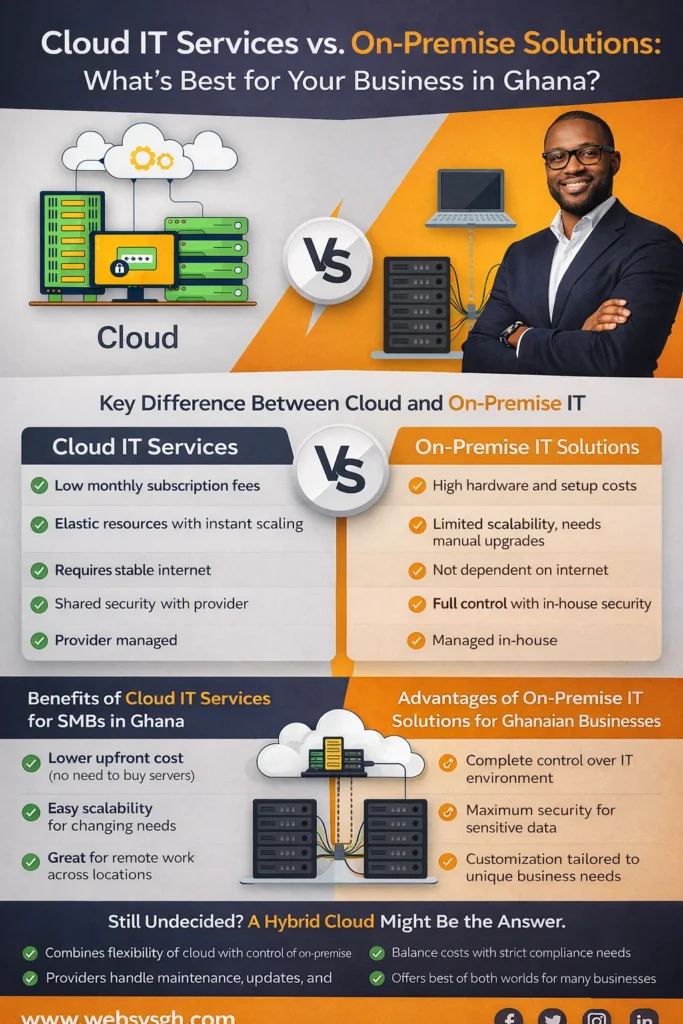
| Aspect | Cloud IT Services | On-Premise IT Infrastructure |
| Upfront cost | Low subscription fees | High hardware purchases |
| Ongoing cost | OPEX with scaling | CAPEX plus maintenance |
| Deployment speed | Hours to days setup | Weeks for full install |
| Scalability | Elastic resources instantly | Add servers manually |
| Remote work support | Seamless from anywhere | Needs VPN or office |
| Security responsibility | Shared with the provider | Fully on your team |
| Compliance/data residency | Contracts ensure local rules | Inherent Ghana control |
| Internet dependence | Essential for access | Minimal required |
| Disaster recovery | Automated backups built-in | Manual systems planned |
| Customization | Provider-guided options | Unlimited tweaks possible |
| Internal IT skill requirement | Basic knowledge enough | Expert staff essential |
The infographic below summarizes the key differences between cloud IT services and on-premise infrastructure for businesses in Ghana, including cost, scalability, security, and deployment speed.
Read more: Outsourcing IT Services: The Smart Choice for Ghanaian Enterprises
The Real Pros of Cloud IT Services for Businesses in Ghana
Cloud IT services transform how your business operates daily in Ghana. You gain flexibility without heavy hardware investments right away. Teams access tools from anywhere, boosting productivity across locations smoothly. Providers handle technical headaches so you focus on growth instead.
- Lower upfront costs let SMEs skip expensive server purchases entirely. Start small and pay as you grow comfortably.
- Faster setup times launch operations in days, not months. Beat competitors to market with quick deployments.
- Remote access shines for multi-branch teams from Accra to Tamale. Sales reps check data on mobile devices easily.
- Built-in backups protect against sudden power failures or floods. Files stay safe without manual efforts.
- Scaling happens instantly during peak seasons like Christmas shopping. E-commerce sites handle traffic surges effortlessly.
- Advanced tools unlock AI analytics and CRM without hiring specialists. Clinics track patient trends in real time.
For example, a retail chain uses cloud hosting services to manage inventory across stores seamlessly. Logistics firms scale cloud storage for delivery tracking during busy harvests. You collaborate through cloud-based collaboration tools without email chains or lost files. Business scalability becomes reality, not just a goal.
This approach drives operational efficiency and digital transformation for IT services for businesses in Ghana perfectly.
The Real Pros of On-Premise Solutions for Businesses in Ghana
On-premise solutions give you total command over your business systems in Ghana. You avoid relying on distant providers during internet hiccups. Direct control builds trust, especially for sensitive operations that demand precision daily.
- Full system ownership lets you customize every feature exactly for your needs. No waiting on vendor approvals slows you down.
- Top security levels keep critical data locked behind your own firewalls. Banks protect transactions without third-party eyes watching.
- Zero internet reliance ensures smooth runs during network outages common here. Core operations never grind to a halt unexpectedly.
- Custom workflows shine for manufacturers building unique production trackers. Tweak code freely without platform restrictions holding you back.
- Performance stays lightning-fast with local on-premise servers. Real-time trading floors process deals instantly without lag times.
- Policy compliance eases as you meet internal rules directly. Government contractors align perfectly with strict oversight demands.
Consider a clinic storing patient records on local drives for instant access. No cloud delays during emergencies disrupt care delivery. Trading firms run custom analytics on dedicated hardware for an edge in fast markets. You maintain data sovereignty under Ghana laws effortlessly.
This setup delivers business continuity planning through hands-on reliability every time.
Read more: Maximize Your Business Efficiency with 24/7 IT Support in Ghana
The True Cost of Cloud vs On-Premise IT Infrastructure
Many Ghana businesses focus only on headline prices when comparing cloud vs on-premise solutions. You miss sneaky expenses that pile up over time. True costs hide in daily operations and growth surprises.
Cloud Hidden Costs
Subscriptions climb fast as your data grows monthly. Transfer fees sting when files move in and out frequently.
- Data egress charges add up during backups or migrations unexpectedly.
- Storage expansion doubles bills as business files multiply yearly.
- Add-on features like premium security always demand extra payments.
- Vendor lock-in risks make switching providers painful and expensive later.
On-Premise Hidden Costs
Hardware demands ongoing care beyond the initial purchase price. Power failures and breakdowns create urgent expenses quickly.
- Cooling systems fight humid Ghana weather around the clock.
- UPS backups replace batteries every two years without fail.
- IT staff salaries consume budgets for 24/7 monitoring needs.
- Hardware refresh cycles hit every three years with full replacements.
- Downtime losses cost thousands when servers crash unexpectedly.
Cloud subscription pricing seems simple upfront, but scales unpredictably. On-premise IT infrastructure steadily burdens you with IT maintenance costs. Tally three-year totals before deciding wisely. Ghana firms learn this lesson when budgets suddenly tighten.
Data Security, Privacy, and Compliance Requirements in Ghana
Ghana businesses must prioritize data privacy regulations when picking IT infrastructure solutions. Data Protection Commission Ghana actively enforces strict rules. You face fines for breaches, so choose systems matching Ghana Data Protection Act (Act 843) perfectly.
Data Protection Commission Role
DPC oversees all data governance nationwide with real authority. They investigate complaints and issue hefty penalties swiftly. Cloud IT services need providers to prove local compliance standards through audits. On-premise setups let you control access directly always.
Cross-Border Data Handling
Cloud risks sending data offshore without tight contracts in place. Data sovereignty demands Ghana storage for sensitive info like health records. On-premise IT infrastructure keeps everything local by default. Cloud security best practices include encryption and IAM.
Banks use access control systems on local servers for transaction safety. Clinics avoid cyber risk management worries with in-house drives. Enterprise data protection varies by model, so review vendor terms carefully. Regulatory compliance shapes your choice more than costs often do.
When Cloud Computing Is the Best Option for Your Business
Cloud IT services often beat alternatives for growing Ghana businesses. You skip complex setups and scale fast without delays. Most SMEs find this path simplest and most effective.
- Startups and SMEs launch quickly with low CAPEX barriers to entry.
- No IT teams needed since providers handle all technical support daily.
- Remote branches connect seamlessly from field offices to headquarters easily.
- Quick deployments win races against competitors launching new services.
- Seasonal demands scale perfectly like retail peaks or harvest logistics surges.
E-commerce stores manage traffic spikes without server crashes disrupting sales. Clinics access patient data remotely during outreach programs smoothly. Business cloud solutions drive digital transformation without infrastructure headaches. You focus on customers, not cables or cooling. Cloud computing for businesses fits flexible operations best naturally.
When Businesses Should Choose On-Premise Infrastructure
On-premise solutions remain vital for specific Ghana businesses needing ironclad control. You prioritize security and customization over external dependencies wisely. Certain operations demand this hands-on approach always.
- Sensitive workloads stay secure like financial data or patient health records.
- Strict control rules satisfy internal audits without third-party access worries.
- Legacy systems integrate smoothly without costly full replacements needed.
- Custom applications run tailored for local manufacturing or trading needs perfectly.
- Uptime strategies rely on your own redundancy plans during outages.
Banks process transactions on on-premise servers for instant reliability every time. Clinics store records in-house to meet privacy laws directly. Enterprise IT systems thrive where tweaks matter most for unique workflows. You avoid cloud uncertainties in critical functions successfully. Traditional IT infrastructure anchors operations, demanding total oversight naturally.
Why a Hybrid Approach May Be Best for Many Ghanaian Businesses
Hybrid cloud environments combine cloud speed with on-premise control smartly. Ghana businesses blend both for optimal results daily. You gain flexibility while keeping critical assets secure always.
- Cloud email systems pair with local finance software for smooth teamwork.
- Cloud backups protect on-site files during unexpected power failures.
- Collaboration tools run in the cloud while internal apps stay on servers.
- Customer platforms scale via the cloud during sales peaks effortlessly.
- Sensitive operations remain on-premise for compliance and quick access.
Retail chains host websites on cloud hosting services but store inventory locally. Banks use public cloud infrastructure for customer apps and private cloud solutions internally. Manufacturers run production systems on-site with cloud analytics overlaid.
This hybrid IT infrastructure balances cost efficiency in cloud computing with data sovereignty. You avoid all-in bets on either model successfully. Managed IT services make hybrid setups practical for SMEs growing steadily.
Read more: How to Ensure Your Business’s IT Systems Are Future-Proof with Managed IT Services
A Simple Decision Framework for Business Owners in Ghana
You need clear steps to choose between cloud vs on-premise solutions confidently. This checklist guides Ghana business owners through key factors systematically. Answer each question honestly for your best fit.
- What data do you handle daily? Sensitive info like health records tilts toward on-premise IT infrastructure strongly.
- How much downtime can you tolerate really? Zero tolerance demands robust disaster recovery planning either way.
- Do you have in-house IT capacity available? Limited skills push you toward cloud IT services immediately.
- Are workloads predictable or seasonal mainly? Variable demands favor scalable IT infrastructure through cloud options.
- Do remote teams need constant access? High mobility screams remote server access via cloud platforms.
- What’s your three-year total cost projection? Compare OPEX against CAPEX with real numbers carefully.
- Does local residency matter for compliance? Strict rules keep data on on-premise servers securely.
Final Verdict
Most Ghana SMEs discover cloud IT services as their smartest starting point today. You slash upfront infrastructure costs dramatically while gaining flexibility for rapid growth. Providers handle headaches, so you chase opportunities instead. Cloud computing vs on-premise leans toward cloud for dynamic operations clearly.
However, on-premise IT infrastructure shines where control outweighs convenience every time. Banks safeguard transactions on local enterprise servers without external risks. Clinics protect patient data under the Ghana Data Protection Act (Act 843) directly. Hybrid cloud environments often deliver the sweet spot. Retailers scale cloud hosting services outward while keeping inventory systems internally secure.
Your best choice hinges on real needs, not passing trends alone. Startups thrive on business cloud solutions for quick launches and remote teams. Manufacturers customize on-premise servers for unique production flows effortlessly. IT services for businesses in Ghana evolve fast, so match your setup to risks, budget, and growth stage wisely.
Ready to decide confidently? WebSys Technology crafts custom cloud IT services, on-premise builds, or hybrid IT infrastructure tailored for Ghana businesses perfectly. Cut costs 20-30%, boost uptime 99.9%, and scale without limits now. Book your free audit, migration plan, and savings analysis today. Email contact@websystechnology.com, call 020-050-8080, or call immediately. Transform your operations this week!
GET IN TOUCH
Upgrade your business IT infrastructure with WebSys experts
FAQs
No clear winner exists here. Cloud security best practices leverage provider expertise effectively. On-premise IT infrastructure gives you direct control. Both demand strong data encryption and monitoring always.
Yes, for most SMEs through steady OPEX models. Cloud subscription pricing scales predictably at first. On-premise solutions burden you with CAPEX and maintenance long-term.
Absolutely with reliable internet now. Cloud infrastructure handles daily operations smoothly for retail and clinics. Start small and scale as your business grows confidently.
Banks and healthcare lead this group. Data sovereignty rules keep sensitive records on local enterprise servers securely under the Ghana Data Protection Act (Act 843).
Hybrid cloud infrastructure blends both worlds smartly. Use it when you need cloud scale outward but on-premise servers inward for compliance and control perfectly.
Yes, improving speeds supports business cloud solutions daily. Cloud hosting services deliver uptime for e-commerce and teams across cities reliably now.