
Small businesses in Ghana are at a turning point. The shift toward digital operations is accelerating, and the businesses adapting fastest are pulling ahead. Cloud-based solutions for SMEs sit at the heart of that shift, delivering real advantages that matter on the ground. The benefits of Cloud Solutions for Small Businesses in Ghana include reduced infrastructure costs, stronger security, better team collaboration, and smoother business continuity.
Ghana’s SMEs represent 92% of registered businesses and drive 70% of the national GDP. That’s an enormous economic weight carried by businesses that often run on tight margins and limited IT budgets. Cloud computing for small businesses solves that tension — you get reliable, scalable technology without the upfront hardware expense.
Whether you’re managing inventory, handling customer payments, or coordinating a remote team, cloud tools deliver measurable results. Cost-effective cloud solutions let Ghanaian SMEs compete with larger players on a more level playing field. The technology is accessible, the ROI is clear, and the shift is happening now.
GET IN TOUCH
Start your cloud journey with Websys today
Why Cloud Solutions Matter for Ghanaian SMBs
Cloud adoption matters because Ghana’s business environment is getting more digital. Internet access keeps expanding, and customer behavior keeps changing. Ghana had 26.3 million internet users with 74.6% penetration by late 2025. That creates strong demand for fast service and online experiences. Digital transformation for small businesses now decides who wins locally.
At the same time, many SMEs still run on fragile systems. A single laptop crash can wipe critical files. A stolen device can expose client details. Power cuts can pause operations for hours. Cloud-based solutions for SMEs reduce that risk and improve continuity.
- Many SMEs can’t justify big server purchases upfront.
- Cloud shifts spending from large CapEx to monthly Opex.
- Ghana’s public cloud market continues to grow and attract investment.
- Public cloud revenue in Ghana is projected at US$306 million in 2025.
- Internet usage is rising, and online shopping is becoming the norm.
- Most mobile connections already use 3G, 4G, or 5G.
- That mobile reality makes cloud apps more practical each year.
Read more: Cloud Computing Services in Ghana
The Advantages of Cloud Solutions for SMEs in Ghana
The real value of cloud is not just “going online.” It’s about building a stronger business with smarter tools. You gain agility, stronger security, and easier teamwork. That’s why Cloud Solutions for Small Businesses in Ghana fit both startups and mature SMEs.
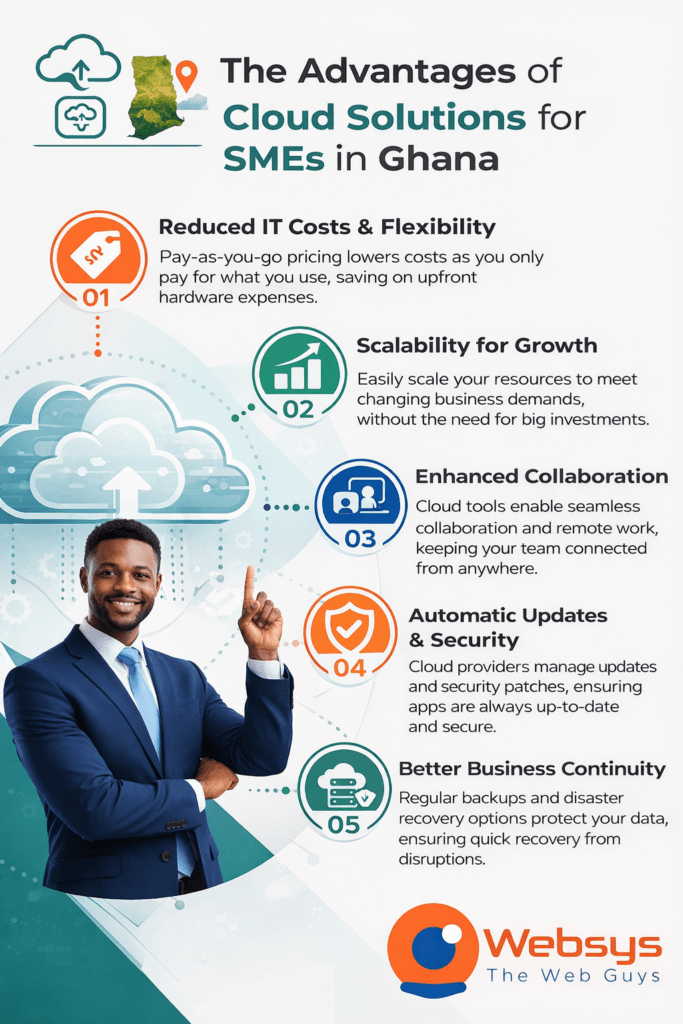
Reduced IT Costs & Pay‑As‑You‑Go Flexibility
With cloud, you don’t buy servers “just in case.” You pay for what you actually use each month. Research published in the InternationalJournal of Science and Research Archives (IJSRA, 2024) found that cloud adoption can deliver cost savings of up to 25% for SMEs — freeing up capital for growth and reinvestment. That makes cost-effective cloud solutions a practical move for tight budgets.
You can start with SaaS and grow from there. For example, use HubSpot for marketing and Dropbox for storage. Add cloud backup when your data grows. That’s how the benefits of cloud storage for businesses show up quickly.
Scalability for Growing Businesses
Growth often comes in waves, not straight lines. Retail spikes during promotions. Schools surge during enrollment periods. A cloud setup lets you scale quickly during peak demand. That’s the everyday power of scalable cloud technology.
With IaaS, you can increase compute resources in minutes. With PaaS, you can ship new features faster. With SaaS, you can add users without new hardware. This is how cloud for business growth becomes real.
Enhanced Collaboration & Remote Work
Your team doesn’t need to sit in one room. Cloud tools support work across Accra, Kumasi, and beyond. Use Slack for quick collaboration and Zoom for client calls. Share files via Dropbox or Google Drive for faster speeds. These remote collaboration tools help you stay responsive.
Cloud collaboration also improves accountability. You get version history, approvals, and access controls. That directly supports business productivity with cloud tools. It also helps when a key staff member travels.
Automatic Updates & Always‑On Security
Many SMEs delay updates because updates feel risky. Cloud vendors handle patches and upgrades on schedule. That removes a common security weakness for small teams. With the right setup, cloud security for small businesses becomes easier.
However, security still needs good habits. You should enforce strong passwords and multi-factor authentication. You should also set role-based access for staff. Cloud makes these controls easier to manage consistently.
Better Business Continuity & Disaster Recovery
Disruptions happen, and they rarely warn you. Power issues, device failures, and even theft can stop operations. Cloud platforms support frequent backups and faster restores. That’s business continuity with cloud in simple terms.
Many cloud plans include data center replication. Some include automated snapshots and rollback options. You can also add cloud-based disaster recovery for critical systems. This matters most for finance, sales, and customer support.
Access to Advanced Technologies
Cloud doesn’t only store files and run email. It gives SMEs access to AI, analytics, and automation. You can use data analytics to spot best-selling products. You can use AI tools to speed customer support responses. That’s how cloud creates “big company capability” on a small budget.
Over time, you can explore Machine Learning and IoT. For example, inventory sensors can reduce stockouts. Payment data can reveal customer buying patterns. This is where cloud shifts from IT to strategy.
Local Compliance & Data Protection
Customers now care about how you handle their data. Regulators also expect responsible data handling practices. Cloud can help through encryption and audit logs. It also supports stronger access control across teams. This reduces compliance pressure for small businesses.
Still, compliance depends on your choices. You must define who accesses what data and why. You must document retention rules for sensitive records. A good provider and a good partner make that manageable.
Read more: Top 5 IT Services Every Growing Business Needs in Ghana
Real-Life Examples of Cloud Adoption in Ghanaian Small Businesses
Some owners still think cloud is “for big companies.” Ghana already has strong proof that cloud drives outcomes. Hubtel is a widely cited example with public documentation. AWS published Hubtel’s case study as a Ghana success story. That example helps clarify what the cloud can unlock.
Hubtel migrated its platform to AWS and modernized its architecture. AWS states that Hubtel achieved 20x revenue growth, rising from $3 million to $62 million. AWS also reports that Hubtel saved $1.5 million annually on infrastructure costs. It also improved platform performance by 100x after migration.
Hubtel’s CEO described the impact in plain terms, saying that AWS made them Ghana’s biggest payment provider. Hubtel’s newsroom also highlighted that this was Ghana’s first AWS success story feature. The bigger lesson is simple: cloud supports reliability when usage grows fast.
Here’s what you can learn from this story:
- Cloud can remove scaling bottlenecks during rapid customer growth.
- Modern architecture improves uptime and the customer experience.
- Savings free cash for product improvements and team expansion.
- Cloud adoption is not a trophy; it’s a business tool.
Read more: How Cloud IT Solutions in Accra Improve Data Security and Accessibility for Growing Businesses
Addressing Common Concerns
It’s smart to question any major IT change. Cloud should reduce risk, not create new stress. You can address the big concerns with planning and clear choices. That’s part of SME cloud adoption done the right way.
Cloud can be cheaper than on-premise when you plan usage. Many SMEs cut costs by avoiding server purchases and maintenance. Accenture research confirms that moving workloads to the public cloud delivers Total Cost of Ownership (TCO) savings of 30–40%. The key is choosing services you’ll actually use.
It can be safer than local storage if configured properly. Cloud providers invest heavily in security engineering and monitoring. You still need strong identity controls and staff training. You should also use encryption and access logging.
This is a fair concern in Ghana. A Ghana-focused study noted infrastructure gaps and reliability challenges. That’s why you should design for intermittent connectivity. Use offline-capable apps and local caching where possible. Also, Ghana’s internet use is still rising quickly. Ghana reached 74.6% internet penetration by late 2025. That trend supports more cloud usage over time. You can also add backup connectivity for critical teams.
Start small and start with business pain points. Pick one workflow that wastes time today. Move that workflow to a secure cloud tool. Then expand in phases, not all at once.
A Beginner’s Guide to Cloud Adoption for Ghanaian Businesses
You don’t need a huge budget to begin. You need a clear plan and a practical sequence. Start with quick wins that reduce stress immediately. This is how Cloud Solutions for Small Businesses in Ghana becomes a smooth transition.
Use this simple roadmap as your starting point:
- Audit your IT setup and identify daily operational bottlenecks.
- Decide on your first goal: cost savings, security, or collaboration.
- Choose a service model: SaaS for apps, IaaS for servers, or PaaS for building.
- Compare public vs private cloud for business based on sensitivity and budget.
- Consider hybrid cloud solutions if you need local systems plus cloud speed.
- Start with email, file storage, and cloud backup for fast wins.
- Add business tools, such as cloud CRM or cloud ERP solutions, gradually.
- Plan your cloud migration process with timelines and owner responsibilities.
- Train staff on access rules and phishing awareness.
- Track results using uptime, response time, and monthly IT spend.
If you want a clear starter stack, keep it simple. Use Microsoft 365 or Google Workspace for productivity. Add Dropbox for file control and sharing. Use Zoom for remote meetings and Slack for daily messaging. Then expand based on outcomes, not assumptions.
Conclusion
Cloud isn’t a buzzword in Ghana anymore. It’s a practical way to lower costs and improve resilience. Ghana’s digital adoption is growing, and SMEs must keep up. Hubtel’s documented gains show what’s possible at scale. Cloud Solutions for Small Businesses in Ghana can help you compete with smarter tools.
If you want help choosing the right setup, WebSys Technology can support you end-to-end. We can assess your current systems, recommend the best-fit cloud model, and manage secure migration. We’ll also help with backups, identity controls, and ongoing optimization. Contact WebSys Technology today to plan a cloud roadmap that matches your budget and growth goals.
GET IN TOUCH