
Running a business in Ghana without solid IT support is like driving on a busy highway with no mirrors. Cyberattacks on Ghanaian businesses jumped 43% in 2024, costing over GH₵300 million in losses. That figure alone shows why managed IT services and strong cybersecurity services have become non-negotiable for any serious operation.
Choosing a Managed Service Provider in Ghana confidently comes down to following the right steps in the right order. Start by auditing your current IT gaps and defining what your business actually needs. Then evaluate each MSP’s industry experience, service depth, and security credentials carefully. Compare business IT solutions across vendors using a structured checklist instead of relying on sales pitches. Review SLA terms, response time guarantees, and escalation paths before signing anything. Check client references, especially from businesses similar in size and sector. Confirm pricing transparency so hidden fees don’t surface after onboarding. Finally, validate backup and recovery processes with a real demo.
Following these steps removes guesswork entirely. With proactive IT support from the right partner, your systems stay stable, your data stays protected, and your business keeps moving forward without costly interruptions slowing everything down.
What Does an MSP Do?
An MSP delivers proactive IT support by monitoring, managing, and securing your business systems around the clock. They replace costly in-house IT teams with structured managed IT services built around your specific operational needs.
Their responsibilities include remote monitoring and management (RMM), cybersecurity, disaster recovery planning, and compliance management. Essentially, they become the technology backbone that keeps your business running without interruption or unexpected IT surprises.
Why Choosing the Right MSP Matters for Ghanaian Businesses
Picking the wrong MSP costs more than a bad invoice. It exposes your operations to real, measurable risk. Ghana lost over GH₵19 million to cybercrime in just the first nine months of 2025 — a 17% increase compared to the same period the year before, according to the Cyber Security Authority (CSA). Businesses without strong managed IT services and structured business continuity plans are often the hardest hit.
The right MSP brings more than technical coverage. It delivers IT consulting for businesses, regulatory compliance management, and a clear disaster recovery plan that actually works when you need it. A mismatched provider, on the other hand, creates bottlenecks, missed SLAs, and security gaps that compound over time.
Mordor Intelligence projects the Africa managed services market will grow from USD 5.53 billion in 2026 to USD 9.62 billion by 2031 at an 11.72% CAGR. That growth signals one clear message — businesses that choose the right MSP partner gain a structural advantage over those who don’t.
Read more: How Managed IT Solutions in Ghana Can Scale with Your Growing Business Needs
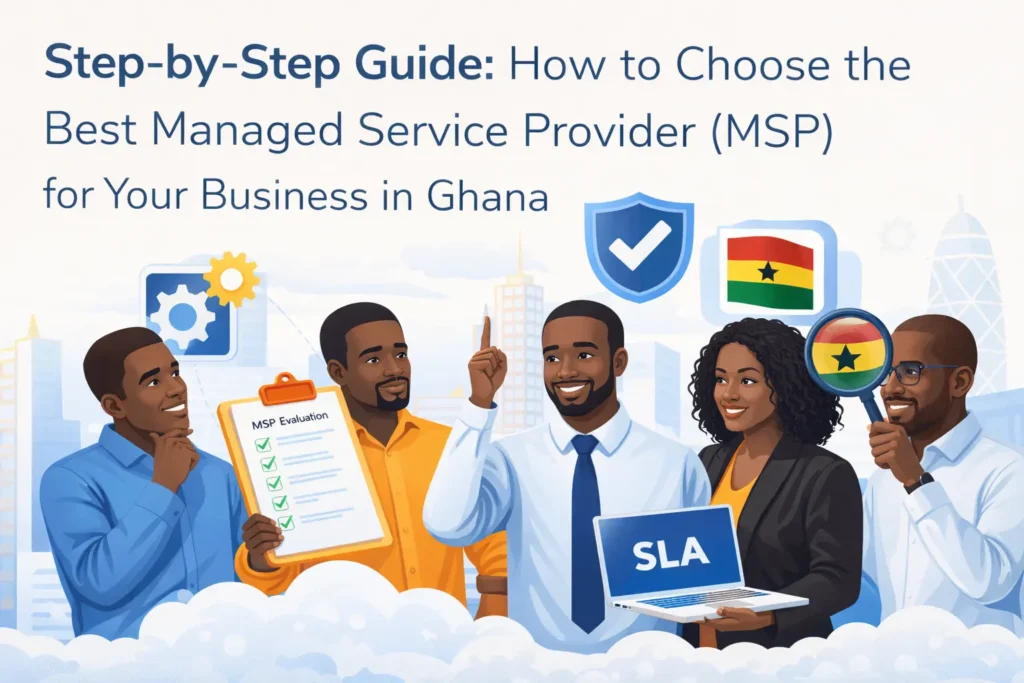
Step‑by‑Step Guide: How to Choose the Best Managed Service Provider (MSP) for Your Business in Ghana
Most businesses struggle here because they compare prices instead of capabilities. Follow these steps to evaluate managed IT services properly and choose a Managed Service Provider in Ghana that genuinely fits your business.
Assess Your Business Needs First
Start by listing your biggest IT pain points — frequent downtime, weak security, or limited in-house expertise. Define what business IT solutions your daily operations absolutely can’t function without. This clarity stops you from paying for services your business doesn’t actually need.
Experience & Industry Expertise
Look for an MSP with proven hands-on experience in your specific industry. A fintech company needs different cybersecurity services than a logistics firm does. Ask for real case studies from Ghana-based clients and let their track record speak louder than their sales pitch.
Compare Service Offerings
Not every MSP covers the same ground. Compare managed cloud services, helpdesk quality, network monitoring, and security depth across every vendor you’re considering. An MSP with gaps in core services will force you into costly secondary contracts you never planned for.
Scalability & Future‑Proofing
Your business will grow and your MSP must keep pace. Confirm they offer real IT scalability solutions for adding users, locations, and cloud workloads. An MSP that can’t scale becomes a ceiling rather than a launchpad for your business expansion.
Pricing Transparency
Demand a fully itemised breakdown before signing anything. Understand exactly what’s included and what triggers additional charges. IT outsourcing only saves money when pricing is clean, predictable, and free from surprises buried in contract footnotes.
Support Quality & SLAs
Read every IT service level agreement (SLA) carefully — response times, resolution targets, and escalation paths all matter. Vague support promises collapse under real pressure. A strong MSP backs its guarantees with documented accountability and measurable monthly performance reports.
Security & Compliance
Confirm the MSP maintains a tested incident response plan and handles compliance management under Ghana’s Cybersecurity Act (Act 1038). Strong data protection and security practices should be daily operations for them, not just marketing bullet points on their website.
Client Reviews, References & Reputation
Request direct references from current clients in similar industries and follow up with honest conversations. Ask specifically how they handled a difficult outage or security incident. A trustworthy Managed Service Provider in Ghana welcomes that question without hesitation.
Read more: Which Company Is Best for IT Services in Ghana? (2026 Buyer’s Guide)
Essential Checklist: Key Questions to Ask Your MSP Before Hiring
A polished sales presentation tells you very little about real delivery. These questions cut straight through the marketing language and reveal how an MSP actually performs when your technology infrastructure faces genuine pressure. Use every single one.
- What services are fully managed and what falls under best-effort coverage only?
- How does your remote monitoring and management (RMM) work during after-hours incidents?
- What are your guaranteed response and resolution times for critical system failures?
- Which cybersecurity services are included in the base plan and what costs extra?
- How do you test backups and how fast can you restore systems after a failure?
- Do you provide a written business continuity plan and disaster recovery plan?
- How do you manage compliance management under Ghana’s Data Protection Act?
- What does your onboarding process look like and how long does migration take?
- Can you scale your IT scalability solutions as my team and locations grow?
- Who is my dedicated point of contact and how do I reach them urgently?
- How often do you provide performance reports and scheduled business reviews?
- Can you share references from current clients facing similar business challenges?
Top 7 Common Mistakes to Avoid When Choosing an MSP for Your Business
Many businesses lock themselves into bad MSP contracts simply by rushing the evaluation process. These seven mistakes are completely avoidable and each one carries a real cost to your business continuity plan, budget, and daily operations.
- Choosing based on price alone. The cheapest option almost always cuts corners on cybersecurity services, staffing quality, or response coverage. You’ll pay far more fixing the damage later.
- Skipping SLA details. Vague “24/7 support” promises mean nothing without documented response times and escalation paths in your IT service level agreements.
- Ignoring compliance expertise. Ghana’s Cybersecurity Act (Act 1038) carries real penalties. An MSP unfamiliar with local compliance management requirements puts your business directly at risk.
- Assuming all cloud skills are equal. Managing managed cloud services requires specific certifications and architecture experience — not just general IT knowledge.
- Skipping backup validation. Never accept a screenshot as proof. Always request a live restore demo before trusting any disaster recovery plan.
- Overlooking scalability. An MSP that can’t support your growth in users and locations becomes a costly obstacle rather than a reliable IT outsourcing partner.
- Signing long contracts too early. Validate support quality, reporting consistency, and proactive IT support delivery before committing to any multi-year agreement.
Read more: What is the Average Cost of IT Services in Ghana?
Final Takeaway & Action Steps
Choosing the right Managed Service Provider in Ghana isn’t just an IT decision. It’s a direct investment in your business stability, security, and long-term growth. The wrong partner creates expensive problems. The right one eliminates them before they start.
- Audit your current systems and identify your most critical IT vulnerabilities first.
- Define non-negotiable requirements for managed IT services, security, and cloud coverage.
- Shortlist at least three MSPs and compare service scope line by line.
- Use the checklist from this blog in every vendor meeting without exception.
- Request a live backup restore demo before trusting any disaster recovery plan.
- Verify compliance management capabilities against Ghana’s Cybersecurity Act (Act 1038).
- Start with a pilot engagement before committing to a long-term contract.
Ready to stop managing IT firefighting and start building something solid?
WebSys Technology delivers proven managed IT services, cybersecurity services, and proactive IT support built specifically for Ghanaian businesses. Their team handles your technology infrastructure end-to-end — from network monitoring and cloud services to compliance management and disaster recovery planning. Get in touch today for a free IT assessment and walk away with a clear, actionable roadmap that protects your operations and accelerates your growth.
FAQ
Start by listing your business-critical systems and pain points. Then compare coverage, tools, and SLA terms across vendors. Validate security practices with specific questions and evidence. Finally, check references and begin with a small pilot.
Focus on service scope, support quality, and security maturity. Review SLAs, escalation, and reporting frequency. Confirm pricing transparency and licensing assumptions. Also confirm scalability for headcount, branches, and cloud growth.
An MSP prevents issues through monitoring, patching, and standard processes. Break-fix waits until something fails, then charges per incident. MSPs provide predictable cost and better continuity. Break-fix often feels cheaper until downtime hits.
Many businesses start with 12 months for fit validation. Longer terms can reduce cost if performance stays consistent. Avoid locking in before the onboarding proves stable. Ensure exit terms remain fair and clearly written.
Finance, fintech, and e-commerce benefit from stronger security and uptime. Healthcare and education gain from safe access and data controls. Logistics and retail need reliable connectivity and device support. Tech startups also gain speed through scalable cloud management.