
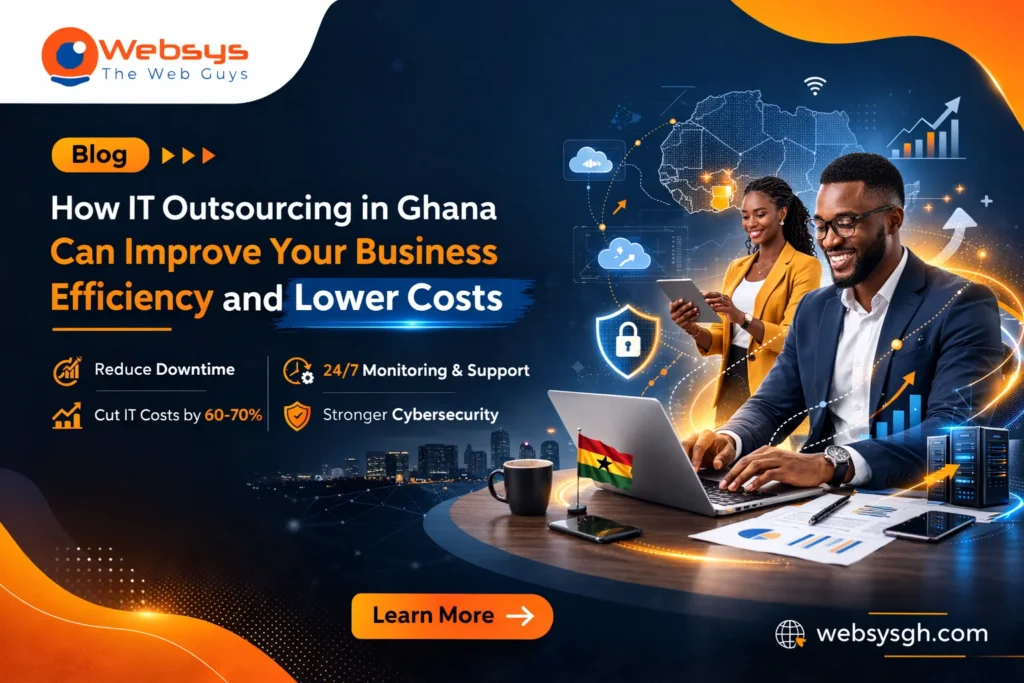
You run a business in Ghana where IT breakdowns halt operations and expenses climb steadily. IT outsourcing in Ghana boosts your business efficiency and cuts costs through proven local solutions.
Managed IT services deliver 24/7 monitoring that catches issues early and reduces downtime significantly. Teams fix problems faster with strict SLAs, returning staff to revenue tasks quickly. You access cybersecurity services experts and cloud specialists without full salaries or benefits. Steady monthly fees replace unpredictable capital spending on tools and training.
Ghana firms achieve 60-70% labor cost savings when outsourcing IT, per industry reports. Local providers handle power fluctuations and rising cyber threats effectively. Leaders refocus on growth instead of tech fires. Workflows optimize naturally for scalability and stronger security. Read further for specific steps tailored to your operations.
GET IN TOUCH
Check Our Competitive IT Support Pricing Now
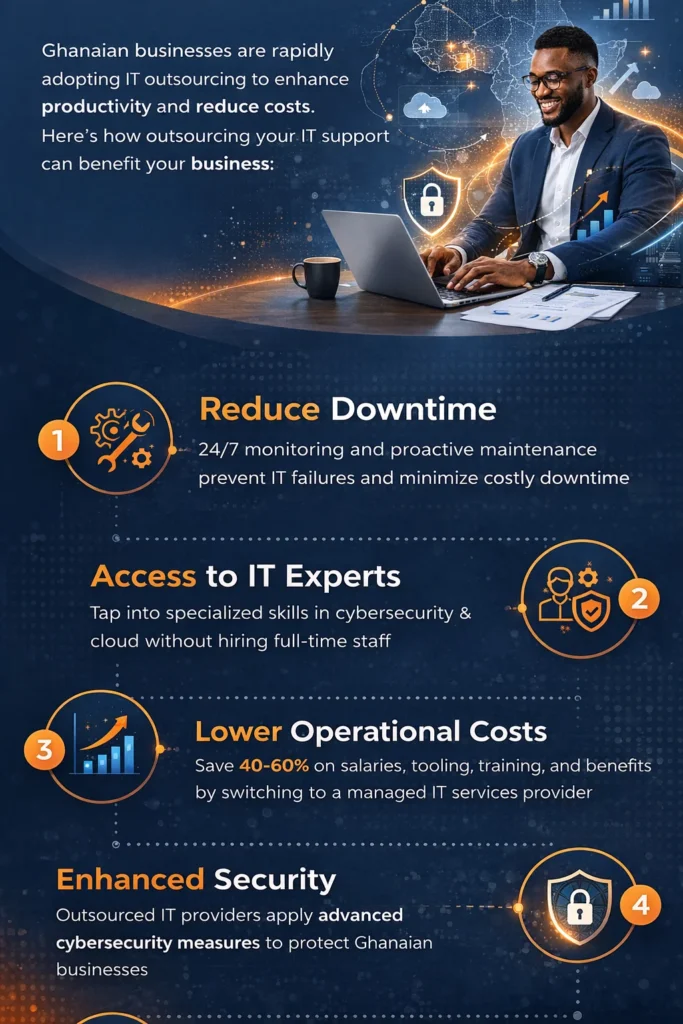
The 6 Biggest Ways Outsourced IT Improves Efficiency (with Ghana examples)
Outsourced IT management transforms daily operations across Ghana. Local experts bring speed and reliability to your business. Here are six proven methods that enhance business efficiency with real Ghana examples.
1) Less downtime through monitoring and preventive maintenance
Proactive monitoring spots trouble before it disrupts work. Providers deploy remote monitoring tools around the clock. Ghana faces frequent power fluctuations that challenge systems. These tools alert teams instantly for UPS checks and generator tests. Industry benchmarks show up to 30-50% less downtime with such monitoring. System uptime stays high for smoother daily workflows. Businesses avoid constant fire-fighting and stay productive.
2) Faster issue resolution with SLAs and escalation paths
Service Level Agreements guarantee rapid responses to issues. Critical tickets receive attention within 15 minutes through defined escalation paths. Ghana teams provide non-stop helpdesk support across time zones. You save hours per incident as staff refocuses on revenue tasks. Faster issue resolution cuts frustration and drives daily progress. Operations flow without unnecessary delays.
3) Access to specialists (cybersecurity, cloud, networking) without full-time payroll
Experts in cybersecurity services, cloud migration, and network management work on demand. Skip hiring full-time staff with high salaries and benefits. Ghana’s IT talent pool grows steadily with competitive rates. Providers deliver endpoint management and Microsoft 365 optimization affordably. You innovate and scale effortlessly without payroll burdens. Growth matches your business needs perfectly.
4) Stronger cybersecurity posture (especially for SMEs)
Advanced endpoint detection tools protect against evolving threats. Ghana lost over GH¢19 million to cybercrime in early 2025 alone. Local IT outsourcing companies conduct vulnerability assessments and multi-factor authentication setups. Ghanaian SMEs build defenses without dedicated in-house experts. Information security strengthens significantly while breach risks drop.
5) Predictable IT budgeting (capex → opex)
Fixed monthly fees replace surprise capital expenditures with operating expenses. Predictable IT budgeting protects against Ghana’s inflation pressures. Eliminate unexpected outlays for tools, licenses, or training. The capex-to-opex shift frees cash for core growth initiatives. You maintain tight IT spending control with reliable infrastructure management.
6) Management focus: shifting teams back to revenue work
Specialists handle server maintenance, patch management, and data backups daily. Your leaders redirect energy toward sales, strategy, and customer growth. Ghana SMEs save 20-30% management oversight time with managed IT, per industry analysis. Business productivity surges as teams tackle revenue-generating priorities. Sustainable growth builds naturally over time.
Read more: Why Network Security Solutions Are Essential for Your Business in Ghana
The Real Cost Savings of IT Outsourcing in Ghana (Simple ROI Model)
IT outsourcing in Ghana offers substantial savings through smart comparisons. This simple model reveals your potential gains clearly. Compare setups to identify quick wins for cost reduction.
Step 1 — Calculate your “true in-house IT cost”
Tally all hidden expenses of internal IT staff thoroughly. Mid-level IT salaries range from GH¢3,000-5,000 monthly plus 13% SSNIT contributions. Annual training costs about GH¢2,000 for certifications like Cisco or AWS. Tools including antivirus, backups, monitoring, firewalls, and M365 licenses run near GH¢500 per user.
Complete checklist:
- Salary + SSNIT/benefits: Base pay plus 13% employer contributions and health insurance
- Training/certifications: Annual courses for current skills and compliance
- Tools: Antivirus/EDR, backup solutions, monitoring software, firewall subscriptions, M365 licenses
- Downtime cost: Average GH¢8,000-12,000 per day in lost productivity and sales
- Security incident risk: Breaches typically cost GH¢50,000+ in recovery and fines
Step 2 — Compare against 3 outsourcing options
Match your totals against scaled outsourcing plans for IT cost optimization. Each tier delivers business IT support suited to your operations.
| Option | What’s Included | Est. Monthly Cost (GH¢) | Typical Savings |
| Helpdesk-only | Basic ticket resolution, phone/email support | 1,000-2,000 | 20-30% |
| Fully managed IT | + Proactive monitoring, security, updates | 3,000-6,000 | 25-45% [websysgh.com] |
| Co-managed | Hybrid: Internal team + provider oversight | 2,000-4,000 | 30-50% |
Fully managed plans excel for comprehensive coverage and peace of mind.
Step 3 — A quick “break-even” rule of thumb
Outsourcing pays off quickly when in-house costs exceed GH¢4,000 monthly. Many Ghana firms break even within three months of switching. Factor in currency stability and power resilience planning. Track return on investment through KPIs like ticket reduction. Total cost of ownership drops steadily with proven solutions.
Risks to Watch (and How Smart Ghana Businesses Manage Them)
Smart decisions balance opportunities with challenges effectively. IT outsourcing in Ghana succeeds through careful planning and proven safeguards. Local businesses implement these protections daily.
- Security & data protection risks require focus under Ghana’s Data Protection Act. Demand vendor audits, data encryption, and strict access controls in contracts. Regular penetration testing strengthens IT governance practices. Accra firms enforce these standards for solid third-party risk management.
- Vendor lock-in affects unwary businesses, but simple steps prevent problems. Require complete documentation, admin access policies, and 90-day exit plans upfront. Data portability clauses ensure smooth transitions. Ghana fintech companies build these protections into every agreement.
- Concentration risk from single-provider dependence needs redundancy. Maintain secondary data backups and detailed runbooks for continuity. Conduct quarterly disaster recovery tests religiously. Risk mitigation preserves business continuity through all scenarios.
- Ghana-specific operational realities demand practical solutions. Power outages and internet instability require redundant fiber plus Starlink connections. Size UPS systems for eight-hour blackouts with offline process backups. Fixed-GH¢ contracts counter inflation pressures effectively.
Read more: Managed IT Services in Ghana: How Outsourcing Can Save Your Business Time and Money
How to Successfully Transition to IT Outsourcing in 90 Days (30–60–90 Day Plan)
Switch to outsourced IT services smoothly within 90 days using this proven roadmap. The phased approach minimizes disruption while maximizing gains. Your business gains strength steadily and confidently.
Days 0–30: Audit & quick wins
Catalog all assets, including servers, endpoints, and cloud configurations, first. Identify immediate fixes like patch gaps or weak passwords quickly. Onboard your IT service provider for comprehensive scans. Secure early wins in network management to build positive momentum.
Days 31–60: Standardize & secure
Migrate systems to the provider’s secure stack with firewall configurations and data backup solutions. Train teams on streamlined workflows and multi-factor authentication protocols. Standardize Microsoft 365 management across all users. Meet Ghana Data Protection Act compliance requirements fully.
Days 61–90: Optimize for cost + performance
Analyze KPIs, including ticket volume and uptime percentages. Eliminate waste through targeted performance optimization adjustments. Refine SLAs to match your specific needs perfectly. Plan strategic expansions like cloud migration confidently.
Who Benefits Most from IT Outsourcing in Ghana?
IT support outsourcing delivers tailored advantages to specific Ghana business types. Your scale and regulatory needs determine the perfect fit. These segments gain maximum value quickly.
- Ghanaian SMEs and startups benefit most with limited budgets and flexibility needs. They start with helpdesk support to bypass local IT talent shortages. Overhead reductions of 25-45% emerge rapidly while scaling remains simple.
- Multi-branch businesses excel through centralized remote monitoring capabilities. Unified networks span Accra, Kumasi, and beyond with real-time visibility. Begin with infrastructure management to eliminate travel delays and costs.
- Regulated industries, including finance, fintech, healthcare, and education, prioritize compliance above all. Bank of Ghana directives demand rigorous cybersecurity services and regular audits. Outsource disaster recovery planning first to satisfy governance standards effortlessly.
FAQs
Yes, businesses achieve 60-70% labor savings outsourcing to Ghana plus 25-45% total IT reductions after all factors. In-house staff exceeds GH¢4,000 monthly with benefits and tools. Managed IT services simplify comparisons effectively.
Expect 24/7 IT support, remote monitoring, patch management, backups, and security scans. Add-ons include cloud management and endpoint protection. Providers manage everything for seamless operations.
Expect 24/7 IT support, remote monitoring, patch management, backups, and security scans. Add-ons include cloud management and endpoint protection. Providers manage everything for seamless operations.
SLAs guarantee response times like one hour for critical issues with built-in penalties. Dashboards track performance for full accountability. Clear terms drive performance optimization consistently.
Yes, modular plans target EDR, phishing protection, and vulnerability scanning specifically. Perfect for Ghana SMEs facing ransomware threats. Strengthen defenses without complete system overhauls.
Ask about SLAs, exit strategies, client references, and data policies specifically. Verify vendor management handles Ghana’s power stability challenges. Secure everything in signed agreements.
Expect 30-90 days depending on complexity and preparation. Follow the audit-to-optimize roadmap outlined above. Proper handoffs ensure minimal operational disruption throughout.
Conclusion
IT outsourcing in Ghana transforms business efficiency while delivering meaningful cost reduction. Ghana’s BPO sector targets 500% growth by 2030, expanding from 19,600 jobs today to over 100,000. Tap this momentum with reduced downtime, specialist access, and predictable budgets. Local providers counter cyber threats costing GH¢19 million last year while addressing talent gaps effectively.
Ready to capture 60-70% labor savings and 25-45% total IT reductions? Contact WebSys Technology today for your free IT audit designed for Ghanaian SMEs. Our managed IT services deliver 24/7 monitoring, robust cybersecurity services, proactive maintenance, and ironclad SLAs ensuring uptime despite power challenges. Enjoy predictable opex pricing, complete documentation preventing lock-in, and our proven 90-day transition roadmap.
Book your 30-minute discovery call now at https://websysgh.com/contact. Don’t let IT disruptions hold you back—gain your competitive edge, boost productivity, and accelerate growth with WebSys. Act today to transform operations before the next outage strikes!
GET IN TOUCH