

You’re probably frustrated trying to predict your monthly IT support costs without any clear framework. Most Ghanaian business owners face the same dilemma when business IT budget planning becomes a guessing game.
Calculating accurate IT infrastructure cost in Ghana involves five essential steps that transform confusion into control. First, inventory all devices and systems requiring support coverage. Second, select the right service model for your company’s size. Third, total your direct expenses across hardware, software, personnel, and security. Fourth, add reasonable contingency reserves for Ghana’s market volatility. Finally, validate your numbers against competitive IT service provider rates from established Ghanaian firms.
Most small business IT support Ghana contracts run GHS 6,000-12,000 monthly for companies with 20-50 employees. This calculation framework eliminates guesswork while revealing optimization opportunities. The guide below breaks down each calculation component with real market rates and practical formulas you can apply immediately to your business situation.
GET IN TOUCH
Find the best IT support package for you
What Is IT Support & Why Accurate Cost Calculation Matters in Ghana
IT support encompasses all technical assistance your business needs to maintain smooth digital operations. It’s more than fixing computers when they break down. In Ghana’s thriving tech ecosystem, where the ICT sector now contributes 9% to GDP, proper IT support has become essential infrastructure.
Understanding your true IT support cost isn’t just about budget planning—it’s about survival. Here’s why accurate calculation matters:
- Financial predictability: Ghanaian businesses lost GHS 23.3 million to cybercrime in 2024 alone. Unplanned IT emergencies devastate small businesses’ cash reserves without warning.
- Strategic investment: Knowing your actual digital infrastructure costs helps you allocate resources effectively. You can’t grow if unpredictable tech expenses constantly ambush your budget.
- Currency volatility protection: The cedi’s fluctuations impact software licensing and hardware procurement costs. Accurate forecasting helps you hedge against exchange rate surprises that inflate expenses.
- Competitive advantage: Ghana’s digital transformation is accelerating with 41.8 million mobile connections nationwide. Companies with solid IT budgets can invest in innovation instead of scrambling for break-fix funds.
- Talent leverage: Ghana’s One Million Coders program has created a skilled workforce. But you need accurate cost models to decide between hiring in-house or outsourcing support.
The bottom line? Without precise IT support cost calculations, you’re flying blind in a market where managed IT services are becoming critical success factors.
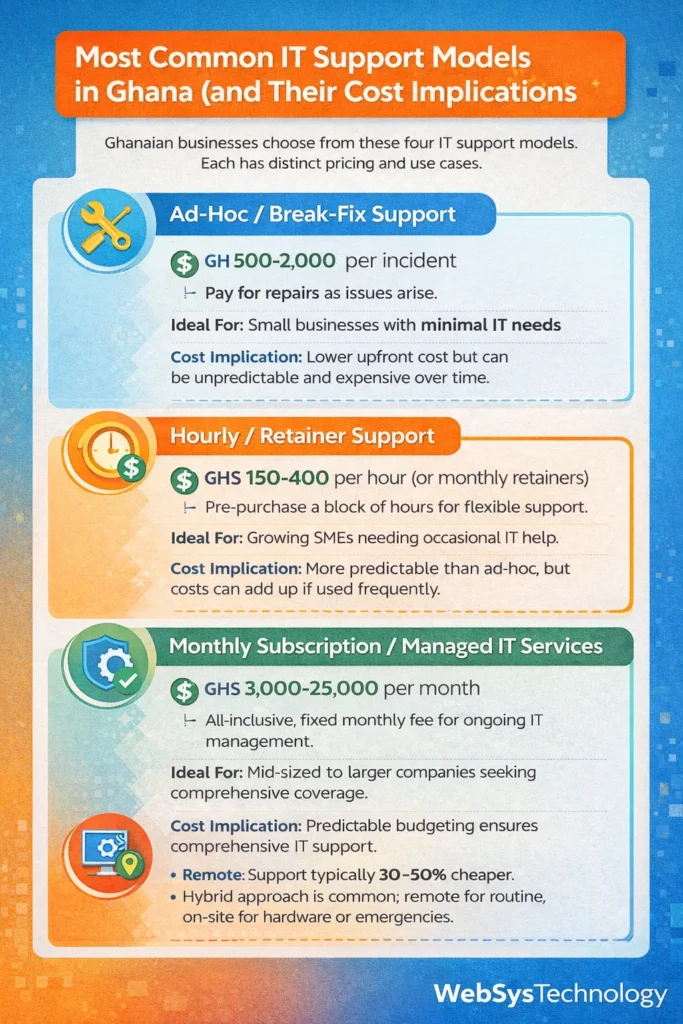
Most Common IT Support Models in Ghana (and Their Cost Implications)
Ghanaian businesses typically choose from four primary support models. Each comes with distinct pricing structures that impact your overall technology budget differently. Understanding these models helps you select what works best for your company’s size and needs.
a) Ad‑Hoc / Break‑Fix Support
This reactive approach means you call a technician only when something breaks. You’re essentially paying per incident without any ongoing relationship or preventive maintenance. Most small vendors in Accra and Kumasi offer this model for businesses with minimal IT infrastructure.
Ghana market rates typically range from GHS 500 to GHS 2,000 per incident. The actual cost depends on problem complexity and urgency level. This works for very small businesses with just a few computers. However, it’s unpredictable and often more expensive long-term. Emergency on-demand repairs always cost more than scheduled maintenance visits.
b) Hourly / Retainer Support
This model offers more flexibility than pure break-fix arrangements. You either pre-purchase a block of hours or pay an agreed hourly rate. Ghana’s IT service provider rates for hourly support typically run GHS 150 to GHS 400 per hour.
Hourly billing works well for growing SMEs that need occasional expert help. You’re not committing to expensive monthly contracts, yet you avoid sky-high emergency rates. Some providers offer retainer packages where unused hours roll over monthly. This gives you predictable access to skilled workforce professionals without full-time employment costs.
c) Monthly Subscription / Managed IT Services
This comprehensive model bundles everything into a fixed monthly fee you can budget reliably. Your managed services provider handles all IT infrastructure, security, updates, and support proactively. Ghana’s IT services market reached $738.91 million in 2025, with managed services driving significant growth.
Monthly costs in Ghana typically range from GHS 3,000 to GHS 25,000, depending on your company size. A 20-person office might pay GHS 6,000 monthly while a 100-employee enterprise could exceed GHS 20,000. This model offers the best value for mid-sized and larger businesses. You get unlimited support, proactive monitoring, and predictable business IT budget planning.
d) On‑Site vs Remote Support
Support delivery method dramatically impacts your costs, regardless of which model you choose. Remote troubleshooting leverages Ghana’s improving internet infrastructure—now at 70% penetration—to resolve most issues virtually. This typically costs 30-50% less than sending field technicians to your location.
On-site support requires travel time, transportation costs, and higher hourly rates. However, hardware installations, network infrastructure work, and critical server maintenance still need physical presence. Many Ghanaian businesses now use hybrid approaches: remote support for routine issues, on-site visits for hardware and emergency situations.
Read more: What is the Average Cost of IT Services in Ghana?
What Are the Core Components of IT Support Costs in Ghana?
Your total IT support cost breakdown involves much more than just paying technicians. Understanding these six major expense categories helps you build accurate budgets that won’t surprise you later.
a) Personnel Costs
Whether you hire in-house staff or outsource to local providers, technical personnel represent your largest cost component. In-house IT staff salaries in Ghana range from GHS 2,500 monthly for junior technicians to GHS 12,000+ for experienced IT managers.
Don’t forget additional costs: training programs, professional certifications, employee benefits, and productivity tools for your IT team.
b) Devices & Hardware Costs
Your equipment investment includes all physical technology assets requiring support and maintenance. Desktop computers, laptops, servers, printers, routers, switches, and networking equipment all factor into total costs.
Consider hardware lifecycle planning too: most business computers need replacement every 3-5 years. Set aside monthly reserves for inevitable hardware failures and scheduled upgrades. A 30-person business might budget GHS 2,000-4,000 monthly for hardware-related expenses, including maintenance reserves.
c) Software & Licensing
Software subscriptions have moved almost entirely to recurring payment models. Microsoft Office 365 costs approximately $6-12 per user monthly, while Google Workspace runs similar rates. Exchange rate fluctuations between the cedi and dollar directly impact these costs.
Industry-specific applications add significantly to monthly expenses. Accounting software, customer relationship management systems, project management tools, and specialized vertical applications all require license management. Track renewal dates carefully—missing renewals often trigger expensive reactivation fees.
d) Network & Connectivity
Reliable internet bandwidth forms the backbone of modern business operations. Ghana’s digital infrastructure has improved dramatically, with 41.8 million mobile connections and expanding fiber networks. Business fiber connections in Accra, Kumasi, and Tema typically cost GHS 800-3,000 monthly, depending on speed requirements.
Don’t rely on single connections for critical operations. Network infrastructure best practices include backup internet service providers and redundant connectivity. VPN solutions for secure remote access add another GHS 500-1,500 monthly for most businesses.
e) Security & Compliance
Threat protection has become non-negotiable as cyber attacks surge across Ghana. The country experienced 2,008 cyber incidents in the first half of 2025. Basic antivirus protection costs GHS 50-150 per device annually, while enterprise-grade security suites run significantly higher.
Ghana earned Tier 1 status in the ITU Global Cybersecurity Index, jumping 46 positions. This achievement reflects growing awareness but also highlights escalating threats. Budget for firewalls, endpoint detection and response systems, email security, and regular data security audits. Most businesses should allocate 10-15% of their total IT budgets specifically for security.
f) Support Tickets & Helpdesk
Your incident management system tracks, prioritizes, and resolves technical issues systematically. Service desk platforms like Zendesk or Freshdesk cost GHS 400-2,000 monthly, depending on user count. These tools ensure no support requests fall through the cracks while measuring team performance.
Consider the hidden costs of downtime and productivity loss when systems fail. Every hour your sales team can’t access customer data costs actual revenue. Efficient ticketing reduces resolution time and minimizes business disruption even when technical problems occur.
Read more: DIY Cyber Security vs Professional IT Services in Ghana
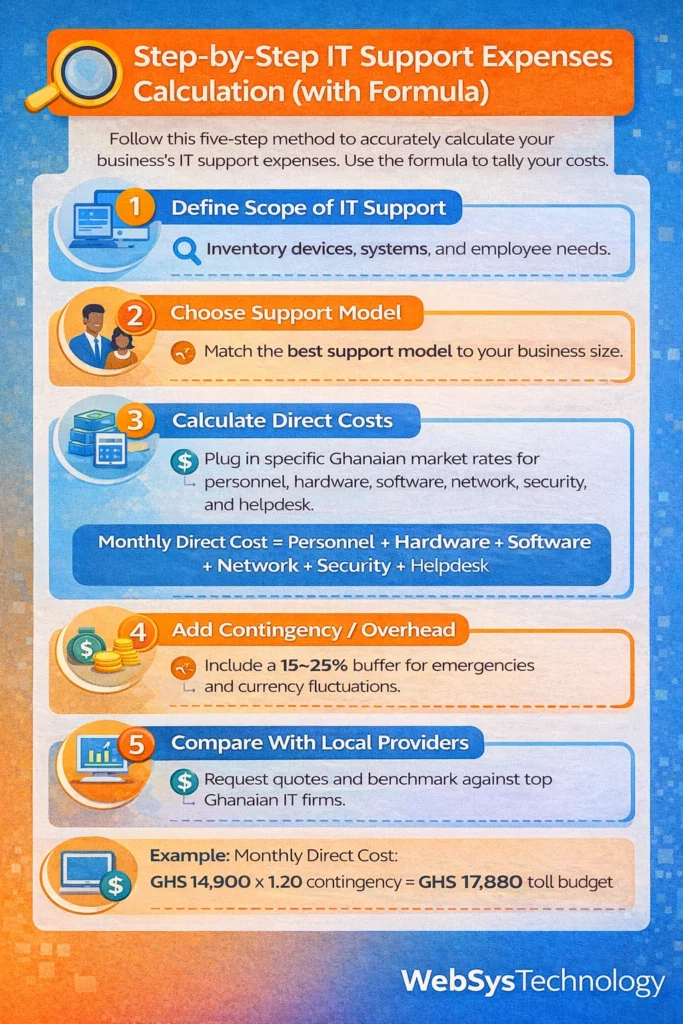
Step‑by‑Step IT Support Expenses Calculation (with Formula)
Now let’s break down the practical process for calculating your specific cost of IT services in Ghana. This five-step methodology gives you accurate numbers for informed decision-making and vendor negotiations.
Step 1: Define the Scope of IT Support
Start by creating a comprehensive asset inventory of everything requiring technical support. List all computers, servers, mobile devices, printers, networking equipment, and specialized hardware. Count how many employees need regular IT assistance and identify critical systems.
Assess your current pain points honestly: frequent downtime, slow performance, security concerns, or lack of strategic guidance. This support coverage definition prevents scope creep and ensures quotes from providers cover your actual needs.
Step 2: Choose Support Model
Review the four models we discussed earlier in this guide. Match your business size, budget constraints, and growth trajectory to the most appropriate model. A five-person startup might start with hourly support, while a 50-employee manufacturing company needs comprehensive managed services.
Your service level agreement should specify response times, coverage hours, and included services clearly. Twenty-four-hour coverage costs significantly more than business-hours-only support. Define what constitutes acceptable support tier performance before committing to any provider.
Step 3: Calculate Direct Costs
Now plug in actual numbers from your scope definition and chosen model. Use this formula for monthly planning:
Monthly Direct Cost = Personnel + Hardware + Software + Network + Security + Helpdesk
Here’s a sample calculation for a 30-person business in Accra:
- Personnel (outsourced): GHS 6,000
- Hardware (maintenance reserve): GHS 2,500
- Software subscriptions: GHS 2,800
- Network connectivity: GHS 1,200
- Security tools: GHS 1,800
- Helpdesk platform: GHS 600
- Total Direct Monthly Cost: GHS 14,900
This expense calculation forms your baseline before adding contingencies and comparing market rates.
Step 4: Add Contingency / Overhead
Ghana’s market volatility requires building cushions into your technology budget. Currency fluctuations, unexpected hardware failures, and emergency support needs will happen. Add a contingency reserve of 15-25% to your direct costs.
Using our example: GHS 14,900 × 1.20 = GHS 17,880 total monthly budget. This buffer protects against hidden expenses while maintaining service quality. It’s better to end the year under budget than scrambling mid-quarter for emergency IT funds.
Step 5: Compare With Local Providers
Request detailed quotes from three to five IT outsourcing Ghana providers with strong local reputations. Ghana’s IT consulting market reached $39.51 million in 2025, offering robust provider options. Share your calculated budget and scope with each vendor.
Use your calculations for vendor comparison and informed negotiations rather than accepting quotes blindly. If a provider’s quote significantly exceeds your calculation, ask for detailed justification. Market benchmarking ensures you’re neither overpaying nor choosing suspiciously cheap providers who’ll underdeliver.
Effective Strategies to Lower IT Service Expenses for Your Business
Budget constraints challenge most Ghanaian SMEs, but smart strategies reduce costs without compromising security. These proven tactics help optimize your business IT expenses in Ghana while maintaining excellent service quality and reliability.
- Embrace cloud solutions: Moving to cloud-based applications like Microsoft 365 or Google Workspace eliminates expensive on-premise server investments. You’ll reduce IT infrastructure costs by 30-60% while gaining better disaster recovery capabilities.
- Negotiate multi-year contracts: Lock in current rates with longer IT service contracts that Ghana providers offer. This protects against cedi depreciation and gives vendors confidence to discount pricing. Three-year agreements typically save 15-20% compared to annual renewals, according to industry pricing data.
- Prioritize preventive maintenance: Regular system updates, security patches, and equipment investment monitoring prevent expensive emergency repairs. Studies show proactive maintenance reduces break-fix incidents by 60-70% annually.
- Train your employees: Basic troubleshooting training dramatically reduces helpdesk ticket volume. Teaching staff to handle password resets, printer issues, and simple connectivity problems frees IT professionals for complex challenges.
- Leverage local talent: Ghana’s One Million Coders program has created a competitive skilled workforce with current technical skills. Hiring locally often costs significantly less than international providers while supporting the domestic economy.
- Implement BYOD policies carefully: Allowing employees to use personal devices for work can reduce hardware costs. However, establish clear security policies and mobile device management to prevent data security breaches.
- Automate routine tasks: Automated backup systems, patch management, and monitoring tools reduce technician hours spent on repetitive work. This cost optimization allows your IT budget to stretch further.
- Bundle services strategically: Single providers offering multiple services—like network infrastructure, security, and helpdesk—typically discount bundled packages. Vendor consolidation also simplifies management and accountability.
- Monitor and optimize regularly: Track which services deliver actual value versus unused features you’re paying for. Quarterly reviews identify operational efficiency opportunities and eliminate waste from your technology spending.
Ghana’s startup ecosystem raised $127 million in 2024, demonstrating a thriving local tech industry. This competitive environment benefits businesses seeking affordable IT support services with excellent quality-to-price ratios.
Read more: How to Choose the Best Cyber Network Security Company in Ghana
Conclusion
Calculating accurate IT support costs for your Ghanaian business requires understanding local pricing models, identifying cost components, and applying systematic formulas. Ghana’s digital economy continues explosive growth with a forecasted 25% digital-driven growth in the coming years. Companies with informed technology budgets will capture competitive advantages while unprepared competitors struggle with surprise expenses.
You’ve now learned the four primary support models, six core cost components, and a practical five-step calculation method. You’ve discovered cost-effective IT support options for startups in Ghana alongside enterprise strategies. The key is moving from reactive spending to strategic business IT budget planning that enables growth instead of limiting it.
Ready to stop guessing and start knowing your exact IT support costs? WebSys Technology specializes in helping Ghanaian businesses optimize their technology investments while maintaining world-class security and reliability. Our local expertise in Accra means we understand cedi volatility, import duty impacts, and Ghana’s unique business environment challenges. We offer comprehensive managed IT services, proactive cybersecurity, 24/7 helpdesk support, and strategic IT consulting fees in Ghana that fit your budget.
Contact WebSys Technology today for a FREE, no-obligation IT cost assessment tailored specifically to your business. We’ll analyze your current setup, identify optimization opportunities, and provide detailed cost projections you can actually trust. Don’t let unpredictable IT expenses drain your cash flow another month. Call 020-050-8080 or visit websysgh.com to schedule your consultation with Ghana’s most trusted IT support partner. Your competitors are already optimizing their technology investments—isn’t it time you did too?
GET IN TOUCH