
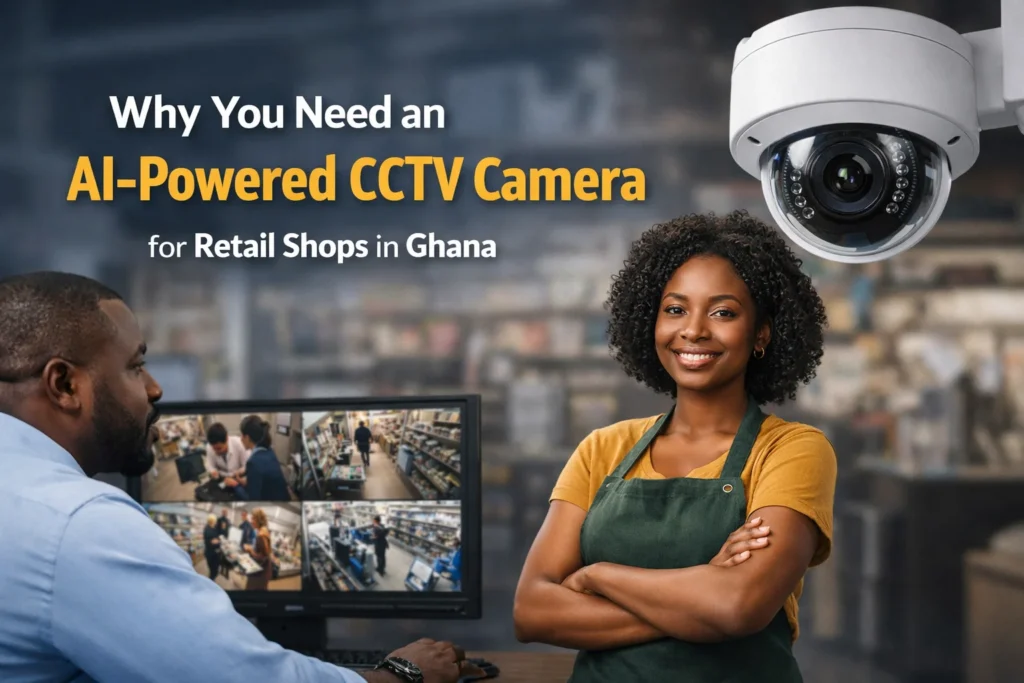
Running a retail shop in Ghana already feels like a tightrope walk where margins stay thin while security risks keep growing.
Retail crime is escalating globally, with one report estimating that retail theft costs businesses in the United States over 100 billion dollars every year, and Ghanaian retailers face similar pressures on profit and stock integrity, even if the exact local figure is lower and less documented.
Ghana’s own security institutions are leaning heavily on technology, and that should tell you something important about the environment your shop operates in.
The Ghana Police Service has rolled out 1,000 surveillance cameras nationwide with central monitoring centres in Accra, Kumasi, and Tamale, specifically to watch high‑risk locations and respond faster to incidents.
If national law enforcement is using intelligent video monitoring to battle crime, it makes sense for retailers to rethink how they protect inventory, staff, and customers inside their own four walls.
Unfortunately, many shop owners still rely on older CCTV cameras for retail security that simply record footage without actually helping to prevent theft in real time. Those systems can show you what happened yesterday, but they rarely intervene when someone is quietly slipping products into a bag.
In busy Ghanaian high streets, markets and malls where staff juggle customer service, stock work and cash handling, that gap becomes costly.
Modern AI‑Powered CCTV cameras close this gap by combining video, artificial intelligence and smart analytics so your cameras become active security partners rather than silent witnesses.
Instead of scrolling through hours of video after a loss, you get real‑time alerts about suspicious behaviour, unsafe situations and operational bottlenecks. That shift from passive recording to intelligent video surveillance is exactly what modern retail shop surveillance systems need in Ghana’s competitive environment.
GET IN TOUCH
Book professional CCTV setup and avoid costly blind spots.
The Rising Security Challenges For Retail Shops In Ghana
Retail risk in Ghana shows up in everyday situations that owners recognise immediately. Stock goes missing during rush hours, cash discrepancies surface at closing time, and disputes arise when there is no clear visual evidence to support either staff or customers. Shrinkage often comes from a mix of customer theft, employee theft, supplier fraud and simple operational errors.
Local authorities increasingly highlight technology as a core tool for crime management because manpower alone cannot cover every corner of every city. The Ghana Police Service’s technology‑driven project placed 1,000 cameras across the country, with command centres that monitor junctions, business districts, borders and other key locations.
This illustrates how video monitoring for shops and public spaces is no longer a luxury but a practical necessity for Ghanaian retail risk management.
Limitations Of Traditional CCTV Systems In Real‑Time Retail Protection
Traditional shop security systems were designed to record incidents, not to prevent them as they unfold.
In most small or mid‑sized stores, footage is only checked after a loss, a customer complaint or a serious incident, which means opportunities for real‑time intervention are missed. Staff rarely have time to watch multiple screens continuously, especially during peak trading hours or promotional events.
These older systems also struggle with intelligent detection. They cannot distinguish between a loyal customer browsing for several minutes and a potential shoplifter repeatedly handling the same high‑value item in a suspicious way. False alarms from basic motion detection quickly condition staff to ignore alerts.
As a result, even the best‑positioned cameras often function as expensive evidence lockers rather than proactive retail loss prevention technology that changes behaviour on the shop floor.
Read more: CCTV Maintenance Checklist & Tools for Ghanaian Homes & Businesses
What Is An AI‑Powered CCTV Camera?
An AI‑Powered CCTV Camera combines familiar security hardware with advanced software that understands what is happening in the video feed using AI video analytics. Instead of just streaming footage to a recorder, these smart retail security solutions run machine learning models and behavioral analysis algorithms on the images to identify patterns, objects and actions that matter for security and operations.
Core components usually include:
- Computer vision that detects people, faces, objects and movements in real time.
- Machine learning CCTV models that learn what normal behaviour looks like in your store and highlight anomalies.
- Real‑time video analytics running either on‑camera through edge computing or in cloud CCTV platforms.
How AI Cameras Differ From Traditional CCTV
The key difference between AI camera systems for business and traditional IP cameras lies in automation, context and intelligence. A conventional system records everything but understands nothing, while AI‑Powered CCTV cameras interpret activities and generate meaningful alerts. That allows security teams or store managers to focus on real threats instead of passively observing screens.
This technology shift is not a small niche trend either. The global AI in video surveillance market was valued at 5.64 billion US dollars in 2024 and is projected to grow to 18.33 billion dollars by 2032, with an annual growth rate of 16.6 percent, according to Fortune Business Insights.
Such growth signals that intelligent video surveillance is rapidly becoming the default choice for security camera analytics in retail and other industries.
When AI CCTV for shops in Ghana monitors a checkout, storeroom entrance or high‑value aisle, it does more than record images.
It connects behaviour analytics in CCTV with specific events like loitering, rapid item concealment or suspicious movements that deserve attention. That means your system moves from being a passive recorder to an active smart retail security solution.
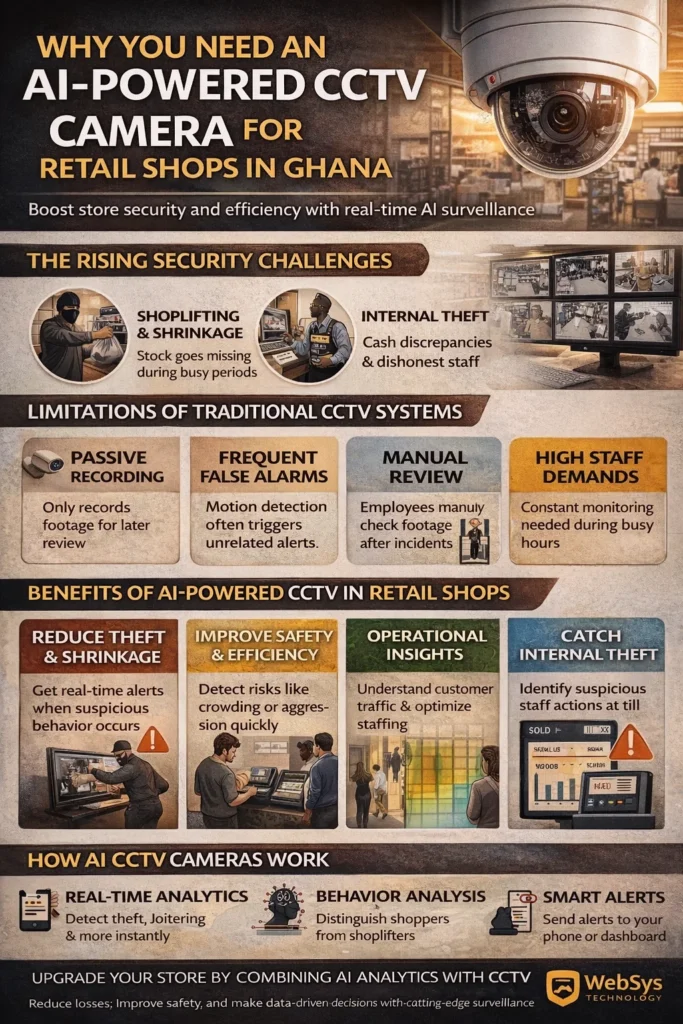
Why Retail Shops In Ghana Need AI CCTV
For Ghanaian retailers, the question is not just “what is AI‑powered CCTV?” but “what problems can AI CCTV solve in retail?” The answer spans loss prevention, safety, operations and better decision‑making. Intelligent business surveillance solutions give owners more control over stock, staff and customer experience without requiring them to sit in front of monitors all day.
Reduce Shoplifting And Shrinkage
Shoplifting prevention technology becomes far more effective when cameras understand behaviour rather than simple movement. AI motion detection combined with people counting cameras and behavior analytics in CCTV can flag suspicious activity such as:
- Repeated item handling without corresponding movement toward the checkout.
- Unusual body positioning around shelves, bags and clothing.
- Coordinated actions by multiple individuals in different parts of the store.
Instead of discovering losses during stock takes, retailers using AI‑Powered CCTV cameras receive real‑time alerts when suspicious sequences occur. Staff can respond quickly, either by approaching the person in a friendly way or by discreetly observing further. For shops dealing with high‑value goods such as electronics, cosmetics or pharmaceuticals, this kind of retail loss prevention has a direct impact on profitability and small business risk management.
Improve Store Safety And Staff Efficiency
Employee safety monitoring matters just as much as stock protection. AI surveillance can identify aggressive behaviour, sudden crowding or dangerous incidents, prompting faster intervention and support for frontline workers. In a busy Ghanaian mini‑mart, supermarket or fashion store, staff often juggle multiple tasks while still needing situational awareness around exits, tills and aisles.
Automated alerts reduce the need for constant manual monitoring, so employees can focus on customer service and store operations optimization. Instead of one person staring at several screens, the system quietly watches everything and only escalates when something needs attention. That combination of coverage and efficiency strengthens both retail business security in Ghana and everyday workflow quality.
Operational Insights And Analytics
Beyond security, AI camera systems for business generate operational data that traditional CCTV simply cannot provide. With customer flow analysis, queue management and store layout optimization, retailers move from guessing to measuring how people use the space.
Practical use cases include:
- Identifying the hours and days when queues regularly build at the checkout.
- Seeing which aisles attract most traffic and which become dead zones.
- Understanding dwell time in promotional areas and end‑caps.
These insights help refine merchandising, staffing levels and promotional placements inside retail shop surveillance systems. When security cameras double as operational sensors, smart retail solutions become a strategic tool, not just a defensive expense.
Detect And Prevent Internal Theft
Internal theft and process fraud can be harder to detect than casual shoplifting. Integration with POS systems and ERP platforms allows AI‑Powered CCTV cameras to align specific video clips with corresponding transactions. That means managers can quickly investigate suspicious patterns such as:
- Frequent “no sale” events on a particular till.
- High rates of manual discounts or voids linked to one user.
- Refunds without customers present or without visible returned items.
When AI CCTV and POS data line up, how AI CCTV helps monitor employee activity becomes very clear. You gain fair, objective visibility over risk behaviour without automatically assuming the worst about staff. This strengthens retail loss prevention while still respecting honest employees who often welcome transparent systems that protect them from false accusations.
Remote Monitoring For Multiple Shop Locations
Ghana’s growing retail chains and franchises often operate branches in several cities, including Accra, Kumasi, Takoradi and regional capitals. For these owners, remote monitoring services and centralized security management are essential.
With cloud‑based surveillance, managers can:
- View live feeds or alerts from multiple branches on one dashboard.
- Compare incident patterns across locations and time periods.
- Enforce consistent shop security systems policies and camera standards everywhere.
This kind of centralized oversight helps franchise owners implement top retail security systems without needing an on‑site security specialist at every branch. AI CCTV for shops in Ghana therefore supports scalable growth by standardising IP camera deployments and analytics across the network.
Read more: Why Your Ghanaian Office Needs 4K CCTV Camera Systems Now
Business ROI Of AI CCTV For Ghana Retailers
Every investment in security ROI for retailers must be justified with clear benefits. AI‑Powered CCTV cameras deliver value by reducing shrinkage, cutting unnecessary labour costs, enhancing safety and improving decision‑making based on accurate data rather than intuition.
Cost Versus Benefit For Retailers
Key financial benefits include:
- Lower shrinkage thanks to real‑time theft detection and better investigations.
- Reduced reliance on multiple static guards, especially in low‑risk areas during off‑peak times.
- Potential for better negotiations with insurers when you demonstrate robust retail shop surveillance systems and evidence preservation.
On the cost side, AI camera systems for business often follow flexible models that combine hardware, installation and ongoing analytics software. Cloud CCTV platforms and wireless CCTV systems reduce the need for heavy on‑site infrastructure, which matters in locations where space or power reliability is limited.
Productivity Gains From Automation And Analytics
Time spent reviewing footage or manually checking suspicious transactions can quickly add up. With intelligent video monitoring for shops, the system automatically bookmarks important events such as unusual access to storerooms, crowding, or door openings outside trading hours.
Managers and owners review a short, relevant list of clips instead of random hours of video. Combined with queue management insights and customer behaviour tracking, AI‑Powered CCTV cameras support smarter roster planning, faster investigations and improved store operations optimization.
Local Reality: Why Self‑Help Matters In Ghana
Public safety structures support retailers, yet they also face their own resource limits. Official documents show that Ghana’s Ministry of the Interior has been working to improve security capacity, and nationwide camera deployments indicate a strong push toward technology‑enabled policing. However, the sheer number of businesses and population density mean shops must take proactive responsibility for in‑store protection.
When you combine law enforcement surveillance networks with in‑store AI CCTV, you create a layered defence strategy. The public system helps monitor roads and public spaces while your own smart retail security solutions protect aisles, tills and storerooms, giving you clear evidence if an incident escalates beyond your premises.
How AI CCTV Works: A Brief Technical Yet Accessible Explanation
Understanding how AI surveillance cameras work helps retailers evaluate solutions with more confidence. The technology is sophisticated, but the basic flow remains straightforward once broken into clear steps.
At a high level, AI‑Powered CCTV cameras:
- Capture video using high‑resolution sensors and lenses.
- Process footage using machine learning models either on the device or a nearby edge computing unit.
- Run artificial intelligence CCTV analytics to detect objects, people and specific actions.
- Compare events against configured rules for suspicious behaviour, safety incidents or operational triggers.
- Send real‑time alerts to mobile devices, dashboards or integrated systems like POS.
Real‑Time Versus Batch Analysis
Real‑time video analytics focus on responding quickly. They power instant alerts when someone enters a restricted area, lingers near a high‑value display or when a queue grows beyond a set threshold. That is where how AI cameras reduce shoplifting and improve safety becomes obvious during daily operations.
Batch analysis, on the other hand, looks at patterns over hours, days or weeks. This mode underpins reporting on footfall, dwell times and customer flow analysis. It helps you answer questions such as “which doorway drives most traffic?” or “how did campaign weekend traffic compare with last month?” Both real‑time and batch analysis contribute to smart retail solutions and store layout optimization for better sales and smoother movement.
Integration With Mobile And Cloud Monitoring
Modern AI‑Powered CCTV cameras typically integrate with cloud CCTV platforms and mobile apps. That means a store owner in Ghana can:
- Receive push notifications when behaviour analytics in CCTV flags a serious event.
- Quickly pull up related clips from any location using authenticated access.
- Share relevant video securely with law enforcement or insurance providers when needed.
Cloud‑based surveillance and remote monitoring services ensure that even if local recording hardware fails, critical clips remain protected. In environments where power fluctuations or hardware damage sometimes occur, this hybrid architecture provides resilience along with convenience.
Read more: How to Choose a CCTV Camera for Your Home in Ghana
Key Features To Look For In AI‑Powered CCTV Cameras
Choosing the best CCTV cameras for shops means understanding which capabilities genuinely add value for retail environments. Not every feature list is created equal, and some specifications matter more than others when protecting stock, staff and customers.
Important features include:
- High‑resolution video and night vision so faces, actions and items remain clear in various lighting conditions.
- AI video analytics such as people counting cameras, intrusion detection, loitering detection and queue monitoring tailored to retail scenarios.
- Mobile alerts and cloud‑based surveillance that allow remote viewing, instant notifications and secure off‑site storage.
- Security system integration with POS, ERP and access control integration to align camera events with transactions and door logs.
- Retail analytics dashboards displaying traffic heatmaps, dwell times, queue lengths and incident reports in a visual way.
When evaluating affordable surveillance for small business setups, focus on what directly supports retail loss prevention, customer experience and workload reduction rather than chasing every possible specification. Good AI‑Powered CCTV cameras for retail shop surveillance systems should feel like practical tools, not complex science projects.
Implementation Considerations In Ghana
Deploying AI CCTV for shops in Ghana requires more than buying a few cameras online. The environment, infrastructure and regulatory context all influence which solution will perform reliably over time.
Infrastructure And Connectivity
Before installation, assess power stability, network quality and physical layout. In some areas, edge AI surveillance where processing happens on the camera or local recorder reduces dependence on constant internet connectivity.
Key points to consider include:
- Whether existing cabling supports IP CCTV standards or you need wireless CCTV systems.
- Storage planning that balances on‑site NVRs with cloud CCTV platforms for redundancy.
- Appropriate surge protection and backup power for critical devices in locations prone to outages.
Compliance And Privacy
Any CCTV camera for retail security must respect customer and employee privacy while maintaining strong protection. Good practice includes clear signage informing visitors that intelligent video surveillance is in use and why it exists. Access to recorded footage should remain restricted to authorised staff following documented procedures.
Retention policies for recorded clips should also be clear and proportionate. Keeping footage only as long as needed for security and operational reviews supports responsible use of AI camera systems for business while still enabling robust investigations when incidents occur.
Cost And Total Cost Of Ownership
When retailers ask “Is AI surveillance worth the investment for retail shops?” the answer rests on understanding full lifecycle costs. Initial pricing covers hardware, installation and basic configuration. Ongoing costs include software licences, cloud storage, support and any remote monitoring services you choose to add.
Transparent quotes that show the total cost of ownership over three to five years help compare AI‑Powered CCTV cameras with older systems. When factoring in reduced shrinkage, less manual investigation work and stronger Ghanaian retail risk management, many businesses find that AI systems pay for themselves through saved stock and smoother operations.
AI CCTV Vs Traditional CCTV: Side‑By‑Side Comparison
The difference between AI and traditional CCTV becomes clearer when comparing them feature by feature. This helps answer a common question: “What features should I look for in a CCTV camera?”
| Feature | Traditional CCTV | AI‑Powered CCTV |
| Real‑time alerts | No, manual monitoring required | Yes, automated alerts for configured events |
| Behavior Analytics | None beyond basic motion | Advanced behaviour analytics in CCTV models |
| Integration with POS | Often limited or absent | Designed for POS and ERP integration |
| False Alarm Rate | High with basic motion triggers | Lower through intelligent object recognition |
| Data Insights | Minimal security history only | Rich security and operational analytics combined |
For Ghanaian retailers choosing CCTV for small stores or multi‑branch networks, this table illustrates why AI‑Powered CCTV cameras are increasingly replacing older record‑only systems. They answer how AI CCTV helps monitor employee activity, improve customer safety and reduce shrinkage with smart surveillance that works continuously.
FAQs: AI‑Powered CCTV For Retail Shops In Ghana
AI‑Powered CCTV cameras help reduce shoplifting, monitor internal theft, improve queue management and support employee safety monitoring. They combine theft detection CCTV with customer flow analysis and loss prevention so security becomes part of broader store operations optimization instead of an isolated system.
Costs vary based on camera quality, analytics depth, number of sites and whether you choose cloud‑based surveillance or primarily on‑site storage. Many providers offer scalable packages that make affordable AI surveillance systems possible for small businesses as well as larger chains.
Yes, many AI‑Powered CCTV cameras and platforms support security system integration with modern POS and ERP tools. This allows video events to align with transaction logs, which is extremely useful for detecting refund fraud, void misuse and other internal risks in retail loss prevention.
Smaller shops often feel the impact of every single missing item more sharply than large chains. AI CCTV for shops in Ghana provides early warning and clear evidence even in compact spaces, making it one of the best CCTV cameras for shops that need reliable retail shop surveillance systems without a full‑time security team.
Conclusion
Retailers in Ghana face a complex mix of challenges, including theft, shrinking margins and growing customer expectations around safety and convenience. Traditional cameras alone struggle to keep pace with organised shoplifting, internal fraud and evolving risk patterns.
In contrast, AI‑Powered CCTV cameras bring together intelligent video surveillance, AI video analytics and integrated operational insights so your cameras help prevent loss, not just document it afterward.
With the global AI in video surveillance market projected to grow from 6.26 billion US dollars in 2025 to 18.33 billion dollars by 2032, it is clear that businesses worldwide now view AI camera systems for business as a strategic necessity rather than an experimental upgrade.
If you want to move beyond basic recording and build smart retail security solutions tailored to the Ghana security camera market, partner with a team that understands both technology and local retail realities.
WebSys Technology can help design and deploy AI‑Powered CCTV cameras, retail shop surveillance systems, POS‑integrated analytics and cloud‑based surveillance architectures that fit your budget, your branches and your long‑term growth plans in Ghana.
GET IN TOUCH