
Security in Ghana has changed fast in recent years. Many homes and shops still rely on old CCTV systems that record, but don’t truly protect. Those weak recordings can turn a small happening into an unforgettable incident.
FOSDA’s media monitoring recorded 86 violent incidents in Ghana in Q2 2024, with Central (22), Ashanti (20), and Greater Accra (16) leading the count. That kind of trend makes reliable video surveillance more than a luxury.
Here’s the problem many people miss. A camera can be installed, yet still fail you. It can blur faces, miss motion, or stop recording quietly. That’s where losses happen, and costs rise later.
The good news is simple. When you spot the warning signs early, you can plan a smart security system upgrade. You avoid repeat repairs, reduce blind spots, and improve day-and-night coverage.
This guide explains the clearest signs you need a new CCTV camera system in Ghana so you can act with confidence.
GET IN TOUCH
Get a free site survey for smarter camera placement.
Why CCTV Systems Need Periodic Evaluation
A CCTV setup is not a one-time purchase. Parts age at different speeds. Cameras face the weather. Recorders depend on hard drives. Cables get stressed. Network gear heats up. Over time, performance slips in small ways, then collapses suddenly.
In Ghanaian urban areas, the environment pushes systems harder. Heat builds up in ceilings and control rooms. Dust settles on lenses and infrared panels. Humidity creeps into outdoor connectors. Coastal air can speed up corrosion. Power fluctuations add another layer of risk for recorders and adapters. These conditions can shorten the useful life of both old and new systems if maintenance is ignored.
Periodic evaluation protects you from “silent failure.” That’s the situation where your monitor looks fine, yet your recordings are missing. It also protects Ghanaian businesses from costly disputes. A customer slip, a staff theft claim, or a break-in investigation can turn ugly when footage is unclear.
Maintenance schedules matter here. A Ghana-based CCTV service provider (Safety Hub Ghana) recommends servicing every 3 to 6 months in Accra due to dust, humidity, and occasional power fluctuations. That recommendation supports one core truth. If you want 24/7 security surveillance, you must treat upkeep as part of ownership.
Read more: How to Choose a CCTV Camera for Your Home in Ghana
Core Signs You Need a New CCTV System
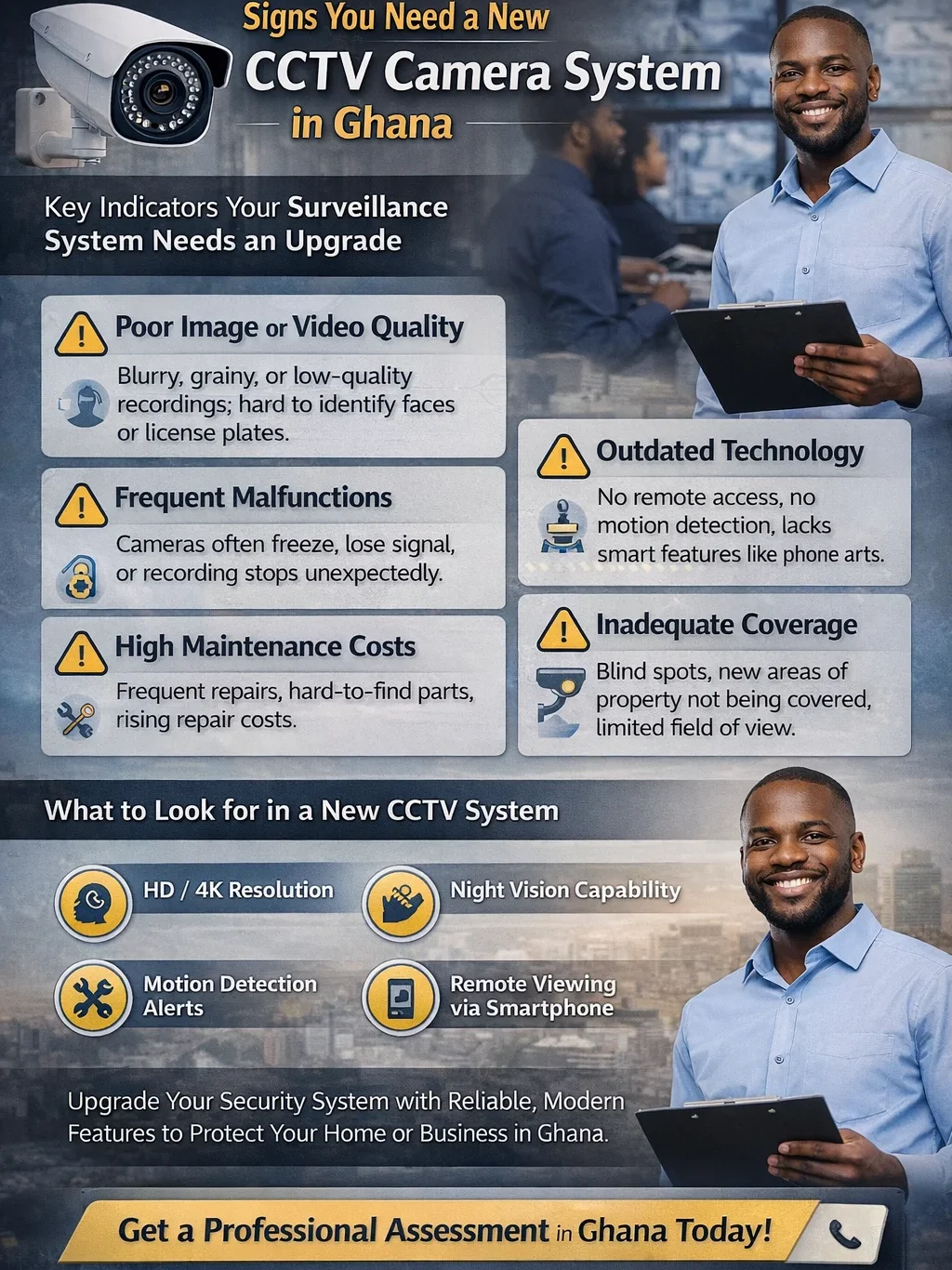
The easiest way to think about replacement is this. If the system can’t consistently deliver usable evidence, it is no longer protecting you. These are the most common signs indicating a CCTV camera replacement in homes and businesses.
Poor Image or Video Quality
Blurry footage is not a small issue. It’s often the difference between “we know who did it” and “we can’t tell.” This problem shows up in many ways:
- Grainy night footage that hides faces.
- Washed-out daylight video caused by glare.
- Motion blur when someone runs past the gate.
- Plates that look like white rectangles at night.
Older analog systems often struggle here, especially when you need details. Many newer HD CCTV cameras and modern IP options provide sharper images, better low-light performance, and improved handling of bright backgrounds. When image quality fails repeatedly, it becomes one of the clearest Signs you need a new CCTV camera system in Ghana.
What to do next:
- Clean and test first if the lens is dusty.
- Check if the recorder is downscaling the feed.
- If clarity still fails, plan a path for a camera upgrade.
Useful keywords that fit naturally here: CCTV camera features, infrared security cameras, security camera technology, and video monitoring.
Frequent Malfunctions & Unreliable Operation
A working system should feel boring. You should not babysit it. When cameras keep disconnecting, freezing, or restarting, you’re dealing with a reliability problem. Common symptoms include:
- Random “no signal” messages.
- Cameras that drop offline for minutes or hours at a time.
- Recordings that stop, then resume without warning.
- A recorder that reboots after voltage swings.
Power instability can push older equipment beyond its limits. It also increases the chance of storage corruption. When reliability drops, your coverage becomes a gamble. That makes this another major entry on the list of Signs you need a new CCTV camera system in Ghana.
What to do next:
- Add surge protection and backup power where possible.
- Replace weak adapters and damaged connectors.
- If faults keep returning, replacement costs less in the long term.
This is also where people start searching phrases like Why CCTV cameras malfunction, security camera malfunction, and CCTV camera troubleshooting, because downtime creates panic.
Outdated Technology That Limits Control
Technology advances, and security follows suit. Many older setups can’t support what users now expect from smart home security systems and modern business surveillance.
Here’s what “outdated” often looks like in real life:
- No secure remote viewing CCTV access on your phone.
- No smart alerts, so you only review footage after trouble.
- No motion zones, so trees trigger recordings all night.
- No analytics support for smarter detection.
Evidence from long-run research also shows that CCTV effectiveness depends on how well a scheme is implemented, and impacts vary by setting.
A U.S. Office of Justice Programs summary of a 40-year systematic review reports CCTV is associated with a “significant and modest decrease in crime,” with the largest and most consistent effects in car parks. That matters because old systems often perform worst in exactly those high-risk areas, where clear evidence and good coverage protect vehicles and entrances.
If your system can’t deliver modern control features, it becomes one of the most practical Signs you need a new CCTV camera system in Ghana.
Inadequate Coverage or New Blind Spots
Your building changes over time. That new storeroom, extra gate, or renovated shop layout can create hidden spaces. Blind spots also appear when cameras shift slightly. Wind, vibrations, and loose mounts can slowly change angles.
Signs you have a coverage problem:
- The gate area is visible, but the fence line is not.
- The cashier point is covered, but the shelves aren’t.
- The driveway shows vehicles, but not number plates.
- The back door is covered, but the approach path isn’t.
This affects both home and business CCTV setups. It also hits Ghanaian businesses hard, because stock shrinkage often happens outside the obvious areas. A proper upgrade may include wider-angle lenses, better placement, or outdoor CCTV cameras with stronger weather ratings.
High Maintenance and Repair Costs
Paying for repairs once is normal. Paying often is a warning. Over time, old systems become money pits because parts wear out and replacements get harder to find. Common cost traps include:
- Replacing adapters repeatedly.
- Fixing cable joints that keep failing.
- Swapping hard drives more than expected.
- Paying for callouts just to restore the signal.
This is where “repair vs replace” becomes a business decision, not a technical one. If repair costs keep piling up, it becomes one of the most expensive signs that you need a new CCTV camera system in Ghana.
Read more: Best CCTV Camera Systems for Ghanaian Home Protection in 2026: Top Picks
How to Assess Whether to Repair or Replace
A smart decision uses clear thresholds. It doesn’t rely on guesswork. Use this framework when deciding when to replace CCTV cameras.
Quick decision checklist
Replace or upgrade when you face these combinations:
- Poor image quality plus outdated recorder limitations.
- Recurring downtime plus repeated service callouts.
- Blind spots plus property expansion.
- Missing features plus rising security concerns.
Repair can still make sense when:
- The cameras are fine, but the connectors are damaged.
- Storage is failing, but the recorder supports upgrades.
- The placement is wrong, and a redesign fixes the coverage.
Repair vs replace table (simple guide)
| Situation | Repair might work | Replacement is smarter |
| Blurry footage | Lens cleaning or settings reset | New HD CCTV cameras, when the detail stays poor |
| Random downtime | Replace adapters or connectors | New recorder/cameras if faults repeat |
| No remote access | Limited add-ons sometimes help | Upgrade to modern IP for remote viewing of CCTV |
| Too many blind spots | Reposition and add a camera | Redesign coverage with newer camera types |
| Repairs keep piling | One-off fix with warranty | Full security system upgrade over time |
This section should naturally pull purchase intent forward. It answers: “Is it time to upgrade your CCTV system?” and “Signs that your CCTV system needs replacing,,” without sounding pushy.
What to Look For in a New CCTV System (Buyer’s Guide)
Buying a new system in Ghana should feel practical, not confusing. Focus on performance, reliability, and support.
Feature checklist to prioritize
- Resolution that matches your goals, not marketing claims.
- Strong low-light performance for night coverage.
- Stable storage with enough retention days.
- Smart motion alerts that reduce false alarms.
- Secure app access for video monitoring and remote viewing.
Installation choices that matter
A system performs only as well as its design. Good security camera installation considers:
- Camera height and angle to prevent tampering.
- Lighting conditions at night and during the harmattan haze.
- Wi‑Fi strength when using wireless CCTV cameras.
- PoE cabling for stability where possible.
Local buying and service realities
Search intent often includes CCTV camera installation services in Ghana and security camera installation because support matters after purchase. Many buyers also check CCTV camera reviews before choosing a vendor or model, especially when comparing “cheap now” versus “stable later.”
If you’re comparing sellers, ask about:
- Warranty support and response times.
- Availability of replacement parts.
- Whether the provider offers security camera maintenance plans.
Read more: Why Your Ghanaian Office Needs 4K CCTV Camera Systems Now
Maintenance Tips to Prolong Your CCTV Investment
Maintenance is not optional if you want consistent coverage. Ghana’s dust and humidity make this even more important. A Ghana-based provider recommends servicing every 3 to 6 months in Accra-like conditions.
Monthly basics (easy wins)
- Clean camera lenses and protective domes carefully.
- Check night vision clarity and glare spots.
- Confirm recording playback for at least two cameras.
- Test phone access and notification delivery.
Quarterly or biannual checks (deeper protection)
- Inspect outdoor seals and cable joints for moisture.
- Confirm storage health and recording continuity.
- Update firmware if the vendor supports secure updates.
- Review camera angles for drift and new blind spots.
These steps reduce faulty CCTV systems, cut downtime, and extend the lifespan of CCTV cameras.
Case Studies / Real Scenarios in Ghana and Africa (verified)
Ghana: Violent incident reporting context (why reliable evidence matters)
FOSDA’s Q2 2024 monitoring recorded 86 violent incidents in Ghana and highlighted Central, Ashanti, and Greater Accra as the regions with the highest counts. While this is media monitoring rather than an official police database, it still supports the argument that incidents occur frequently enough to justify dependable surveillance systems in Ghana.
Kenya (Africa): Nairobi “Safe City” CCTV deployment
An Africa-China Reporting Project case discussion describes Nairobi’s Safe City rollout with over 1,800 CCTV cameras deployed and live feeds monitored through an integrated control center at police headquarters.
The same report says “official figures quoted by Huawei” claimed a 46% drop in crime in Nairobi in the first year (2014–2015), while also noting that later crime reporting trends became more complex. That story shows a useful lesson for Ghana’s market: surveillance value depends on long-term operations, data quality, and consistent upkeep, not just installation day.
A separate analysis also notes Huawei’s claimed 46% drop while comparing it with other publicly available reporting, which reinforces the need to treat vendor claims carefully and demand ongoing performance proof.
Conclusion
Clear warning signs usually show up before total failure. Blurry images, repeated downtime, outdated controls, coverage gaps, and rising repairs all point to the same thing. Your current setup may no longer meet today’s security needs in Accra, Kumasi, and other fast-growing areas. A planned upgrade can restore clarity, improve remote viewing CCTV, and make maintenance simpler over time.
If you want an expert assessment and upgrade plan, contact WebSys Technology for professional CCTV evaluation, installation, and maintenance support in Ghana.
GET IN TOUCH
Book professional CCTV setup and avoid costly blind spots.
FAQ
Lifespan depends on camera quality, environment, and maintenance frequency. Ghana’s dust, humidity, and power fluctuations can shorten working life without routine servicing.
A Ghana-based CCTV provider recommends servicing every 3 to 6 months in Accra due to dust, humidity, and occasional power fluctuations.
Yes, many systems allow phased upgrades, such as replacing cameras first or upgrading storage and recorders later. A proper assessment helps you avoid compatibility issues and wasted spending.