

Hiring the right software company in Ghana unlocks doors you never knew existed. You gain sleek websites that pull in customers, apps that streamline operations, and networks that run like clockwork. Businesses partnering with solid IT firms see sales rise 22% for digital adopters or 36% revenue growth like MTN Ghana.
Yet here’s the twist. Many Ghanaian owners chase these wins but stumble hard. They pick vendors based on flashy promises or rock-bottom prices. Months later, projects drag, budgets explode, and frustration mounts. Sound familiar? You’ve felt that pull to transform your business digitally.
But common mistakes in choosing software companies in Ghana leave you burned. This guide spots those top mistakes businesses make when hiring software companies in Ghana. You’ll dodge them and land a partner that delivers real value.
What Mistakes Cost Businesses Most When Hiring a Software Company in Ghana?
Even experienced Ghanaian business owners often overlook critical red flags during vendor selection, turning promising software development partnerships into expensive lessons. Reports show 25-50% of outsourced projects fail or underperform due to poor management, inflating IT outsourcing costs and causing significant delays.
The following sections break down the top pitfalls, complete with real-world examples and avoidance strategies to protect your investment. Let’s explore:
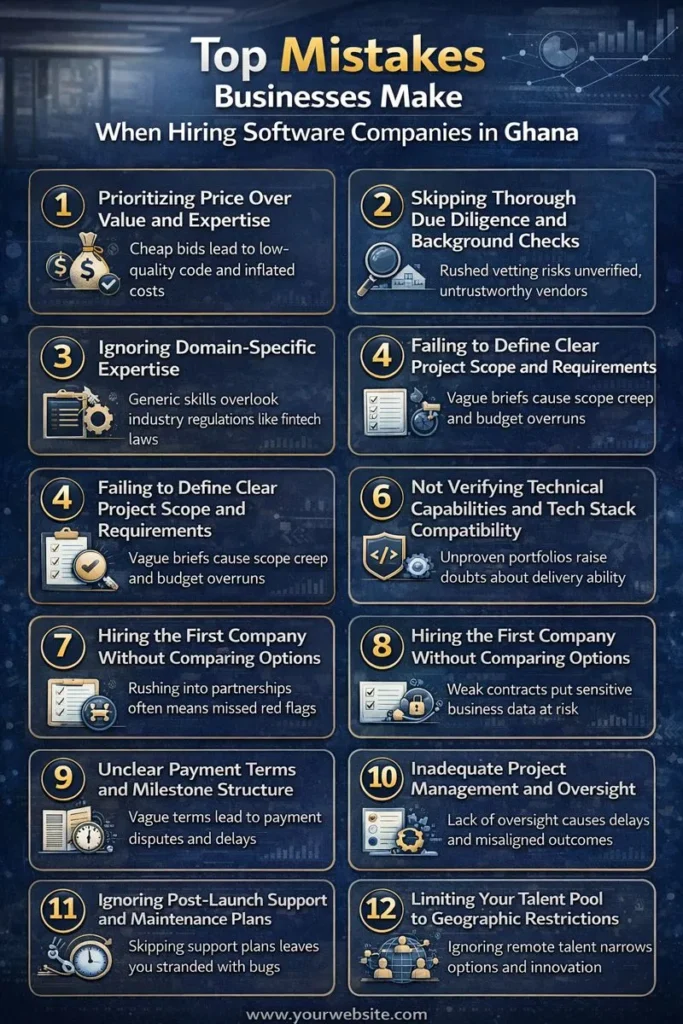
Mistake #1 – Prioritizing Price Over Value and Expertise
You spot a bid that’s half the others. Tempting, right? But cheap often means trouble. Low-cost software development companies in Ghana cut corners on testing or security, leading to bugs that pile up and drive customers away. Studies show IT projects average 27% budget overruns, with 1 in 6 exceeding 200% when poor vendors win low bids.
In Ghana, where competition drives down rates, SMEs chasing budget outsourcing pitfalls ignore long-term savings from quality code. IT firms prioritizing expertise deliver scalable solutions that reduce maintenance costs by 20-35% over time.
How to Avoid: Calculate the total cost of ownership (TCO) including post-launch support. Ask for process documentation, case studies from similar projects, and tech stack scalability proofs. Verify Clutch rankings and client references before signing.
Mistake #2 – Skipping Thorough Due Diligence and Background Checks
Rushing vendor selection feels productive, but skipping due diligence is gambling with your business. Many Ghanaian entrepreneurs trust flashy websites without verifying registrations or client outcomes, only to face mid-project vendor disappearance or incompetence. Clutch data shows 94% of B2B buyers use verified online reviews during selection, yet many Ghanaian entrepreneurs skip this step.
Real risks abound: Studies show poor vendor vetting causes up to 30% of outsourcing failures, with average IT project losses reaching $100K+ for SMEs. In Ghana, unregistered firms evade accountability—Ghana Investment Promotion Centre (GIPC) registration confirms legitimacy, while Registrar General’s Department verifies business status.
How to Vet Properly:
- Demand 3 recent case studies from similar Accra/Ghana projects with metrics (e.g., “Reduced load time by 40%”).
- Contact three client references from the past 12 months; ask about delivery timelines and post-launch support.
- Check Clutch.co Ghana rankings and Google reviews (aim for 4.5+ stars with 10+ reviews).
- Verify GIPC registration and tax compliance via official portals.
- Request team credentials (LinkedIn profiles, certifications like AWS/Azure).
These steps filter pretenders from proven software development companies in Ghana, saving you from costly surprises.
Mistake #3 – Ignoring Domain-Specific Expertise
Fintech firms in Ghana face strict rules under the Payment Systems and Services Act 2019 (Act 987), overseen by the Bank of Ghana’s Fintech and Innovation Office.
On the other hand retail SMEs need different solutions than healthcare providers, who must comply with the Data Protection Act 2012 (Act 843) to secure patient data through encryption and audits. Generic Accra developers often overlook these, leading to compliance failures and fines for SMEs.
Key Compliance Examples
Healthcare apps require consent for data processing and Data Protection Commission registration, unlike fintech’s focus on payment licensing. SMEs in Ghana spend GHC 2,315–4,687 yearly on tax compliance alone, showing the high cost of mismatched expertise.
Case studies like Paywell.io prove success: Local developers built a mobile money system handling 650,000+ transactions while meeting BoG rules.
How to Evaluate Partners
Match developer experience to your niche by requesting case studies from similar Ghana sectors. Probe their knowledge of local laws, like BoG’s Fintech and Innovation Office guidelines or NHIS integration for health apps.
- Verify past compliance successes without breaches.
- Test understanding of SME pain points, such as power outages or intranet limits in Accra facilities.
- Ensure they offer post-launch support for audits and updates.
Mistake #4 – Failing to Define a Clear Project Scope and Requirements
Vague project briefs trigger scope creep, causing 15% average budget overruns and affecting 52% of projects worldwide. Ghanaian SMEs face amplified risks, as poor planning ranks as the top IT project failure cause amid power outages and funding gaps. Without precise specs, Accra developers build mismatched software that needs expensive fixes.
Reports suggest that over 60% of Ghanaian project managers cite poor planning as the primary failure driver, worsened by infrastructure limits like intermittent internet and NHIS data integration hurdles.
How to Define Scope Effectively
Detailed requirements using proven tools foster trust and curb overruns.
- Write user stories: “As a [user], I want [feature] so that [benefit].”
- Specify must-haves, timelines, KPIs (e.g., 99% uptime), and change protocols.
- Apply MoSCoW prioritization (Must/Should/Could/Won’t) for focus.
Proven Outcomes
Clear scopes make projects 53% more likely to finish on time and on budget, slashing Ghana SME infrastructure risks. Defined specs enable 30% faster product launches per PMI data. Teams resolve issues 50% quicker with transparent requirements, avoiding vague “build an app” disasters.
Mistake #5 – Overlooking Communication Skills and Cultural Fit
According to PMI Pulse 2013, poor communication causes 57% of project failures, far above technical issues, as teams misalign on expectations and delays compound. Ghanaian SMEs face extra hurdles: 9-hour time zone gaps with Europe, power outages disrupting calls, and cultural norms favoring indirect feedback over blunt critiques.
Accra developers must grasp local realities like NHIS API limits or mobile-first user habits. Without shared tools (Slack, Jira) and daily stand-ups, B2B projects falter—65% of Ghana SME owners lack management training, fueling 58% failure rates within three years.
Test fit early: Schedule video calls to discuss work styles. Ask about handling Ghana’s infrastructure woes. Cultural alignment transforms vendors into true partners, cutting misunderstandings and boosting on-time delivery.
Read more: Why Partnering with Software Companies in Ghana is More Cost-Effective Than Outsourcing
Mistake #6 – Not Verifying Technical Capabilities and Tech Stack Compatibility
Shiny portfolios hide gaps. 70% of enterprise projects fail from mismatched tech stacks ignoring scalability or team expertise. Ghanaian SMEs risk this when Accra developers claim broad skills without proof—red flags include vague architecture answers or unverified NHIS API experience.
Hertz’s 2018 Accenture disaster proves it: $32M+ spent on a website with faulty Angular2 code, security flaws, and no scalability, forcing total scrap. Local parallels emerge in abandoned Ghana IT systems lacking mobile optimization for 60%+ smartphone users.
Verification Steps
Test rigorously before commitment.
- Request live code audits of recent projects.
- Assign small paid tasks (e.g., API integration).
- Probe stack choices: “Why React Native over Flutter for Ghana’s MTN API?”
Mistake #7 – Neglecting Intellectual Property and Data Security Agreements
Weak contracts expose ideas to theft. Ghana’s Data Protection Act, 2012 (Act 843) mandates data controllers register with the Data Protection Commission, implement encryption, and obtain consent, or face up to GHC 250,000 fines or 5 years imprisonment.
Software outsourcing skips NDAs at peril: 3,804 cyber incidents reported in Ghana (2019-2023), with social engineering hitting 52% of attacks.
Source code ownership defaults to developers without explicit contracts, per Ghana IP law. Africa outsourcing amplifies risks—firms lose control over custom fintech/healthcare code built by Accra teams.
Essential Contract Clauses
Mandate these protections upfront.
- IP Assignment: Full ownership transfer upon payment.
- NDA + Non-compete: 2-5 years post-project.
- Security: ISO 27001 compliance, annual audits, breach notification within 72 hours.
- Consult Ghanaian IP lawyers for Patents Act (Act 657) alignment.
Mistake #8 – Unclear Payment Terms and Milestone Structure
Payment delays rank as the top cause of Ghana construction project failures, triggering abandonment and bankruptcies across sectors. SMEs risk funds vanishing when Accra developers demand upfront payments amid FX volatility and certification delays.
Industry-standard milestone payments protect both parties: 20-30% upfront (planning/wireframes), 40-50% mid-project (core features tested), 20-30% final (deployment/training). Ghana outsourcing demands escrow due to unexpected fee disputes—a top red flag.
Essential Protections
- Tie payments to verifiable deliverables with client sign-off.
- Include penalty clauses for delays (1-2% weekly).
- Use World Bank Ghana PPP guidelines for escrow/FX safeguards.
Ghana Public Works Case Study: Unclear payment terms without milestones caused abandonment of multiple Ministry of Roads projects. Contractors halted work after 6-month certification delays, leading to 30-50% cost overruns and bankruptcies—identical risks for Accra software SMEs skipping structured payments.
Read more: Avoiding Common Pitfalls When Working With IT Companies in Ghana
How to Choose the Right Software Company in Ghana: 8-Step Framework
Ready to nail it? Follow these steps for foolproof selection.
- Define needs clearly. List must-haves vs. nice-to-haves.
- Research deeply. Use Google, LinkedIn, and Ghana tech forums.
- Review portfolios. Seek Ghana-specific wins.
- Verify credentials. Check PPC, ISO if relevant.
- Interview technically. Quiz on your stack.
- Compare RFPs. Score objectively.
- Call references. Hear unfiltered truths.
- Test with the pilot. Small project proves fit.
This framework crushes software outsourcing mistakes. Businesses using it report 70% higher success rates.
Read more: What Questions You Must Ask Before Hiring IT Companies in Ghana
Recap:
Avoid these eight critical mistakes when hiring Ghana software firms to protect your SME investment and ensure project success.
- Domain Expertise Gap: Mismatched skills ignore Ghana fintech (Act 987) or healthcare (Act 843) compliance, causing fines and failures.
- Scope Creep Chaos: Vague briefs inflate costs 15%+; Queensland Health lost AUD 1.25B from poor specs.
- Communication Breakdowns: 57% failures from misalignments; Ghana SMEs need cultural fit amid power outages.
- Tech Stack Mismatches: 67% projects fail without verification; Hertz wasted $32M on unscalable code.
- IP & Data Risks: 3,804 Ghana cyber incidents (2019-2023); weak contracts default code ownership to developers.
- Payment Pitfalls: Delays rank #1 failure cause; Ghana public projects are abandoned due to unclear milestones.
Partner with Proven Experts
WebSys Technology delivers Accra-based custom software with milestone payments, full IP ownership, and Ghana-compliant stacks. Contact WebSys today for a free project audit—avoid these pitfalls and launch 30% faster. Visit websysgh.com or call now.
GET IN TOUCH