

One day, an excited business owner reached out to me, Thompson, founder of WebSys Technology in Accra. He shared his big plan for a clothing website to boost sales across Ghana. I explained key features like responsive design and smooth navigation.
Then he asked, “What’s this mobile-first design you mentioned, and why’s it so crucial?” That made me realize beginners often lack deep knowledge of this vital concept.
Today, I’ll share clear insights from top website developers Ghana trusts. You’ll see why mobile-first design powers business growth. Let’s dive in together.
What is Mobile-First Design?
Mobile-first design means building websites starting from smartphones upward, not shrinking desktops down. You craft the core user experience for small screens first, then enhance features for tablets and larger displays.
This mobile-first approach prioritizes what users need most on phones where space runs tight, and attention spans shrink fast.
Responsive design adapts layouts across all devices, but mobile-first puts phones at the center from day one.
Developers use CSS media queries and flexible grids to scale content smoothly as screens grow bigger. Unlike the desktop-first approach that uses graceful degradation to trim features down, this method employs progressive enhancement to layer up.
The concept gained traction around 2009 when Luke Wroblewski coined the term, pushing designers to rethink priorities. But Google’s 2018 mobile-first indexing rollout changed everything permanently.
Search engines now crawl your mobile version first for ranking decisions, covering over 90% of websites globally. Sites without a mobile-friendly design plummet in search results, losing visibility and traffic instantly.
Read more:
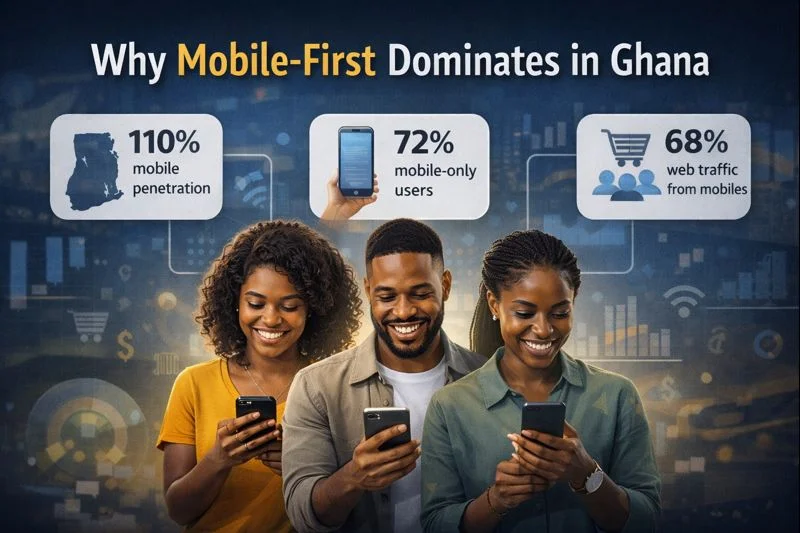
Why Mobile-First Dominates in Ghana
Ghana thrives on mobile power where smartphones outnumber people. With approximately 38.3 million active mobile connections at 110% penetration by early 2025, businesses ignoring phones lose big.
- Massive mobile-only access shapes everything. TechStock² reports that over 68% of Ghana’s population accesses the internet via smartphones, compared to only ~6% via computers or tablets — showing strong mobile‑centric access. Your site must shine on small screens or vanish from their view during daily scrolls.
- Traffic tilts heavily toward mobiles. Especially in Africa, mobile devices account for over 72% of all web traffic, far outpacing desktops. Ghanaian shoppers hunt deals on phones amid commutes, so mobile responsive websites in Accra capture that rush before competitors do.
- Smartphone boom fuels urgent needs. Internet adoption across Ghana has climbed sharply, reaching nearly 70% of the population by early 2025, heavily driven by smartphones. Budget models dominate, demanding mobile-first responsive design that handles low-res displays without choking.
- E-commerce explodes through phones. Mobile commerce continues to grow strongly worldwide, so Ghanaian businesses that optimize for mobile are likely to see improved engagement and sales.
- Performance gaps crush the unprepared. Non‑optimized sites typically have higher bounce rates compared to well‑optimized mobile first designs. Cost-effective websites for Ghana startups win by prioritizing touch-friendly UI and lazy loading for spotty networks.
Skip mobile-first design, and your business fades in this phone-first nation. Embrace it for growth that matches our reality.
Read more: Read more: Why is mobile-friendly web design important?
What My Experience Says
After 13 years of building sites in Accra, I’ve seen desktop designs crash hard against Ghana’s mobile wave. One client begged for a revamp—his traffic tanked on phones. We switched to a mobile-first design, and leads doubled overnight. Touch-friendly UI turned frustrated scrolls into sales. It’s not hype; it’s survival for businesses here. Trust me, skip it and watch competitors zoom past.
What Defines True Mobile-First Design Principles?
You might wonder what makes mobile-first design tick at its core. This approach flips traditional website design on its head by focusing on small screens from the start. Developers craft essential features for phones first, then expand outward. In Ghana, where mobile user experience drives everything, grasping these concepts helps businesses like yours stand out. Leading website developers in Ghana rely on them for responsive design that performs anywhere. Let’s break down the key pillars with clear details so you can apply them right away.

Start with Content Hierarchy and Visual Hierarchy
Content leads the charge in a mobile-first approach. You prioritize what matters most—your call-to-action buttons or key messages—before anything else. This creates a strong visual hierarchy that guides eyes naturally on tiny screens. For instance, place headlines and buy buttons front and center since users scan fast on the go.
In practice, strip away extras until the mobile view shines crisply. Ghanaian e-commerce sites thrive this way because shoppers want quick paths to checkout amid slow connections. Content prioritization and performance optimization help your site load in under three seconds, which is critical because 53% of mobile users will abandon a page that takes longer than three seconds to load. Optimizing mobile UX and responsive design can also significantly boost engagement metrics.
Embrace Flexible Grids and Fluid Grid System
Flexible grids anchor mobile-first responsive design with relative units like percentages over rigid pixels. Layouts flow smoothly as screens stretch from phones to desktops without ugly breaks. Developers set CSS media queries at key breakpoints—320px for mobiles, 768px for tablets—to trigger smart shifts.
This fluid grid system suits Ghana’s device mix, from high-end phones to budget models on shaky 4G. Pair it with flexible media so images resize cleanly, dodging blurry woes. Performance optimization kicks in via lazy loading, slashing wait times on slow networks. Users stay engaged longer when nothing cramps or overflows. Your site adapts perfectly, boosting conversions naturally.
Prioritize Touch-Friendly UI and Touch Target Size
Thumbs rule mobile worlds, so touch-friendly UI demands buttons at least 48 pixels tall and wide. Small taps lead to rage quits, but proper touch target size makes interactions joyful. Space elements generously to avoid fat-finger errors during bumpy trotro rides.
UI/UX design shines here with screen size adaptation for gestures like swipes or pinches. Ghana apps succeed by testing on real hands, not just emulators. Combine this with progressive enhancement, adding hover states only later for desktops.
Focus on Performance Optimization and Faster Load Times
Speed defines the mobile-first design framework. Compress images, minify CSS, and enable browser caching to cut load times drastically. Ghana’s variable internet makes this non-negotiable—users flee slow sites faster than you can say “buffering.”
Incorporate SEO benefits by serving lightweight HTML to crawlers first. PWAs add offline caching for rural users, turning dead zones into opportunities. Key concepts, such as mobile-first design like these yield mobile-first UX design benefits: higher ranks via Google’s mobile-first indexing and real revenue from happy visitors.
Integrate User-Centric Design with User Research
True power lies in user-centric design. Conduct user research to map thumb zones and habits—Ghanaians scroll vertically more than swipe sideways. Build high-fidelity prototypes from insights, ensuring responsive layouts that mobile-first match real behaviors.
Voice search optimization fits naturally since many queries in Twi or Ga are on the move. This omnichannel strategy links sites to native apps for iOS and Android smoothly. How to build mobile-first apps starts here: test iteratively for touch gestures that feel native. Mobile-first vs mobile-friendly? The former researches deeply; the latter just resizes. Local businesses gain local SEO features and loyalty when sites anticipate needs perfectly.
Leverage Progressive Enhancement Over Graceful Degradation
Forget graceful degradation that starts fat and trims down. Progressive enhancement builds lean mobile cores, then layers extras like animations for bigger views. This keeps cost-effective websites for Ghana startups affordable and future-proof.
In Ghana, it means cross-platform solutions that evolve with 5G rollouts. App development process mirrors this: core functions first, polish later. Developers avoid bloat, focusing on what mobile-first design truly delivers—universal access.
These concepts interlock to make mobile-first design examples like Jumia’s a reality. Ghana entrepreneurs, adopt them for why mobile-first design transforms your online game. Your site won’t just work; it will wow.
Read more: How Website Developers in Ghana Help SMEs Overcome Digital Challenges
Real Ghana Case Studies
Wondering how mobile-first design powers real wins in Ghana? Jumia Ghana’s story delivers proof with numbers you can trust.
- Jumia Ghana’s PWA Revolution Crushed Barriers.
- Africa’s e-commerce leader rolled out Progressive Web Apps embodying mobile-first responsive design for sites like Jumia Travel.
- They scored a 33% jump in conversion rates and 50% drop in bounce rates.
- Users flocked 12 times more to native apps, loving faster load times on 2G/3G networks.
- The PWA gobbled 5x less data and 25x less storage—perfect for Ghana’s budget phones and spotty connections.
- Now PWA traffic beats apps hands down, showing that mobile-first UX design benefits rule our mobile world.
This case screams why mobile-first design transforms Ghana businesses. Your site could follow suit with similar gains.
Reference: web.dev
Conclusion
Mobile-first design changes everything for Ghanaian businesses in our phone-driven world. With 68.5% mobile traffic and 72% users sticking to smartphones, ignoring it means missing sales. You’ve seen the stats, concepts, and Jumia’s 33% conversion win prove it works.
Don’t let competitors lap you. Partner with WebSys Technology in Accra for responsive web design Ghana that ranks high and converts fast. We build touch-friendly UI tailored for your needs. Ready to dominate? Contact us now at websysgh.com/contact. Let’s launch your growth today!
Read more: Why WebSys Technology Is One of the Best Website Developers in Ghana
GET IN TOUCH
FAQs
Google’s 2018 mobile-first indexing update made it crucial—search engines now prioritize mobile versions for rankings. With global mobile traffic hitting 60%+, sites ignoring phones lose visibility fast.
It starts with small screens, using flexible grids and content priority for phones first, then scales up via progressive enhancement. Designs focus on touch-friendly UI and speed over desktop bloat.
72% of Ghana users browse only on mobiles, so non-responsive sites spike bounces by 2.5x and kill conversions. It boosts SEO and keeps users engaged on slow networks.
Websites cost less to build and update than apps. They work across all devices without app store downloads. Reach grows instantly via search, unlike app installs.
Prioritize user needs with simple navigation. Ensure fast load times under 3 seconds. Use responsive layouts for all screens. Focus on clear visual hierarchy. Optimize for accessibility always.