

Running a small business in Ghana takes real effort — and poor IT infrastructure makes everything harder than it needs to be. Seven specific IT problems are holding Ghanaian SMEs back right now: weak internet connectivity, power outages, lack of backup systems, rising cybersecurity threats, undertrained staff, data compliance gaps, and disconnected tools that multiply manual work every day.
The UK-Ghana Chamber of Commerce confirmed that 65.7% of businesses in Ghana report significant digital capability gaps — and most of those businesses are losing money as a result. Ghana’s digital economy keeps moving forward, but small businesses dealing with constant system failures and poor IT management fall further behind each week.
These problems are costing Ghanaian small businesses real money right now — but they’re also solvable, and addressing them directly is one of the fastest ways to improve your business’s performance.
GET IN TOUCH
Fix Your Business IT Problems With WebSys Today
Why IT Problems Hit Small Businesses Harder in Ghana
Large companies absorb IT failures with backup teams, recovery budgets, and redundant systems already in place. Small businesses in Ghana don’t have that safety net — and that’s exactly what makes poor IT infrastructure so dangerous for SMEs. One system failure doesn’t just affect one department. It hits sales, communication, records, and customer service all at once, with no specialist available to fix it quickly.
Here’s why small businesses in Ghana take the hardest hit when IT breaks down:
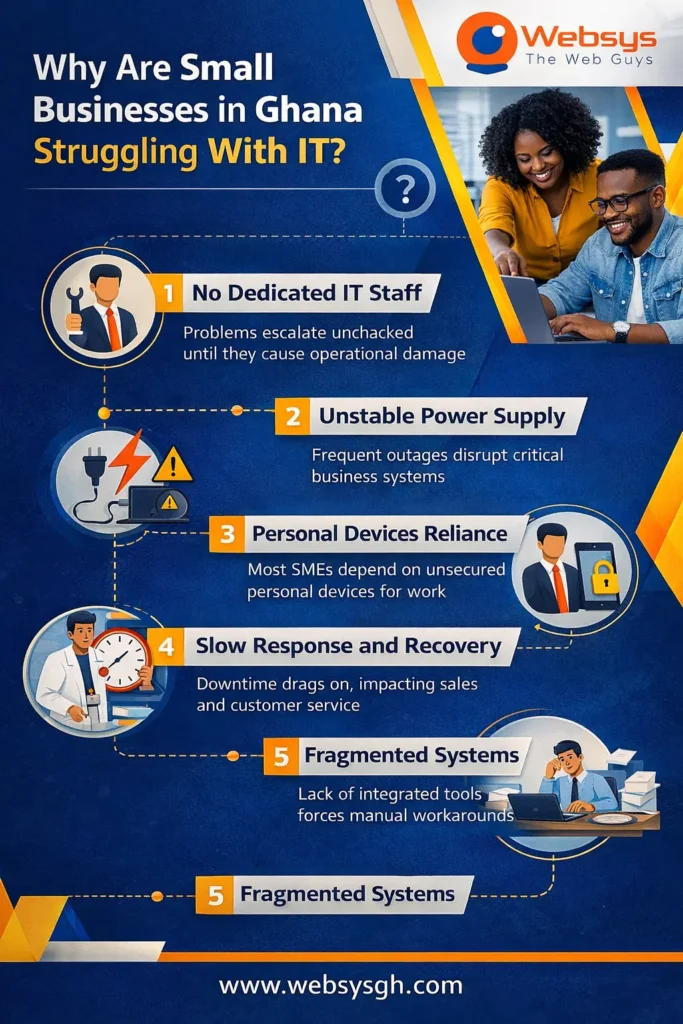
- No dedicated IT staff — problems escalate unchecked until they cause serious operational damage
- Tight budgets mean there’s rarely money reserved for urgent IT repairs or equipment replacement
- Most businesses rely heavily on personal devices that carry no endpoint security or professional maintenance
- Owners and staff often don’t recognise an IT problem until it has already disrupted daily operations
- Recovery time is significantly longer than at larger companies, meaning revenue loss continues well after the initial failure
- A single IT breakdown triggers a chain reaction — disrupting business continuity, damaging client trust, and stalling cash flow simultaneously
- Without integrated systems, staff resort to manual workarounds that further slow down an already struggling operation
- The result is a business that works twice as hard just to stay in place — not because of poor effort, but because the technology foundation underneath it keeps giving way
Why Are Small Businesses in Ghana Struggling With IT?
These IT challenges didn’t appear overnight. They follow predictable patterns across industries — from retail shops in Accra to service providers in Kumasi. Here are the seven IT problems small businesses in Ghana deal with most consistently.
1. Unreliable Internet and Weak Wi-Fi
Slow network performance might feel like a minor inconvenience but it’s costing businesses real money. Payment terminals go offline mid-transaction. Cloud tools stop responding entirely. Video calls drop mid-sentence with a client. Your team sits idle waiting for pages to load — during hours you’re paying for.
The deeper problem is that weak Wi-Fi coverage affects every digital process your business runs. Point-of-sale systems, inventory tools, and communication platforms all depend on a stable connection. When that connection fails, so does your business. Ghana’s internet infrastructure continues to face reliability challenges outside major urban centres, and connectivity gaps disproportionately affect small businesses that can’t afford enterprise-grade alternatives or backup connectivity solutions.
2. Power Interruptions That Knock Systems Offline
Anyone running a business in Ghana knows “dumsor” all too well. Power outages cost Ghanaian SMEs over $686.4 million in annual sales — and for micro-businesses, outages wipe out more than 50% of their daily revenue during downtime periods. That’s not a minor setback. For many, it’s existential.
Beyond lost sales, power interruptions cause server downtime, corrupted unsaved data, and physical damage to hardware such as computers, routers, and external drives. Most small businesses don’t have a UPS or a generator connected to their critical systems. So when the power goes, everything stops — and what’s lost during that time rarely comes back in full.
3. No Proper Backup and Recovery Plan
Here’s the uncomfortable truth: most small business owners in Ghana don’t think about data backup solutions until they’ve already lost something critical. A crashed hard drive, a stolen laptop, or a ransomware attack can erase months of customer records, invoices, and inventory data in minutes.
Globally, 93% of companies that lose data for 10 or more days file for bankruptcy within a year. That’s not a scare tactic — that’s a well-documented pattern. And yet, data loss prevention remains dangerously low on most SME priority lists. Cloud backup is affordable, often fully automated, and doesn’t require a full IT team to manage. Not having it isn’t saving money. It’s gambling with your entire business.
4. Weak Cybersecurity and Phishing Exposure
Ghana’s cyber threats for small businesses are growing fast and getting more sophisticated. A survey by the Ghana Chamber of Young Entrepreneurs found that 43% of SMEs in Ghana suffered cyberattacks — and most were hit more than once. Ghana’s Cyber Security Authority (CSA) confirmed 1,255 incidents in 2023 alone, with reported losses of GHS 59.9 million.
The attacks aren’t always dramatic. Most start with a convincing phishing attack — a fake payment link, a spoofed supplier email, or a WhatsApp message asking for login details. Employees at small businesses face 350% more social engineering attacks than those at large companies. Without endpoint security or basic cybersecurity awareness training, your staff becomes the easiest entry point for attackers.
5. Staff Using Tools They Were Never Trained to Use
You invested in business management software. But if your team doesn’t know how to use it properly, you’re paying for a tool that’s actually slowing you down. 55.6% of businesses in Ghana cited lack of training as a critical gap in digital capabilities — according to the UK-Ghana Chamber of Commerce Digital Readiness Survey.
The result? Staff creates workarounds. They manage orders in personal Excel sheets instead of the system you paid for. Errors multiply and data becomes inconsistent. The IFC estimates a $4 billion digital skills training opportunity in Ghana through 2030, which tells you exactly how large the problem is. Technology adoption only delivers results when your team is actually trained to use what you’ve given them.
6. Customer and Employee Data Handled Without Compliance Controls
Ghana’s Data Protection Act 2012 (Act 843) requires every business processing personal data to register with the Ghana Data Protection Commission. Most small business owners either don’t know this law exists or assume it only applies to larger corporations. It doesn’t.
In 2025, the Data Protection Commission issued a firm warning to non-compliant businesses nationwide. The risk isn’t just legal — mishandled data can quickly destroy customer trust. Globally, only 17% of small businesses encrypt their stored data, leaving customer records, employee details, and financial information completely exposed. Storing client data in an unprotected spreadsheet or a shared folder isn’t convenient. It’s a liability waiting to surface.
7. Disconnected Systems That Create Manual Work
Your sales tool doesn’t talk to your inventory system. Your invoicing app doesn’t connect to your accounting software. So someone spends hours every week manually copying data between them. That’s not just inefficient — it’s expensive. 41% of SMB employees manually transfer data between systems every single day.
According to a Harvard Business Review and Pegasystems study, employees switch between applications more than 1,200 times per day, losing nearly 9% of their productive time. For a small business already stretched thin on resources, that’s a massive hidden cost. Business process automation and connected systems can eliminate most of this manual work. But too many businesses across Ghana are still running on legacy systems and disconnected tools that multiply effort rather than reduce it.
Read more: Maximize Your Business Efficiency with 24/7 IT Support in Ghana
Real-Life Examples: When IT Problems Hit Ghanaian Businesses Hard
The seven IT problems above don’t just exist in reports and surveys — they’ve already disrupted operations across Ghana in very specific, very costly ways. Here are two documented cases that show exactly what these breakdowns look like in practice.
Example 1: MTN Ghana Cybersecurity Breach (April 2025)
In April 2025, MTN Ghana — the country’s largest telecom provider —confirmed a cybersecurity breach that compromised the personal data of 5,700 customers. The company launched an immediate forensic investigation and publicly advised all affected users to take protective action. Here’s what made this incident particularly alarming:
- Customer personal data was accessed without authorisation despite enterprise-level security resources
- MTN had to publicly urge users to change passwords immediately and enable multi-factor authentication
- The breach damaged customer trust on a scale that a small business simply couldn’t survive
- If Ghana’s largest telecom is vulnerable, an SME with no endpoint security or data protection protocols is exponentially more exposed
Source: Graphic.com.gh, April 2025
Example 2: Power Outages Cutting Sales Across 288 Kumasi SMEs (2025)
A peer-reviewed study published in the RSIS International Journal examined 288 small-scale enterprises in Greater Kumasi and found that power outages directly reduced sales performance across the board. The findings were striking:
- Businesses using generators as backup still recorded significant annual sales losses from fuel costs alone
- A 1% increase in generator-sourced electricity corresponded with a 0.29% increase in annual sales lost to power disruptions
- Most businesses had no IT continuity plan to keep critical systems protected during outages
Source: RSIS International Journal of Innovative Research in Social Sciences, 2025
A Quick Self-Audit: Is Your Business Being Slowed Down by IT?
You don’t need an IT consultant to run this check. Just answer honestly. If three or more of these apply to your business, IT problems are already costing you money.
- Does your internet drop or slow down during working hours?
- Has a power cut ever caused you to lose data or miss a transaction?
- Do you have an automated backup running right now — one you’ve actually tested?
- Has any staff member clicked on a suspicious email or link in the past year?
- Are all your staff fully trained on the software your business uses daily?
- Do you know whether your business is registered with the Ghana Data Protection Commission?
- Does your team manually copy data between different tools or apps?
- Have you experienced unexpected system downtime that disrupted sales or operations this year?
If you answered “yes” to three or more, your IT setup is creating hidden costs. The good news is that every single problem on this list has a practical, affordable fix.
What Small Businesses in Ghana Should Prioritize First
Fixing everything at once isn’t realistic — especially with limited budgets. The goal is to tackle what hurts the most first and build from there. IT management for small businesses doesn’t have to be complex. It has to be strategic.
- Start with cybersecurity basics — set up multi-factor authentication, install antivirus software, and run one staff phishing awareness session this month
- Automate your cloud backup today; don’t wait for a data loss event to make this a priority
- Set up a backup internet connection — a secondary SIM or mobile data plan prevents complete outages at very little cost
- Invest in a UPS for your most critical devices: computers, routers, and servers
- Register with the Ghana Data Protection Commission — it’s a legal requirement under Act 843
- Identify your most-used tools and schedule basic training sessions for your team
- According to the Ponemon Institute, businesses with a tested incident response and continuity plan identify and contain breaches 78 days faster than those without one — and the IBM Cost of Data Breach Report found organizations using AI-assisted detection saved an average of $1.9 million per breach. That’s the real, measurable value of preparation.
- Before adding new tools, focus on integrating the systems you already have
Read more: Building a Secure IT Infrastructure: Essential Steps for Ghanaian Businesses
Final Takeaway
The IT challenges facing SMEs in Ghana aren’t going away on their own. Every day without a stable internet backup, a recovery plan, or basic cybersecurity training is a day your business carries unnecessary risk. The businesses that take these problems seriously today are the ones that will still be operating — and growing — five years from now.
Most of these fixes are affordable. Many are available locally. None of them requires a full-time in-house IT team to implement. What they do require is a decision — a decision to stop treating technology as an afterthought and start seeing it as the foundation your business runs on.
🚀 Stop Letting IT Problems Cost You — WebSys Technology Is Here to Help
At WebSys Technology, we’ve built our services specifically to address the technology challenges that small and medium-sized businesses in Ghana face every day. We know your constraints. We understand your environment. And we have practical, affordable solutions ready to deploy.
Here’s what we bring to your business:
- Managed IT Support — We proactively monitor and maintain your systems so problems are caught before they cost you
- Cybersecurity Solutions — Comprehensive protection including endpoint security, firewall setup, phishing awareness training, and multi-factor authentication
- Cloud Backup & Disaster Recovery — Automated, reliable backups that protect your business data around the clock
- Network Setup & Wi-Fi Optimisation — Stable, business-grade connectivity designed for Ghana’s infrastructure environment
- System Integration & Business Process Automation — Connect your tools, eliminate manual data entry, and recover lost productivity
- IT Consulting for SMEs — Straightforward, budget-conscious IT strategies built for Ghana’s business reality — not generic global templates
You shouldn’t have to lose revenue to a power outage, a phishing email, or a system that was never properly set up. These are solvable problems — and solving them starts with one conversation.
👉Contact WebSys Technology today for a free IT consultation. Let’s build a technology foundation your business can actually rely on.
GET IN TOUCH
Get Reliable IT Support for Your Business Today
FAQs
Several interconnected factors limit technology advancement across the country. Persistent infrastructure gaps — particularly unreliable power supply and inconsistent internet connectivity — make it difficult for businesses to depend on digital tools day to day. Limited funding for IT development from both the government and private sectors significantly slows progress. Low digital literacy across many communities means technology adoption remains shallow, even where access exists. Poor coordination between public institutions and private technology providers further stalls meaningful growth across Ghana’s digital economy.
Three key factors have significantly set back Ghana’s economic and technological momentum in recent years. First, the recurring energy crisis — widely known as “dumsor” — disrupted business operations for years and continues to affect operational efficiency across sectors. Second, sharp currency depreciation reduced purchasing power and made technology imports considerably more expensive for SMEs. Third, a growing public debt burden restricted government spending on critical infrastructure, including the digital development programs and IT support initiatives that small businesses across Ghana desperately need.
Ghana faces several serious challenges, including poverty, rising unemployment, inadequate healthcare infrastructure, and unequal access to quality education. Among these, poor IT infrastructure and limited digital inclusion are increasingly urgent — because economic growth today depends heavily on digital access and capability. Small businesses are particularly affected by this gap. Without reliable internet, stable power, and affordable IT support, Ghana’s SMEs struggle to compete, scale, and contribute fully to the country’s broader digital transformation goals.