

Cybercriminals are no longer just targeting banks and large corporations. Ghanaian small businesses are increasingly in their crosshairs — and most owners don’t realize it until the damage is already done. The security mistakes Ghanaian small businesses make online aren’t always obvious. They’re everyday oversights: a recycled password, a skipped update, an untrained employee. But each one creates a gap that hackers are more than willing to walk through.
Ghana recorded over 2,000 cyber incidents in the first half of 2025 — a 52% increase over the same period in 2024, according to the Cyber Security Authority (CSA). The Ghana digital economy is growing fast and so is the risk. Your business doesn’t need to be a Fortune 500 company to be targeted. It just needs to be vulnerable. Here’s what’s putting your website at risk and exactly how to fix it.
Why Small Businesses Are a Major Target for Hackers
Many small business owners believe cybercriminals target only big corporations with deep pockets. That assumption is dangerously wrong. Hackers don’t always hunt for the biggest prize — they hunt for the easiest entry point. Small businesses, with limited IT resources and often no formal cybersecurity framework, are exactly that.
- Small businesses store valuable assets — customer data, online payment security records, login credentials — but rarely protect them the way larger companies do
- 43% of all cyberattacks globally target small businesses (ElectroIQ, 2025) — and most of those attacks succeed because defenses are weak
- Businesses with fewer than 100 employees are 2.5x more likely to be targeted than larger enterprises (BroadbandSearch, 2025)
- Over 4,000 cyberattacks hit Ghanaian businesses in 2024 alone, with annual losses estimated at over GH₵300 million (Ghana National Cyber Security Centre, via ACiTy University)
- Most SMEs in Ghana have no dedicated IT team, no active security monitoring system, and no clear recovery plan — making them low-effort, high-reward targets
- 60% of small businesses that suffer a cyberattack close within six months (ElectroIQ, 2025)
- The threat is real, it’s local, and it’s growing — awareness is your first and most powerful line of defense
What Security Mistakes Do Ghanaian Small Businesses Make Online?
These mistakes aren’t always the result of carelessness. Most business owners simply don’t know what gaps exist in their digital business security until a hacker finds them first. Here are the five most common — and costly — ones you need to address right now.
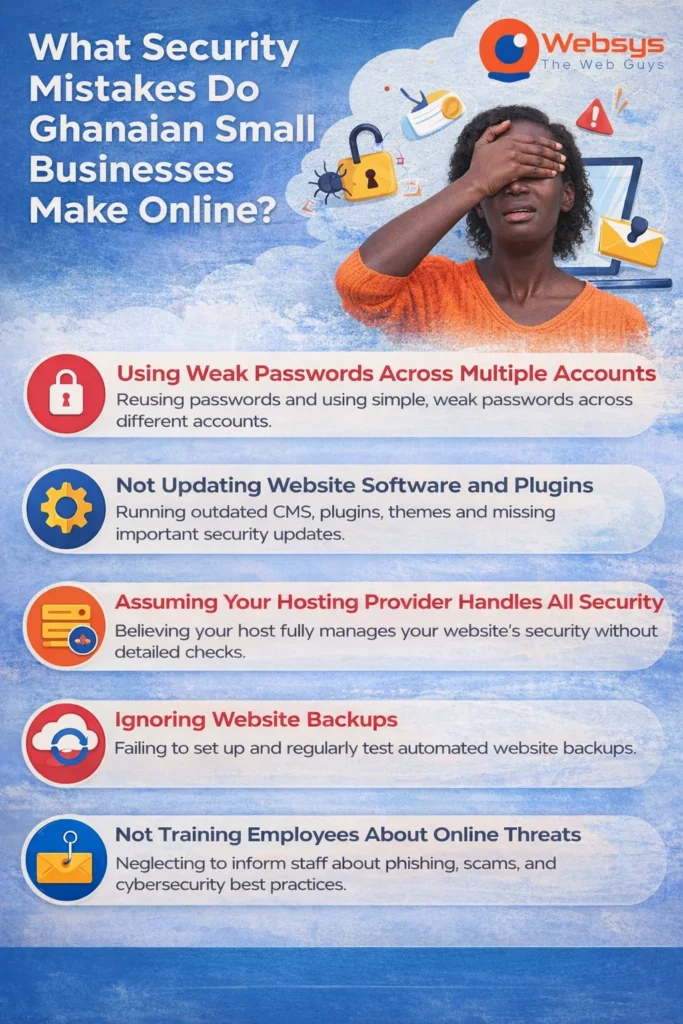
1. Using Weak Passwords Across Multiple Accounts
Convenience is the enemy of password security. When you’re juggling a business, it’s tempting to use one easy-to-remember password for everything — your email, your hosting panel, your social media accounts. But that single habit puts your entire digital operation at serious risk.
According to Verizon’s 2025 Data Breach Investigations Report, 88% of basic web application attacks involve stolen credentials — and only 3% of compromised passwords meet basic complexity requirements.
⚠️ For illustration purposes only — not a real incident: A small clothing retailer in Accra uses the same password across their email, hosting account, and mobile money portal. One phishing email tricks an employee into revealing it. Within hours, all three accounts are compromised and the business funds are gone.
How to avoid it:
- Use a password manager like Bitwarden or LastPass to generate and store unique passwords for every account
- Enable multi-factor authentication (MFA) on everything — especially your website admin panel and email
- Never reuse passwords across platforms, no matter how convenient it feels
- Aim for passwords that are at least 12 characters long, mixing letters, numbers, and symbols
2. Not Updating Website Software and Plugins
Outdated software isn’t just a performance issue — it’s an open door for attackers. Every unpatched plugin or theme on your website is a potential entry point. This is especially critical for businesses running WordPress, which powers a significant share of Ghana’s business websites.
52% of WordPress hacks are directly linked to outdated plugins. In March 2025, a single WordPress security vulnerability in a widely used form builder plugin affected 1.2 million websites globally — and 47,000 were compromised within just 72 hours of public disclosure, with an average cleanup cost of $4,200 per site (SiteGuarding, 2025).
The Media Foundation for West Africa (MFWA) also flagged that most active websites in Ghana run on outdated platforms, with security audits rarely conducted — leaving thousands of local businesses exposed without even knowing it.
How to avoid it:
- Turn on automatic updates for your WordPress core, themes, and all plugins
- Do a monthly audit and delete any plugins or themes you no longer actively use
- Use a staging environment to safely test major updates before pushing them live
- Schedule a vulnerability scanning check at least once a month to catch any gaps
3. Assuming Your Hosting Provider Handles All Security
This is one of the most common — and most expensive — misconceptions among Ghanaian small businesses. Your hosting provider secures their servers. Your website’s security is your own responsibility. Those are two very different things.
Think of it like renting office space. The building owner secures the premises, but you’re still responsible for locking your own office door. Secure hosting gives you a solid foundation — it doesn’t protect everything built on top of it.
⚠️ For illustration purposes only — not a real incident: A small travel agency in Accra relies entirely on its host’s server firewall for protection. A vulnerable plugin sends a request for a malicious file that the server firewall treats as legitimate traffic. Their site was defaced overnight — and they had no independent web application firewall to intercept it.
In April 2025, MTN Ghana confirmed that approximately 5,700 customers were affected by a cybersecurity breach — proof that even well-resourced hosted platforms aren’t immune (The Graphic, Ghana, 2025).
How to avoid it:
- Install a Web Application Firewall (WAF) directly on your website, separate from your host’s server-level protection
- Use a dedicated malware protection plugin like Wordfence or Sucuri for real-time scanning
- Ask your hosting provider exactly what their plan covers — and what it doesn’t
- Get an independent security audit at least once a year to identify blind spots
Read more: Why Cheap Web Hosting Can Cost Ghana Businesses More
4. Ignoring Website Backups
Security tools are built to keep threats out. Backups are what save you when one slips through. Skipping regular backups is one of the most common cybersecurity mistakes small businesses make — yet it’s also one of the easiest to fix.
According to CrashPlan’s 2026 data loss report, 93% of companies that lose data for 10 or more days file for bankruptcy within a year. That’s not a scare tactic — that’s a business survival statistic.
In Ghana, a healthcare institution was hit by a ransomware attack after a phishing email targeted an administrative staff member. The malware spread to the facility’s backup and recovery systems within just six hours. Estimated recovery costs reached GHS 5.8 million (FactoSecure Incident Report, 2026).
How to avoid it:
- Set up daily automated backups stored in a secure off-site location or secure cloud infrastructure
- Test your backups regularly — an untested backup is an unreliable backup
- Keep multiple restore points: daily, weekly, and monthly versions give you real flexibility
- Choose a backup and recovery solution with one-click restore so you can get back online fast — no technical expertise required
5. Not Training Employees About Online Threats
Your firewall can block thousands of attacks. But it can’t stop a team member from clicking a suspicious link. Cybersecurity awareness training isn’t optional anymore — it’s a core part of protecting your business.
Human error accounts for 68–95% of all data breaches globally (Brside, 100+ studies, 2025). Without proper training, roughly 1 in 3 employees will click on a phishing email — that’s the average across 62,400 organizations studied by KnowBe4 in their 2025 Phishing Benchmark Report.
In Ghana, a sophisticated social engineering campaign targeted C-level executives across 30+ corporations in banking, mining, and insurance. Attackers researched each target on LinkedIn and crafted highly personalized phishing messages. Estimated losses across targeted organizations reached GHS 4.2 million (FactoSecure, 2026).
The good news? Just 90 days of consistent training reduces phishing susceptibility by over 40% — and after 12 months, that number climbs to an 86% reduction (KnowBe4, 2025).
How to avoid it:
- Run quarterly phishing simulation tests with your whole team — not just management
- Train employees to recognize phishing emails, fake login pages, and suspicious attachments
- Create a simple, clear internal protocol for reporting anything that looks out of place
- Build cybersecurity best practices into your onboarding process for every new hire
How These Mistakes Can Cost Your Business
These risks aren’t theoretical. Each one carries real financial, legal, and reputational consequences — and for Ghanaian small businesses, a single incident can be the difference between staying open and shutting down for good.
- The average cost of a cyberattack on a small business is $200,000 — enough to permanently close most SMBs (Genatec, 2024)
- Ghana’s reported cybercrime losses hit GH₵14.94 million in 2025, a 17% year-on-year increase (Cyber Security Authority, Ghana)
- Legal liability is very real: Bolt Ghana was ordered to pay GHC 1.9 million after a data protection failure enabled customer identity theft — a landmark ruling that set a clear precedent for customer data protection accountability in Ghana (Modern Ghana, 2024)
- Reputational damage is often harder to recover than lost data — once your customers lose trust in you, rebuilding it takes years
- Operational downtime means missed orders, broken client relationships, and direct revenue loss every single hour your site stays offline
- Business continuity planning isn’t just for large enterprises — it’s what separates businesses that survive an attack from those that don’t
Simple Website Security Checklist for Small Businesses
You don’t need a full IT department to keep your website protection strategies solid. A few consistent habits, applied regularly, dramatically reduce your exposure to cyber risks for small businesses.
- ✅ Use strong, unique passwords and enable multi-factor authentication (MFA) on all accounts
- ✅ Update all website software, themes, and plugins at least once a month
- ✅ Install and configure a Web Application Firewall (WAF) directly on your website
- ✅ Set up daily automated backups with secure cloud infrastructure storage off-site
- ✅ Install and activate an SSL certificate — confirm the padlock appears in your browser bar
- ✅ Limit failed login attempts on your admin panel to block brute-force login attacks
- ✅ Remove unused plugins, inactive themes, and dormant user accounts
- ✅ Train your team regularly on recognizing phishing emails and social engineering
- ✅ Run a malware scanning check on your website at least once a month
- ✅ Review who holds admin-level access to your site — revoke what’s unnecessary immediately
How WebSys Website Security Protects Your Business
Knowing what to fix is one thing — having the right partner to handle it is another. WebSys Technology offers a complete website security solution built specifically for businesses in Ghana, so you get serious protection at a price that actually makes sense for an SMB.
- Daily malware scanning with automatic threat removal — threats get identified and eliminated before they cause lasting damage
- A Web Application Firewall (WAF) that filters malicious traffic before it ever reaches your website
- SSL certificate setup and ongoing management for full HTTPS encryption across your entire site
- Automatic daily backups with one-click restore — no technical skills or IT support required
- Consistent monitoring of software and plugin updates, with security patches applied promptly as new vulnerabilities emerge
- A free security audit on signup — so you know exactly where you stand from day one
- A local support team that understands the Ghana digital economy, the specific threat landscape here, and what your business actually needs
- Flexible, affordable plans built for SMEs in Ghana — not bloated enterprise pricing that small businesses can’t sustain
GET IN TOUCH
Explore WebSys Website Security Plans
Final Thoughts
The security mistakes Ghanaian small businesses make online are avoidable — every single one of them. The tools exist, the knowledge is accessible, and the steps aren’t complicated. What’s complicated is recovering from an attack you could have prevented.
Ghana’s cyber threat landscape is escalating fast. The CSA reported over 2,000 incidents in just the first half of 2025. Businesses that treat cybersecurity as an afterthought are the ones that end up in those statistics. Don’t let yours be one of them.
WebSys Technology’s Website Security Services give your business everything it needs to stay protected — daily backups, malware scanning, a web application firewall, SSL encryption, and dedicated local support. All in one plan, built for businesses just like yours in Ghana.
Secure your website before someone else makes that decision for you.
👉 Get Started with WebSys Website Security Today →