
The security situation in Ghana also presents alarming crime trends that require proactive risk mitigation measures. In July 2025, the country reported 628 cases of robbery and 340 cases of murder, indicating high levels of violent crime and prompting national safety initiatives. (source)
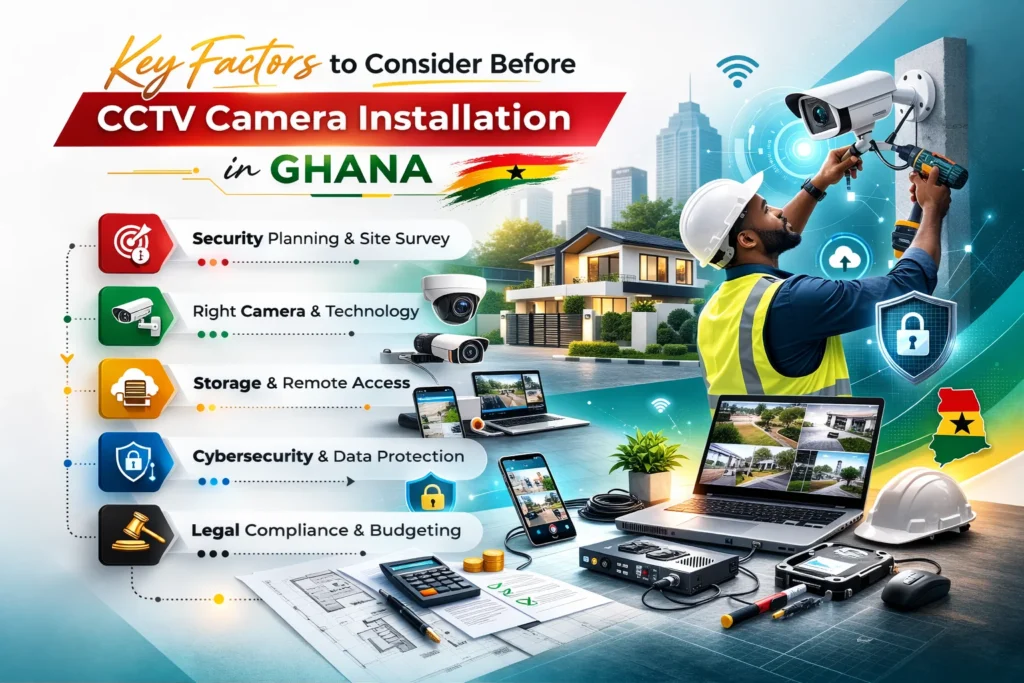
There are five important considerations that homeowners and businesses should consider before installing a system, which include defining security goals, conducting a site survey to understand coverage, selecting the right camera technology, planning data storage and cybersecurity, ensuring legal compliance, and budgeting properly.
Being aware of these will allow you to prevent typical pitfalls, increase security effectiveness, and invest in what will actually guard your property.
This guide discusses all the factors in detail with practical information and unconventional approaches that the majority of CCTV guides fail to discuss.
What Should You Know Before Installing a CCTV Camera in Ghana?
The first step in successful CCTV installation is to understand your reasons and how environmental factors affect performance. In Ghana, property owners must deal with diverse conditions such as varying power supplies, increasing theft cases, and the tropical climate that may affect the performance of outdoor cameras.
Selecting the wrong system may cause blind spots, unreliable footage, and critical security failures. The following factors clarify what you should consider before investing in hardware or services.
Factor 1: Define Your Security Objectives Before Installing CCTV
The most common cause of failure in CCTV projects is starting planning with equipment rather than security objectives.
Before selecting anything, ask yourself:
- What am I protecting? Is it people, property, inventory, or operational activity?
- Is it deterrence, evidence collection, remote surveillance, or a combination of all of the above?
- How detailed footage do you require, HD to identify or a large-scope overview?
Document your security goals in a simple plan. This will guide everything from camera type to placement strategy.
Read more: How to Install CCTV Cameras in Ghana: Step-by-Step Guide (Home & Business)
Factor 2: Site Survey and Coverage Engineering
The placement of cameras is usually ignored, but it forms the cornerstone of efficient video surveillance systems. Blind spots and ineffective monitoring are the result of random installation.
Advanced strategies:
- Conduct a risk-mapping survey to identify high crime areas.
- Use environmental design concepts to build security through design (crime prevention through environmental design concepts, CPTED).
- Take into consideration lighting differences. Cameras are ineffective in shadows or bright illumination.
- Evaluate outdoor exposure. The tropical weather in Ghana requires weatherproof systems.
Apply principles such as Crime Prevention Through Environmental Design (CPTED) to ensure that cameras are oriented toward natural sightlines and deterrent areas.
Factor 3: Choosing the Right Camera Technology
The selection of cameras is not one-size-fits-all. British and international research is more inclined to stress that the overall performance is determined by the quality of CCTV coverage and monitoring, not by the quantity of cameras.
Consider these tech factors:
- Analogue vs IP vs Wireless: IP systems have better resolution and can be used to monitor activities remotely, which is convenient for owners travelling.
- Resolution & night vision: A higher resolution means a better ability to identify incidents after they occur
- Backup power: Ghana has power cuts; a constant power supply means that the recording continues.
To achieve a balance between coverage and cost, some businesses use wired and wireless cameras (hybrid).
Read more: Why CCTV Camera Installation is Essential for Home Security in Ghana
Factor 4: Data Storage, Remote Access, and Cybersecurity
CCTV systems are now integrated with digital infrastructure. Cybersecurity is one of the things that many owners do not pay attention to, putting their systems at risk of hacking or unauthorised access.
Consider the following:
- Cloud vs Local Storage: Cloud allows off-site backup, yet internet restrictions in certain locations can affect uptime.
- Remote monitoring: Secured mobile access allows 24/7 viewability.
- Data retention: You should know your storage capacity and GDPR-style requirements within the Data Protection Act of Ghana.
- Secure firmware and passwords: Old firmware and weak login security have been used to compromise the cameras.
Manage your CCTV like any other network device: upgrade it, segment it, and secure it.
Factor 5: Legal Compliance, Privacy, and Budget Planning
Surveillance carries legal obligations. The legal system in Ghana, such as the Data Protection Act, requires appropriate handling of recorded data and adherence to personal privacy.
Best practices include:
- Not pointing cameras at public roads or neighbours without consent.
- Place posters warning visitors about surveillance.
- Determining the data retention period before deletion.
Budget planning also goes beyond camera cost:
- Installation, maintenance, upgrades of storage and replacement due to wear and tear.
- Tropical weather-rated equipment is more expensive but durable.
Draft a total cost of ownership plan to avoid surprises.
Read More: The Ultimate Guide to CCTV Camera Installation for Small Businesses in Ghana
Common Mistakes to Avoid When Installing CCTV
Many installations fail even with the finest intentions. Awareness of pitfalls helps avoid wasted investment and the failure to secure.
- Installing the cheapest system without assessing coverage needs.
- Ignoring power backup or connectivity issues.
- Overlooking environmental concerns, such as lighting and weatherproofing.
- Lack of proper cybersecurity exposes systems to hacking.
- Lack of planning for data storage and retention policies.
Audit your CCTV system periodically. This ensures cameras remain effective, storage is sufficient, and remote monitoring works reliably.
Real-World Case Study: Proven CCTV Impact on Property and Business Security
The strategic placement of CCTV systems has been proven to minimise crime and enhance operational supervision. Real-world deployments from multiple communities and retail environments demonstrate measurable results.
Community Deployment Example:
| Crime Metric | Before CCTV Installation | After 6 Months | Reduction |
| Vandalism incidents/month | 12 | 3 | –75% |
| Vehicle break-ins/month | 7 | 2 | –71% |
| Suspicious activity reports/month | 20 | 6 | –70% |
Source: CCTV Security Pros Case Studies
Business Deployment Example
- Retail chain reduced internal theft by over 60%.
- High-resolution IP camera systems with motion detection and remote monitoring decreased shoplifting by about 66 per cent and worker theft by about 80 per cent.
These results illustrate that coverage planning, cloud storage, and strategic camera placement are significant in making video surveillance systems effective.
Conclusion: Secure Your Property the Smart Way
Proper installation of CCTV cameras in Ghana is not just a matter of hardware. Planning, which takes into consideration the objectives, coverage, technology selection, remote monitoring, cybersecurity, and legal considerations, is what separates a system that appears installed from one that actually protects.
Use the above steps to maximise security, reduce risk and have the confidence that your investment is bringing you peace of mind. Install a professional CCTV system that covers all areas, provides secure storage, and complies with the law.
- Custom risk-mapped installations
- Hybrid IP and cloud systems
- Ongoing maintenance and monitoring support
Secure your business or home today with WebSys Team and take the first step toward safe, future-proof security.
Frequently Asked Questions (FAQs)
For effective operation, you should define your security objectives, identify high-risk locations, choose the appropriate camera type, plan storage and remote access, consider legal requirements, and budget for future upgrades
A CCTV system comprises five key elements, which include cameras to film the footage, focus lenses, recording devices (DVR/NVR), monitors to view the footage and cabling or network connections in order to transfer the data effectively.
The fundamentals of CCTV encompass the knowledge of the camera type (analogue, IP, wireless), resolution, night vision, field of view, storage, motion detection, power, remote monitoring, and the integration of the cameras with security systems to secure property and people.
The important considerations are the right location to be covered, compatibility with the system, reliable power supply, environmental considerations, legal requirements, integration with the existing safety systems, and keeping maintenance plans to ensure smooth operation and emergency response of the system.
Yes. CCTV cameras can operate offline with the assistance of local storage devices such as DVRs or NVRs. However, functions such as remote monitoring, cloud backup, and notifications cannot work without an internet connection.